


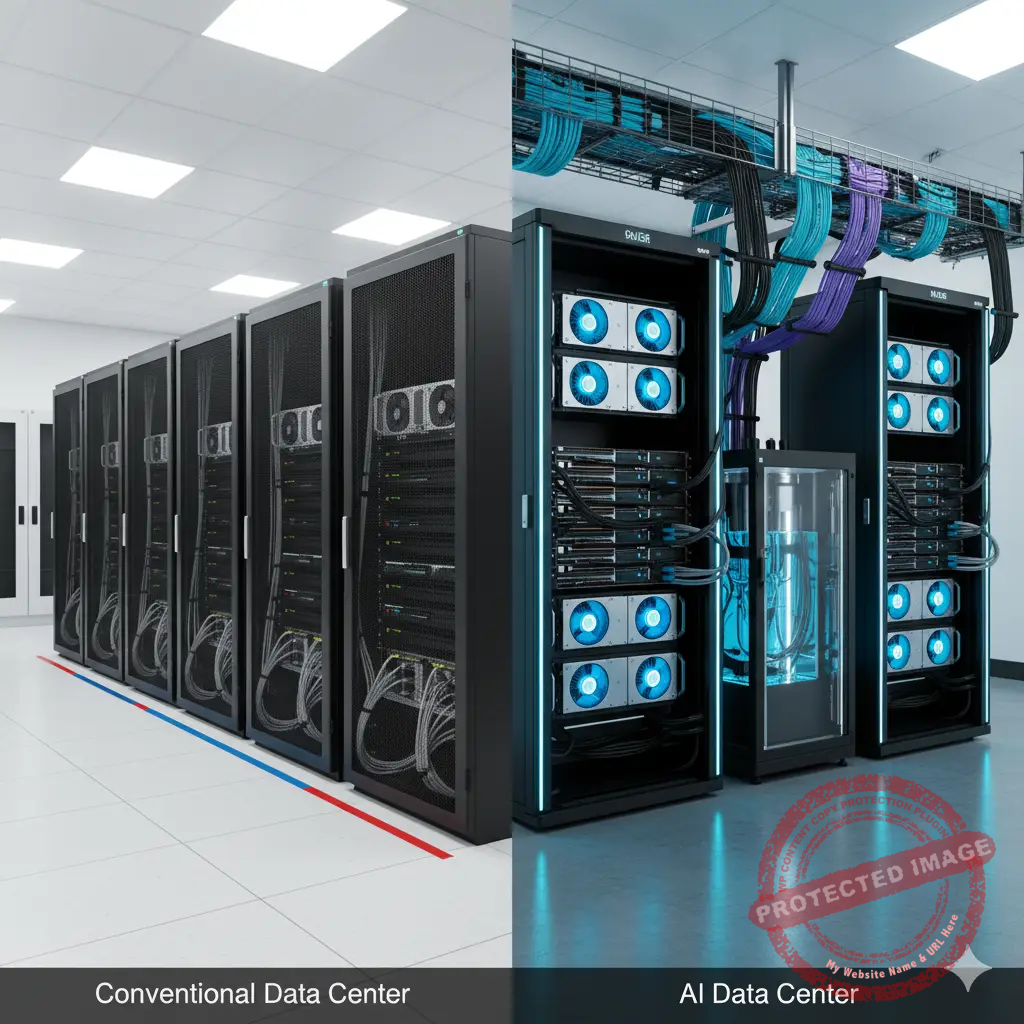
Burst, steady-state, and everything in between—how utilization, data gravity, and power shape the bill.
The Question That Actually Matters: Utilization
“Which is more economical?” is really “How busy will the GPUs be?” If your workloads are spiky—prototype this month, idle next—renting capacity in AI datacenters (public cloud or GPU clouds) usually wins on pure cash flow and risk. If your workloads are predictable and heavy—high-volume inference, recurring fine-tunes—owning gear and running it on-prem (or in colocation) tends to win over a 3–5 year horizon because you spread capital across consistently high utilization. Vendor TCO studies echo this: cloud flexibility shines for burst training; steady, high-duty cycles flip the math toward owned infrastructure.
What AI Datacenters Really Offer
Elasticity and speed to first compute are the headline perks. Hyperscalers and GPU clouds expose the newest silicon quickly (H100/H200 today; Blackwell variants next) with managed networking, storage, and orchestration. Pricing is typically per GPU-hour, with on-demand, spot, and committed-use discounts. On Google Cloud, H100s live behind accelerator-optimized A3 machines; pricing is metered and discountable via sustained-use and commitments. AWS’s P5/P5e families similarly package H100/H200 capacity for large training and HPC, allowing teams to scale clusters to hundreds or thousands of GPUs without owning a single rack. The trade-offs: egress fees for moving data, variable spot availability, and price exposure if your jobs run for months rather than days.
Where On-Prem Pays Off
Owned systems concentrate spend into a known depreciation schedule and sidestep variable per-hour compute charges. If you can keep GPUs busy most of the day—especially for inference or repeated fine-tunes of enterprise models—your effective cost per GPU-hour declines as utilization climbs. Lenovo’s recent TCO work frames it this way: high and steady utilization plus data that already resides on-prem drives down unit economics relative to cloud; the opposite is true when usage is intermittent or experimental. On-prem also keeps sensitive data local by default, simplifying some compliance paths and shrinking egress exposure—though you inherit power, cooling, space and staffing obligations.
The Hidden Variables That Swing the Math
Power price and availability: electricity is quickly becoming the biggest line item in both footprints. Analysts and grid researchers project rapid growth in data-center power draw through 2030, which will flow into pricing, siting, and queue times for utility upgrades. If your local rates are high—common in dense metros—that erodes on-prem savings unless you can secure favorable tariffs or behind-the-meter renewables.
Interconnect and data gravity: training near the data you already have can save real money. If your data is born in the cloud, compute there avoids egress; if your data is produced in plants, branches, or secure facilities, running inference close to source cuts WAN costs and latency.
People and process: on-prem requires SRE/DevOps, facilities, and lifecycle management. Cloud requires FinOps discipline. Surveys show many IT leaders still struggle with cloud cost visibility—noise you’ll need to manage if large AI bills are in play.
Market dynamics: AI infrastructure spend is climbing fast and remains capacity-constrained in spots, which can mean premium pricing and lead-time risk either way.
A Simple Economic Lens for 2026
-
Training bursts, uncertain demand: cloud/AI datacenters. Renting lets you right-size clusters, test architectures, and walk away if a model path changes. Committed-use discounts and reservation strategies can smooth variance, but you still benefit from elasticity and the option value of not owning quickly obsolete gear.
-
Steady inference at scale: on-prem (often in colo). If your application traffic is predictable and you can drive high GPU utilization, the capex amortized over three to five years plus lower variable cost (no per-hour surcharge, no egress) often beats cloud run-rate. Lenovo’s TCO modeling highlights this steady-state advantage for on-prem, particularly when data already sits inside your estate.
-
Hybrid is not a hedge—it’s a plan. Many teams now train big models in cloud to exploit burst capacity and hardware choice, then export distilled/fine-tuned versions for on-prem inference close to data and customers. That keeps spend aligned with each workload’s cost curve while respecting latency and sovereignty.
What Changes in 2026
Two macro forces shape both options. First, grid constraints: utility upgrades and substation queues affect new datacenter builds and customer turn-ups, while older on-prem rooms struggle to support 30–80kW racks without retrofits. Expect longer lead times and more attention on heat rejection and water use across both camps. Uptime Institute’s latest survey flags rising costs and density challenges as the sector modernizes for AI. Second, capital prudence: enterprises will still chase GPU access, but boards will ask for clear ROI and unit economics to justify multi-year commitments; IDC tracks double-digit growth in AI infra spend into the latter half of the decade, keeping pressure on both supply and cost.
How to Decide in Practice
-
Map utilization honestly. If you cannot keep >~half of cores busy most days, renting likely wins. (If you can, start sizing an on-prem/colo block.) 2) Follow the data. Where your largest datasets already live should heavily influence compute placement. 3) Price power. Model $/kWh scenarios and include cooling overhead; your local rate can swing TCO more than you expect. 4) Include people and risk. Cloud shifts some operational risk to providers; on-prem shifts it to you. 5) Lock in the easy savings. Whichever path you choose, use committed discounts in cloud and high-efficiency gear/power contracts on-prem.
Bottom Line
There isn’t one “cheapest.” In 2026, AI datacenters are generally more economical for bursty or exploratory workloads and for orgs that value speed, access to the latest GPUs, and operational simplicity. On-prem (or colo) becomes more economical as utilization stabilizes and scales, especially for inference close to proprietary data, provided you can secure power, space, and the right talent. Most winners will mix both—train where capacity is elastic, infer where the data and customers are.
Our Closing Thoughts
AI economics are converging on a simple truth: cost follows utilization and data gravity. If you size to your reality—not your wish list—you’ll avoid stranded capex on one side and runaway opex on the other. 2026 rewards teams that run the numbers, pick the right venue per workload, and stay flexible as silicon, pricing, and power landscapes keep shifting.
References
-
LenovoPress — “On-Premise vs Cloud: Generative AI Total Cost of Ownership.” https://lenovopress.lenovo.com/lp2225.pdf
-
Google Cloud — “GPU pricing.” https://cloud.google.com/compute/gpus-pricing
-
Amazon Web Services — “Amazon EC2 P5 Instances.” https://aws.amazon.com/ec2/instance-types/p5/
-
IDC — “Artificial Intelligence Infrastructure Spending to Surpass the $200Bn USD Mark in the Next 5 years.” https://my.idc.com/getdoc.jsp?containerId=prUS52758624
-
Reuters — “Data centers could use 9% of US electricity by 2030, research institute says.” https://www.reuters.com/business/energy/data-centers-could-use-9-us-electricity-by-2030-research-institute-says-2024-05-29/
Co – Editors
Serge Boudreaux – AI Hardware Technologies
Montreal, Quebec
Peter Jonathan Wilcheck – Co-Editor
Miami, Florida
Post Disclaimer
The information provided in our posts or blogs are for educational and informative purposes only. We do not guarantee the accuracy, completeness or suitability of the information. We do not provide financial or investment advice. Readers should always seek professional advice before making any financial or investment decisions based on the information provided in our content. We will not be held responsible for any losses, damages or consequences that may arise from relying on the information provided in our content.
 AAPL
AAPL AMD
AMD CIS.HA
 DELL
DELL IBM
IBM INTC
INTC MSFT
MSFT GOOG
GOOG HPE
HPE NVDA
NVDA TSLA
TSLA TMC
TMC MSI
MSI NOK
NOK ECDH26.CME
 OPEAZZX