


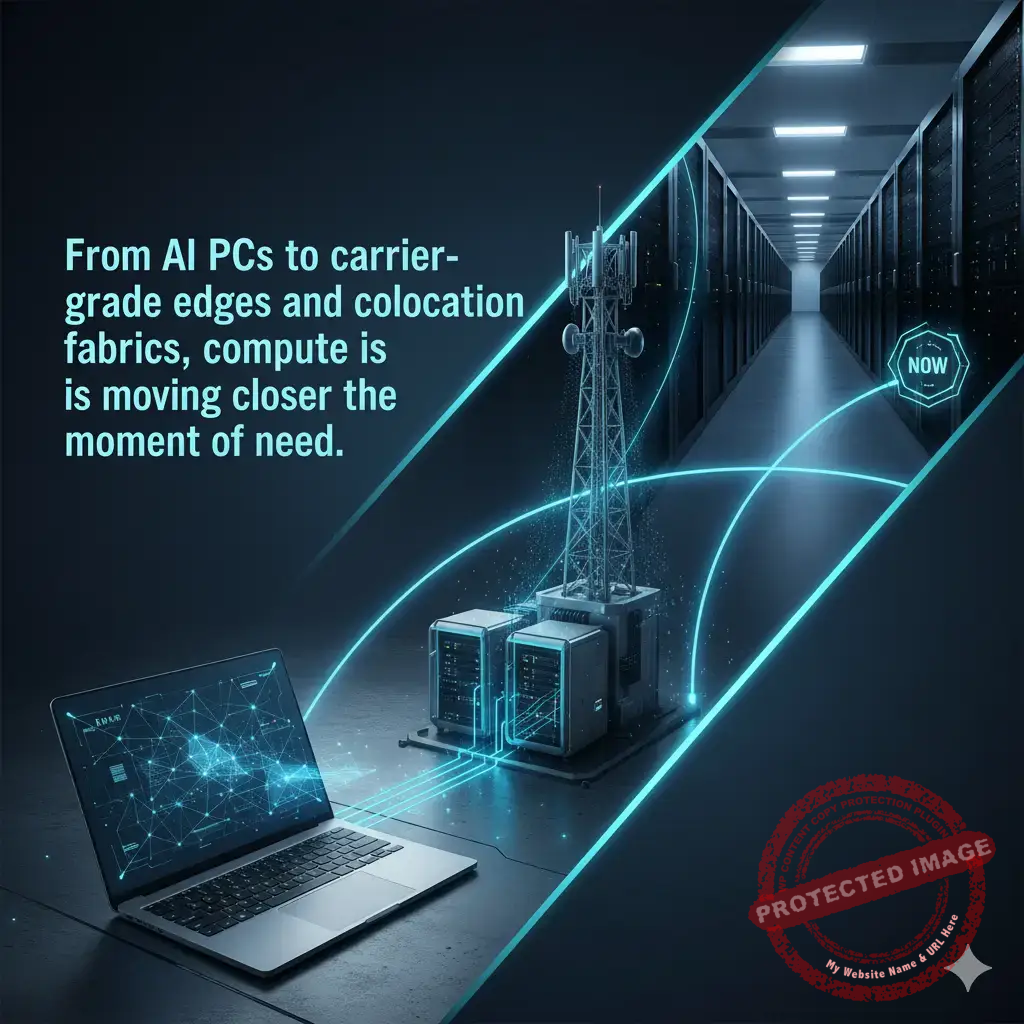
From AI PCs to carrier-grade edges and colocation fabrics, compute is moving closer to the moment of need.
Why the Edge Is Heating Up
Two forces are colliding in 2026: skyrocketing demand for inference and a need to cut latency and cost. Running every request in a distant hyperscale region is slow and expensive for interactive experiences; pushing compute closer—on device, in branch servers, or in carrier PoPs—improves responsiveness and reduces bandwidth. Analysts now expect AI PCs to dominate enterprise refresh cycles by 2026, putting NPUs in most new laptops and shifting everyday assistance out of the cloud.
Colocation and Interconnect: The New AI Fabric
Datacenter operators are repositioning themselves as AI transit hubs. Equinix’s “Distributed AI infrastructure” pitch bundles an AI-ready backbone, a global solutions lab, and Fabric Intelligence for real-time workload awareness across multicloud and edge locations. The idea: keep training where the GPUs live, but place inference next to data sources, stores, and users. Expect other colo providers to answer with similar fabrics and cross-connect-friendly designs.
Carrier-Grade Edge Inference
CDN providers are stepping into AI with specialized inference tiers. Akamai’s new Inference Cloud expands from core data centers to thousands of edge locations, integrating NVIDIA hardware so developers can deploy models within a content-delivery footprint. That could shrink cold-start penalties for real-time use cases like personalization, media, or industrial telemetry.
On-Device: Phones and Laptops Get Capable
On the device side, Apple’s Foundation Models framework opens direct access to the on-device model that powers Apple Intelligence, enabling private, offline features without per-query cloud fees. In Windows PCs, Qualcomm, Intel, and others are racing to ship higher-TOPS NPUs; Microsoft’s Phi-4 multimodal targets precisely these small-compute contexts for perception and reasoning. Enterprises will mix: cloud for heavy jobs, device for frequent assistive tasks.
Compact Workstations for Local AI
Not every workload belongs in a rack. Nvidia’s compact Blackwell-based professional GPUs (like the RTX Pro 4000 SFF) put serious acceleration in 70-watt envelopes for deskside or micro-edge nodes. For teams that need privacy or deterministic latency—engineering, creative, field ops—these cards enable local vector search, RAG, and video analytics without a server closet.
Design Principles for 2026
• Place compute by data gravity. Keep inference near where data is captured or consumed; reserve far-edge or device for privacy-sensitive, low-latency loops.
• Architect for burst vs. base. Train and fine-tune in elastic clouds; shift steady inference to colo, edge, or device when utilization justifies it.
• Standardize models and telemetry. Use one eval suite and logging taxonomy across cloud, colo, edge, and device so you can compare performance and cost apples-to-apples.
• Build for portability. Containerize runtimes and rely on model formats that export cleanly across vendors.
Closing Notes
“Cloud vs. edge” is the wrong debate in 2026. We’re headed to an AND world: heavy models in centralized clusters; fast loops on device and at the edge; colocation fabrics and carrier networks knitting it together. The winners will be the teams that measure latency and cost, follow the data, and let the workload choose the venue.
References
-
Gartner — “Worldwide Shipments of AI PCs to Account for 43% of All PCs in 2025; By 2026, AI laptops will be the only choice for large businesses” — https://www.gartner.com/en/newsroom/press-releases/2024-09-25-gartner-forecasts-worldwide-shipments-of-artificial-intelligence-pcs-to-account-for-43-percent-of-all-pcs-in-2025
-
Equinix — “Unveils Distributed AI Infrastructure to Help Businesses Accelerate the Next Wave of AI Innovation” — https://investor.equinix.com/news-events/press-releases/detail/1084/equinix-unveils-distributed-ai-infrastructure-to-help
-
Akamai — “Akamai Inference Cloud Transforms AI from Core to Edge with NVIDIA” — https://www.akamai.com/newsroom/press-release/akamai-inference-cloud-transforms-ai-from-core-to-edge-with-nvidia
-
Apple Newsroom — “Foundation Models framework unlocks new intelligent app experiences” — https://www.apple.com/newsroom/2025/09/apples-foundation-models-framework-unlocks-new-intelligent-app-experiences/
-
Tom’s Hardware — “Nvidia introduces compact Blackwell professional graphics cards—RTX Pro 4000 SFF and Pro 2000” — https://www.tomshardware.com/pc-components/gpus/nvidia-introduces-compact-blackwell-professional-graphics-cards-rtx-pro-4000-sff-and-pro-2000-gpus-launched-at-siggraph-2025
Authors – Co-Editors
Serge Boudreaux – AI Hardware Technologies
Montreal, Quebec
Peter Jonathan Wilcheck – Co-Editor
Miami, Florida
Post Disclaimer
The information provided in our posts or blogs are for educational and informative purposes only. We do not guarantee the accuracy, completeness or suitability of the information. We do not provide financial or investment advice. Readers should always seek professional advice before making any financial or investment decisions based on the information provided in our content. We will not be held responsible for any losses, damages or consequences that may arise from relying on the information provided in our content.
 AAPL
AAPL AMD
AMD CIS.HA
 DELL
DELL IBM
IBM INTC
INTC MSFT
MSFT GOOG
GOOG HPE
HPE NVDA
NVDA TSLA
TSLA TMC
TMC MSI
MSI NOK
NOK ECDH26.CME
 OPEAZZX