


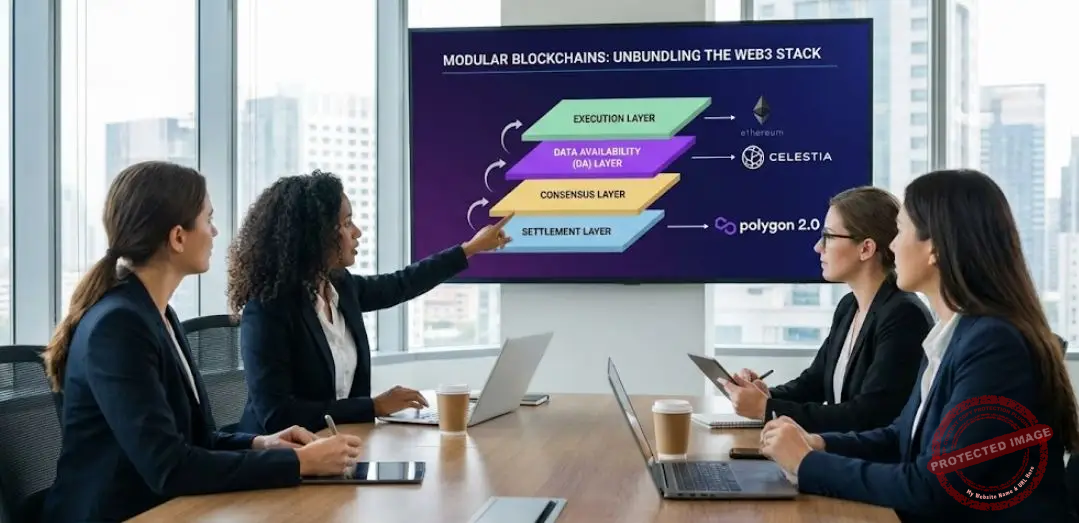
The next significant shift in blockchain design is not another “Ethereum killer,” but a quiet architectural refactor. Modular blockchains separate core functions like execution, consensus, settlement, and data availability into specialized layers instead of forcing one chain to do everything. This unbundling is changing how rollups are built, how fees are pai,d and how enterprises think about Web3 infrastructure.
From monolithic chains to modular ecosystems
Early blockchains such as Bitcoin and Ethereum were monolithic systems. A single network executed transactions, ordered them, stored the data, and enforced consensus. That design was elegant but brittle at scale: every node had to download and re-execute all transactions, and any attempt to improve throughput risked compromising decentralization or security.
Modular architecture breaks this trilemma into smaller, more manageable pieces. Recent technical overviews describe four core components in a modern stack: an execution layer that runs smart contracts, a data availability (DA) layer that stores and guarantees access to transaction data, a consensus or ordering layer that sequences blocks, and a settlement layer that arbitrates finality and dispute resolution. Bitium Blog
In practice, these roles can be combined or further subdivided, but the guiding idea is the same: let each layer specialize and evolve independently. Execution environments can be tuned for high-throughput gaming or compliant institutional DeFi, while DA networks focus on bandwidth and sampling, and settlement layers prioritize security and composability.
Celestia and the rise of data availability layers
No concept illustrates modularity better than data availability. If users cannot be sure that transaction data is actually published and retrievable, they cannot independently verify state transitions, and rollups become fragile. DA layers address this by providing a common, shared medium where rollups post compressed transaction data along with cryptographic commitments.
Celestia is the flagship example. Its documentation describes it as a “modular data availability (DA) layer” that lets developers launch their own blockchains without spinning up a separate validator set. Rollups and app chains publish their data to Celestia, which uses data availability sampling to ensure that the data is genuinely accessible while dropping the cost of DA by as much as 95 percent compared with storing everything directly on a monolithic chain. KuCoin Celestia coingecko.com
Instead of competing directly with Ethereum on smart-contract functionality, Celestia positions itself as a “Dropbox for blockchain data.” Developers can mix and match: use Ethereum or another L1 for settlement, run execution on customized rollups, and rely on Celestia for cheap, scalable DA.
Other DA players such as EigenDA, Avail, and specialized “blob” markets within Ethereum are pursuing similar goals, creating an emergent marketplace for bandwidth and data guarantees rather than a single, vertically integrated chain. Token Metrics
Polygon 2.0, Cosmos SDK and the rollup-as-a-service era
On the execution side, modularity is driving a proliferation of app-specific rollups and “L2 as a service” platforms. Polygon 2.0, for example, envisions a network of interconnected Layer 2 chains built with its CDK stack, each targeting different use cases but sharing common liquidity and governance. Web3 development trend reports emphasize how Polygon 2.0, Celestia and the Cosmos SDK exemplify a shift toward ecosystems where dozens or hundreds of specialized chains plug into shared security and DA layers. KingIT Solutions
Cosmos pioneered the idea of sovereign app chains connected by the Inter-Blockchain Communication (IBC) protocol. In a modular future, these chains can increasingly offload data or settlement to external layers, turning what began as a federation of independent networks into a more tightly coupled, composable fabric.
For developers, this means more choice. Instead of deploying exclusively to a single shared L1, teams can pick an execution environment tuned to their priorities, whether that is ultra-low fees, strict compliance controls, high-speed gaming or privacy-preserving financial contracts.
What modularity means for enterprises and regulators
Enterprises evaluating blockchain infrastructure have often been caught between public networks that scale poorly and consortium chains that risk vendor lock-in. Modular stacks offer a middle path. An enterprise can run its own execution environment—an app rollup or permissioned chain—with complete control over whitelisting, governance and data residency, while still inheriting DA and settlement security from a larger public ecosystem.
Consulting and engineering firms covering modular architecture argue that this flexibility is one reason enterprises are now piloting rollup stacks such as OP Stack, Polygon CDK and Cosmos-based solutions. NetSetSoftware+2Token Metrics Instead of choosing “Ethereum vs. private chain,” organizations can blend components: public DA plus private execution, or public settlement plus industry-specific shared rollups.
For regulators, modularity introduces both clarity and complexity. On one hand, DA layers can provide transparent, standardized records of data publication, simplifying audits and dispute resolution. On the other hand, responsibility is now distributed across multiple layers and operators. If something goes wrong, supervisors must untangle whether a failure lies in the rollup code, the DA network, the settlement layer or the bridge connecting them.
New risks: Fragmentation, security assumptions, and UX
The gains in scalability and flexibility are real, but modularity comes with its own risk surface.
One concern is security fragmentation. Each rollup or app chain may rely on different DA layers, settlement rules and validator sets. If standards are loose, bridges between these zones could become exploitable chokepoints. Analysts warn that modular designs still rely on shared assumptions, particularly around DA sampling and light client security, and that premature complexity could reintroduce systemic risk. Celestia Docs+2Chiliz
Another challenge is user experience. From a consumer perspective, juggling multiple gas tokens, wallets and bridge hops is already painful. A modular world with dozens of rollups could worsen that fragmentation unless wallet providers and aggregators make the complexity invisible. There is an emerging race to build account abstraction, unified gas and cross-rollup routing into a single UX layer, so users see one network even if they are interacting with many.
Finally, governance becomes more intricate. Protocol upgrades on a DA layer can have cascading effects on hundreds of dependent rollups. Coordinating these changes without introducing central points of control is an unresolved challenge.
Closing thoughts and looking forward
Modular blockchains are less a new “coin narrative” than a restructuring of crypto’s underlying operating system. By unbundling execution, DA, consensus and settlement, the ecosystem is starting to look more like the layered architecture of the internet itself: specialized, composable and, ideally, resilient. DA layers such as Celestia lower the cost of publishing data, rollup frameworks like Polygon 2.0 and the Cosmos SDK make it easier to spin up tailored execution environments, and shared settlement layers promise deep liquidity and security.
Over the next few years, the most successful Web3 platforms will likely be those that embrace this modularity without letting it become chaos. That means clear standards for DA, robust light clients, thoughtful governance and UX abstractions that hide complexity from end users. If the industry gets it right, modular blockchains could turn today’s fragmented patchwork of chains into a coherent fabric where applications pick and choose the components they need. Enterprises plug into public infrastructure without surrendering control.
References
Modularity in Blockchains: Understanding Execution, Data Availability, Transaction Ordering, and Settlement Layers – Bitium Blog – https://blog.bitium.agency/modularity-in-blockchains-understanding-execution-data-availability-and-settlement-layers-5e8e291bf5d6 Bitium Blog
What Is Celestia? Data Availability and the Rise of the Modularity Era – CoinGecko Learn – https://www.coingecko.com/learn/what-is-celestia-tia-data-availability-modular-blockchain coingecko.com
What Is the Data Availability Layer in Blockchain and Why It Matters – KuCoin Learn – https://www.kucoin.com/learn/crypto/what-is-data-availability-layer-dal KuCoin
The Future of Scalable Modular Blockchains: Celestia Explained – Lithium Digital – https://www.lithiumdigital.com/blog/celestia-explained-the-future-of-scalable-modular-blockchains Lithium Digital
The Future of Web3 Development: Trends to Watch in 2025 – KING IT Solutions – https://www.kingitsolutions.net/component/content/article/the-future-of-web3-development-trends-to-watch-in-2025?Itemid=392&catid=29 KingIT Solutions
Co-Editors. Benoit Tremblay, Co-Editor IT Security Management, Montreal, Quebec.
Peter Jonathan Wilcheck, Co-Editor, Miami, Florida.
#Blockchain #ModularBlockchains #DataAvailability #Celestia #Rollups #Polygon2 #CosmosSDK #Web3Scalability #Layer2Infrastructure #OnchainArchitecture
Post Disclaimer
The information provided in our posts or blogs are for educational and informative purposes only. We do not guarantee the accuracy, completeness or suitability of the information. We do not provide financial or investment advice. Readers should always seek professional advice before making any financial or investment decisions based on the information provided in our content. We will not be held responsible for any losses, damages or consequences that may arise from relying on the information provided in our content.
 AAPL
AAPL AMD
AMD CIS.HA
 DELL
DELL IBM
IBM INTC
INTC MSFT
MSFT GOOG
GOOG HPE
HPE NVDA
NVDA TSLA
TSLA TMC
TMC MSI
MSI NOK
NOK ECDH26.CME
 OPEAZZX