


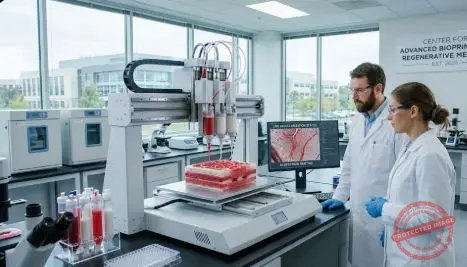
Bioprinting is no longer a speculative promise tucked away in university labs. In late 2025, 3D printing of living tissues has become a serious translational discipline, pushing toward organ-scale constructs, personalized implants and smarter drug discovery. Hospitals, pharma companies and regulators are now wrestling with what happens when printers begin producing not plastic prototypes, but vascularized tissue patches and organ-like structures that could one day replace donor organs.
Clinicians who once saw 3D printing as a clever way to make surgical guides are now being drawn into multidisciplinary teams with bioengineers, cell biologists and AI specialists. The goal is simple to state and enormously complex to achieve: reliably print living, functional tissue that safely integrates with the human body.
From plastic parts to living, vascularized tissues
Modern bioprinting combines high-precision 3D printing systems with bioinks that contain living cells, growth factors, and biomaterials. Recent reviews highlight how extrusion, inkjet and laser-assisted bioprinting can now fabricate complex 3D architectures with multiple cell types for regenerative medicine and tissue engineering. ScienceDirect
A core challenge has been vascularization. Without stable blood vessels, thick tissue constructs quickly fail. In 2024, researchers at Harvard’s Wyss Institute reported a method for printing branching blood vessels that closely mimic human vasculature in heart tissue, bringing the field closer to organ-scale constructs that can be perfused and maintained over time. Harvard SEAS In parallel, high-throughput bioprinting platforms are being built to pair tissue printing with organs-on-a-chip systems, creating sophisticated multicellular models for drug testing and disease modeling. PubMed
These advances are quietly shifting the economic narrative. Instead of simply reducing prototyping time, bioprinting is unlocking new business models in pharma and medtech, from bespoke tissue models for clinical trials to pre-validated grafts for reconstructive surgery.
Patient-specific implants, prosthetics, and surgical guides
While fully transplantable organs are still in the future, bioprinting is already impacting patient care in more incremental ways. Surgeons use 3D-printed anatomical models and guides to plan complex procedures and practice challenging reconstructions before the first incision. Orthopedic and craniofacial teams deploy patient-specific implants fabricated from biocompatible polymers or high-performance materials such as PEEK, tailored to each patient’s anatomy and load profile. PMC
These personalized devices improve fit, shorten surgery times, and may reduce complications. Hospitals that once outsourced this work to specialized service bureaus are increasingly investing in in-house additive manufacturing labs that sit adjacent to operating rooms. Bioprinting is the logical next step: replacing inert materials with living constructs, whether cartilage patches for joints or tissue-engineered grafts for reconstructive surgery.
AI-accelerated design and defect detection
Bioprinting is data-rich. High-resolution imaging, sensor readings, cell viability metrics and process parameters generate a continuous stream of information. Machine learning is now being used to optimize bioprinting workflows, from tuning droplet size and extrusion pressure to predicting defect locations in complex constructs. ScienceDirect
Recent work has shown how deep neural networks and computer vision systems can detect anomalies in real time, allowing printers to adjust parameters on the fly or halt failed builds before wasting expensive bioinks and cells. www.mmscience.eu AI also supports generative design, helping researchers explore novel scaffold architectures that maximize nutrient diffusion, mechanical strength and cell differentiation, all under strict biocompatibility constraints.
This AI layer is critical as bioprinting moves from single-lab experiments to scalable platforms. Quality control, repeatability, and traceability are all essential for regulatory approval and clinical adoption, and algorithmic oversight is becoming a standard feature rather than a futuristic add-on.
Regulation, ethics, and scale-up
The path from bench to bedside is complicated. Regulators must decide how to classify bioprinted constructs that blur the boundaries between devices, drugs, and tissues. Recent analyses emphasize gaps in standards for bioinks, cell sourcing, sterilization, and long-term safety, especially for constructs that integrate human cells and synthetic scaffolds. Cureus
Ethical questions are also intensifying. Who owns a bioprinted organ—a hospital, a device company, a software vendor that designed the scaffold, or the patient whose cells seeded the construct? How should clinical trials be run for tissues that can be iteratively improved between batches? And how do health systems prevent inequities if early bioprinted therapies are available only at elite centers?
Nonetheless, momentum is unmistakable. High-scale platforms, combined with organs-on-chips, are already transforming preclinical research, allowing more realistic models for toxicity and efficacy while reducing reliance on animal testing. PubMed
Closing thoughts and looking forward
Bioprinting in 2025 feels like a field at the cusp of crossing from experimental novelty to regulated medical practice. The near-term road map is more likely to feature hybrid products—printed scaffolds seeded with cells, vascularized patches, precision surgical guides, and patient-specific implants—than fully bioprinted hearts. Yet each of these steps builds the supply chain, data infrastructur,e and regulatory precedent that organ-scale constructs will ultimately depend on.
Over the next five to ten years, expect bioprinting to embed itself in hospital workflows, clinical trials, and biotech R&D pipelines. AI-driven optimization will help stabilize manufacturing, while better bioinks and vascularization strategies will steadily expand the types of tissues that can be reliably produced. The long-term destination—a world where organ waitlists shrink as printers spin up bespoke grafts—is still distant. Still, the path toward it is becoming clearer with every new clinical and preclinical milestone.
Reference sites
Advances and challenges in 3D bioprinting for organ transplantation – Cureus – https://www.cureus.com/articles/438203-advances-and-challenges-in-3d-bioprinting-for-organ-transplantation-bridging-the-gap-between-research-and-clinical-applications
Advancements in tissue and organ 3D bioprinting – Materials & Design (Elsevier) – https://www.sciencedirect.com/science/article/pii/S0264127524002260
Recent advances in 3D bioprinting of tissues and organs – Expert Review of Medical Devices (Taylor & Francis) – https://www.tandfonline.com/doi/full/10.1080/17452759.2024.2384662
High-scale 3D-bioprinting platform for automated organ-on-chip models – Biofabrication (via PubMed) – https://pubmed.ncbi.nlm.nih.gov/38511587/
3D-printed blood vessels bring artificial organs closer to reality – Harvard John A. Paulson School of Engineering and Applied Sciences – https://seas.harvard.edu/news/2024/08/3d-printed-blood-vessels-bring-artificial-organs-closer-reality
Randy Johnson, Contributor, 3D Printing, Montreal, Quebec.
Peter Jonathan Wilcheck, Co-Editor, Miami, Florida.
#3DPrinting #Bioprinting #TissueEngineering #OrganOnChip #RegenerativeMedicine #AIInHealthcare #PersonalizedImplants #Medical3DPrinting #DigitalSurgery #FutureOfMedicine
Post Disclaimer
The information provided in our posts or blogs are for educational and informative purposes only. We do not guarantee the accuracy, completeness or suitability of the information. We do not provide financial or investment advice. Readers should always seek professional advice before making any financial or investment decisions based on the information provided in our content. We will not be held responsible for any losses, damages or consequences that may arise from relying on the information provided in our content.

 AAPL
AAPL MSFT
MSFT GOOG
GOOG TSLA
TSLA AMD
AMD IBM
IBM TMC
TMC IE
IE INTC
INTC MSI
MSI NOK
NOK DELL
DELL ECDH26.CME