


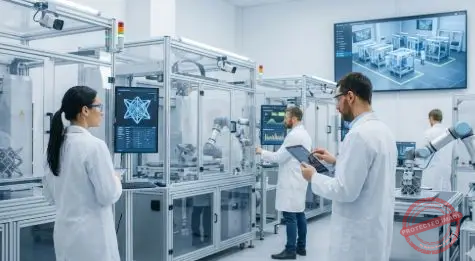
As 3D printing systems scale up, the factories around them are being re-architected for data and autonomy. Cameras peer into build chambers, sensors track temperatures and vibrations, and software orchestrates entire fleets of printers. The next chapter of additive manufacturing is defined less by new hardware than by the integration of artificial intelligence at every stage of the workflow, from design to post-processing.
In this AI-native vision, printers are no longer isolated machines on the shop floor. They are part of a living, learning system that continuously adjusts parameters, predicts failures and proposes novel geometries that humans would never have designed on their own.
Generative design and AI-assisted engineering
AI has already transformed how engineers approach design. Generative design tools use algorithms to explore thousands of design variants under specified constraints—weight, stiffness, thermal performance, cost—surfacing highly optimized structures that often resemble organic forms. When paired with 3D printing, these lattice-rich, topology-optimized designs can be manufactured without the limitations of traditional machining.
Recent studies point out that AI-driven algorithms can also optimize the digital files themselves, minimizing geometric errors, improving mesh quality, and reducing the computational overhead of complex designs. ResearchGate This matters when factories are processing large numbers of customized parts, each with subtle variations.
In bioprinting and medical applications, AI-assisted design extends to scaffold architectures that control cell distribution, nutrient diffusion and mechanical cues, bridging CAD tools and biological function. ScienceDirect
Intelligent process control and defect prediction
The print process is where AI arguably has the most significant immediate impact. Machine learning models trained on historical build data can predict defects such as warping, porosity or layer delamination before they become catastrophic. By monitoring images of melt pools, layer surfaces or resin interfaces in real time, these models flag anomalies and automatically adjust power, speed or material flow.
A growing body of work shows how convolutional neural networks and other deep learning techniques can detect subtle changes in texture or emission patterns associated with emerging defects, enabling in-situ quality assurance rather than relying solely on post-build inspection. www.mmscience.eu
The result is a shift from open-loop to closed-loop printing. Instead of treating each print as a static recipe, AI-native systems treat it as a dynamic process in which feedback from each layer informs the next.
Printer fleets, scheduling and supply-chain integration
When manufacturers run dozens or hundreds of printers, AI becomes essential for orchestration. Algorithms can allocate jobs to specific machines based on material availability, maintenance status, historical performance and due dates, optimizing for throughput and energy consumption. Integrated with ERP and MES systems, AI-driven schedulers adjust workloads as orders change, materials arrive late or printers require unplanned maintenance.
Trend data from industrial surveys show that more businesses are moving beyond prototyping, using additive manufacturing for end-use parts where reliability and delivery times are critical. Protolabs AI-enhanced planning helps these organizations hit lead-time targets while avoiding underutilization of expensive equipment.
Downstream, digital twins of printers and production lines simulate the impact of parameter changes or design modifications before physical builds start, reducing trial-and-error on the factory floor. ScienceDirect
Sustainability and AI-optimized resource use
AI and additive manufacturing are also aligned around sustainability. Optimization algorithms can reduce material usage, support structures and failed builds, which collectively represent a significant share of waste in 3D printing operations. Reviews of AI-enabled 3D printing highlight how predictive modeling and multi-objective optimization can concurrently minimize material use, energy consumption and build time. ScienceDirect
In parallel, AI helps manufacturers explore sustainable material options—bio-based polymers, recycled filaments, hybrid composites—and understand how they behave in their processes. As more data is collected on novel materials, recommendation systems can suggest optimal process windows that balance sustainability targets with mechanical performance.
New skills, new risks
The AI-native factory creates new roles and risks. Engineers must understand not only materials science and mechanics but also data science and model governance. Manufacturers will need to manage model drift, cybersecurity concerns and the risk of over-automation if humans lose situational awareness of complex systems.
Regulators and customers are beginning to ask how AI decisions are documented and how quality is assured when algorithms adjust parameters autonomously. In highly regulated sectors like aerospace, medical devices and defense, explainability and auditability will be critical for certifying AI-assisted production.
Closing thoughts and looking forward
AI-native 3D printing is more than a buzzword; it is becoming the default architecture for serious additive manufacturing operations. Over the next few years, expect to see more printer vendors ship machines with embedded AI capabilities, more factories deploy centralized analytics platforms that ingest multi-printer data, and more design teams treat generative design as a standard step rather than an exotic experiment.
The winners in this transition will be organizations that treat data as a first-class asset, invest in cross-functional skills and build robust processes for validating and governing AI models. In that environment, 3D printers become not just hardware, but intelligent nodes in a tightly integrated, highly adaptive digital manufacturing network.
Reference sites
AI-Driven Innovations in 3D Printing: Optimization, Automation and Intelligent Control – Journal of Manufacturing and Materials Processing (MDPI) – https://www.mdpi.com/2504-4494/9/10/329
The Role of Artificial Intelligence in 3D Printing Systems – ACM Digital Library – https://dl.acm.org/doi/10.1145/3756423.3756511
Artificial Intelligence for Optimizing 3D Printing Quality, Time and Material Use – ResearchGate – https://www.researchgate.net/publication/397858914_Artificial_Intelligence_for_Optimizing_3D_Printing_Quality_Time_and_Material_Use
A review of AI for optimization of 3D printing of sustainable products – Additive Manufacturing Letters (Elsevier) – https://www.sciencedirect.com/science/article/pii/S2666682024000823
Revolutionizing 3D printing through machine learning: potential and challenges in bioprinting – MM Science Journal – https://www.mmscience.eu/journal/issues/june-2025/articles/revolutionizing-3d-printing-through-machine-learning-potential-and-challenges-in-bioprinting/download
Randy Johnson, Contributor, 3D Printing, Montreal, Quebec.
Peter Jonathan Wilcheck, Co-Editor, Miami, Florida.
#3DPrinting #AIManufacturing #GenerativeDesign #PredictiveMaintenance #SmartFactories #AdditiveManufacturing #DigitalTwin #IndustrialAI #QualityByDesign #SustainableManufacturing
Post Disclaimer
The information provided in our posts or blogs are for educational and informative purposes only. We do not guarantee the accuracy, completeness or suitability of the information. We do not provide financial or investment advice. Readers should always seek professional advice before making any financial or investment decisions based on the information provided in our content. We will not be held responsible for any losses, damages or consequences that may arise from relying on the information provided in our content.

 AAPL
AAPL MSFT
MSFT GOOG
GOOG TSLA
TSLA AMD
AMD IBM
IBM TMC
TMC IE
IE INTC
INTC MSI
MSI NOK
NOK DELL
DELL ECDH26.CME