


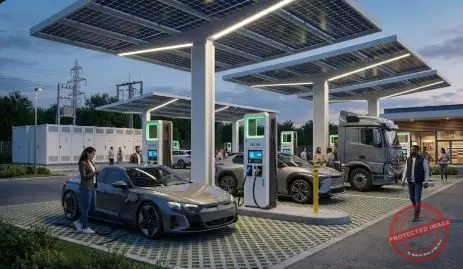
By late 2026, many electric vehicles will not only consume electricity but also sell it. Bidirectional charging technologies such as vehicle-to-grid (V2G), vehicle-to-home (V2H) and vehicle-to-load (V2L) are transforming parked cars into flexible batteries that can power homes, support the energy system and supply off-grid devices. The shift is blurring the line between transportation and electricity markets and forcing utilities, regulators and automakers to coordinate in new ways.
From one-way plugs to energy conversations
Traditional EV charging is a one-way transaction: electrons flow from the grid into the vehicle, and the billing system records consumption. Bidirectional charging turns that model into a two-way conversation. When the grid is stressed or prices spike, an EV can discharge some of its stored energy back to the system, either into a home through a bidirectional charger (V2H) or through an aggregator into the wider grid (V2G).
Industry guides describe V2G as a way to use idle EV batteries as distributed energy resources to balance demand and supply, integrate more renewable generation and provide ancillary services such as frequency regulation. Solidstudio In practice, that means a fleet of parked vehicles could respond to a grid operator’s signal by injecting power for a few minutes or hours, then recharge when demand and prices are lower.
V2H and resilience for homes and businesses
For many drivers, the first tangible benefit of bidirectional capability is backup power. Vehicle-to-home systems allow an EV to serve as an emergency generator during outages, powering critical loads such as refrigerators, lighting, internet routers, and medical equipment. Companies that specialize in grid analytics and flexibility note that bidirectional charging turns EVs into “batteries on wheels,” adding resilience for households and adding flexibility for clean energy systems that rely more heavily on variable wind and solar. gridX
By 2026, more automakers are expected to integrate factory-supported V2H capabilities and to certify compatible bidirectional chargers. Combined with rooftop solar and behind-the-meter stationary batteries, an EV can become part of an integrated home energy management system. When the sun is shining, excess solar power charges both the stationary battery and the car; in the evening or during outages, both can discharge to keep the lights on.
Standards, ISO 15118 and Plug-and-Charge for V2G
Flipping the energy direction requires secure and interoperable communication between the vehicle, charger and grid operator. Standards such as ISO 15118 are key here. The same protocol that supports Plug-and-Charge and seamless authentication also includes provisions for bidirectional energy flow and contract-based energy services. go-e
This matters because V2G requires trust: utilities must know which vehicle is feeding energy, under what contract terms, and how much capacity is available, while drivers must be confident that participating in grid programs will not leave them stranded with an empty battery. ISO 15118 and related smart-charging standards provide a common language for these interactions, so that a driver could, in principle, plug into any compatible public charger and have both charging and discharging handled automatically under their chosen service agreements.
Business models and driver incentives
The success of V2G and V2H will depend on economics as much as technology. Studies of smart EV charging suggest that coordinated charging alone can shave peak demand and reduce system costs; adding discharging makes these benefits more pronounced but also introduces wear on the battery. Nature
Aggregators and utilities are experimenting with different incentive models. Some offer fixed monthly payments for enrolling a vehicle in a V2G program, while others pay per kilowatt or per service delivered, similar to how industrial demand-response programs work today. Early pilots indicate that drivers could earn hundreds of dollars per year, but those figures depend heavily on local wholesale markets, regulatory frameworks and how many hours per year the vehicle is available.
Automakers, for their part, must address concerns about battery degradation. Many are exploring optimized algorithms that limit depth of discharge, keep operation within a narrow state-of-charge window and schedule V2G events to minimize thermal stress. Warranty terms will be a decisive factor influencing driver adoption.
Fleet and depot opportunities
While individual household V2G is promising, some of the earliest large-scale deployments are likely to occur in fleets. Urban bus systems, delivery vans and corporate vehicles often return to depots every night, creating predictable windows during which their batteries can interact with the grid. Fleet operators can sign capacity contracts, aggregating hundreds of vehicles into a virtual power plant.
Because depots are often located in industrial zones with stronger grid connections and more flexible load management, they can support larger bidirectional power flows than typical residences. The combination of intelligent scheduling, depot-scale stationary batteries and V2G-capable vehicles may become a cornerstone of urban grid flexibility in the second half of the decade.
Closing thoughts and looking forward
Bidirectional charging is evolving from a niche experiment into a central pillar of EV and grid integration. By 2026, many new EVs will leave the factory ready for V2H or V2L, and growing numbers will participate in early V2G programs through aggregators and utility pilots. The technology promises economic rewards and resilience for drivers, flexible resources for grid operators and a smoother path for decarbonizing electricity systems.
To fulfill that promise, stakeholders must align on standards, tariffs, and consumer hardware protections. Policymakers will need to clarify how distributed energy resources are compensated, how grid operators can dispatch them, and how data from connected vehicles is governed. If those pieces fall into place, the parked EV in a driveway or depot will no longer be a passive asset. It will be an active participant in a cleaner, more flexible energy future.
Gut Azzit, Co-Editor EV Charging, Montreal, Quebec.
Peter Jonathan Wilcheck, Co-Editor, Miami, Florida.
References
Reference 1) “What is the Vehicle-to-Grid technology?” Solidstudio, https://solidstudio.io/blog/vehicle-to-grid Solidstudio
Reference 2) “A comprehensive review of vehicle-to-grid integration in power systems,” Journal of Energy Storage (ScienceDirect), https://www.sciencedirect.com/science/article/pii/S2590174524003428 ScienceDirect
Reference 3) “Vehicle-to-grid (V2G) and vehicle-to-home (V2H),” GridX Knowledge Hub, https://www.gridx.ai/knowledge/vehicle-to-grid-v2g-and-vehicle-to-home-v2h gridX
Reference 4) “ISO 15118: The standard you can’t afford to ignore any longer,” go-e, https://go-e.com/en/magazine/iso-15118-the-standard-you-cant-afford-to-ignore-any-longer go-e
Reference 5) “Smart Electric Vehicle Charging Approaches for Demand Response,” Energies (MDPI), https://www.mdpi.com/1996-1073/17/24/6273 MDPI
#EVCharging #BidirectionalCharging #V2G #V2H #V2L #SmartGrid #DistributedEnergy #ISO15118 #VirtualPowerPlant #EnergyTransition
Post Disclaimer
The information provided in our posts or blogs are for educational and informative purposes only. We do not guarantee the accuracy, completeness or suitability of the information. We do not provide financial or investment advice. Readers should always seek professional advice before making any financial or investment decisions based on the information provided in our content. We will not be held responsible for any losses, damages or consequences that may arise from relying on the information provided in our content.

 AAPL
AAPL AMD
AMD CIS.HA
 DELL
DELL IBM
IBM INTC
INTC MSFT
MSFT GOOG
GOOG HPE
HPE NVDA
NVDA TSLA
TSLA TMC
TMC MSI
MSI NOK
NOK ECDH26.CME
 OPEAZZX