


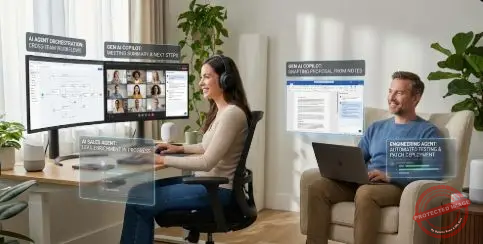
AI agents and generative AI copilots are moving from novelty to necessity in the remote workplace. By 2026, most knowledge workers will rely on at least one AI “colleague” to manage routine tasks, navigate complex workflows, and keep distributed teams aligned.
From assistants to autonomous digital coworkers
The first wave of AI at work focused on embedded assistants that lived inside productivity apps, answering questions, drafting emails, or suggesting code. That model is now evolving into task-specific AI agents that can plan, execute, and adapt across multi-step workflows with minimal human intervention. Gartner forecasts that by 2026, 40% of enterprise applications will feature these task-specific agents, making them a default layer of the digital workplace rather than a specialty add-on. DEVOPSdigest
Microsoft’s recent “Frontier Firm” research frames this shift as a three-phase journey, where AI evolves from assistant to agent to fully integrated digital coworker embedded in every function. In phase two, which is unfolding now, agents join teams as specialized colleagues that generate research, prepare plans, and coordinate cross-team actions on behalf of human workers. Microsoft
For remote teams, this means that AI is no longer a one-to-one personal tool. Instead, shared agentic systems will own entire processes: monitoring channels, triaging requests, opening and updating tickets, routing work, and ensuring that nothing falls through the cracks as tasks bounce across time zones.
Agentic workflows for distributed teams
In a typical 2026 remote sales team, an AI agent will continuously track pipeline movements across a CRM, customer emails, and collaboration tools. When a new lead appears, it enriches the record with external data, drafts a personalized outreach sequence, schedules follow-ups, and nudges the right salesperson when a human response is needed.
Engineering teams will lean on development agents that integrate with repositories, CI/CD pipelines, and issue trackers. These agents will open and prioritize tickets based on production telemetry, propose patches, run tests in sandbox environments, and create documentation for changes they make or recommend.
In operations and shared services, AI copilots will connect to ERP, HR, and finance platforms, automatically preparing reconciliations, cross-checking policy compliance, and generating weekly performance briefings. Platforms emphasizing agent ecosystems—such as those highlighted in emerging “enterprise AI platform” rankings—are competing to become the orchestration layer for exactly these kinds of cross-application workflows. Sema4.ai
Crucially, these agents will operate within a governance framework that logs decisions, exposes prompts and outputs for audit, and allows human approvers to control which actions can be fully automated versus which require human sign-off.
AI copilots inside every remote tool
While agents coordinate work across systems, generative AI copilots will be embedded nearly everywhere remote workers spend their time. In videoconferencing platforms, copilots will automatically capture action items, track who is waiting to speak, flag time overruns, and draft follow-up messages with decisions and next steps. In office productivity suites, copilots will be able to convert rough notes into polished proposals, summarize lengthy email chains, or transform data dumps into executive dashboards.
Industry surveys already show that enterprises are standardizing on copilots from major cloud vendors and specialized AI platforms, often with large-scale deployments. For example, consulting firms deploying AI assistants to tens of thousands of professionals demonstrate how quickly copilots can become a basic expectation rather than a premium add-on. Reuters
By 2026, the line between “native” features and “copilot” features will blur. Users will expect every application to understand natural language, auto-generate content, and suggest next actions by default.
Governance, trust, and “agentwashing” risks
The rapid rise of agents also brings new risks. Analysts already warn about “agentwashing,” in which vendors rebrand basic assistants as “agents” without providing real autonomy or robust safety controls. DEVOPSdigest
For remote work, the stakes are high. Agents with direct access to cloud apps, sensitive documents, and production environments must enforce least-privilege access, apply data-loss prevention policies, and log all actions. Organizations will establish “agent governance boards” with responsibilities spanning:
Human-in-the-loop design, deciding which workflows can be fully automated and which require human review.
Risk classification of agent tasks, distinguishing low-risk automation from high-risk interventions like financial approvals or production changes.
Continuous monitoring of agent behavior to detect drift, biased decisions, or security anomalies.
Regulators and industry bodies are starting to issue guidance on AI governance, and remote-heavy companies will need to demonstrate that agent-driven workflows are auditable and compliant, especially in regulated sectors such as healthcare and financial services.
Skills, roles, and the human side of AI coworkers
As agents and copilots become standard, new roles will emerge around “agent operations.” These include prompt engineers embedded in business units, AI product owners responsible for specific workflows, and ethics or compliance specialists tasked with reviewing agent logs and escalated decisions.
For individual workers, the most valuable skill will be learning how to orchestrate agents rather than compete with them. Remote professionals who can design clear outcomes, break complex goals into steps, specify constraints, and interpret AI-generated outputs will become the new power users of the digital workplace.
Enterprises that invest in this reskilling are repositioning themselves as “AI-first remote organizations,” where agents handle much of the digital drudgery and humans focus on relationship-building, creative problem-solving, and strategic judgment. TTMS
Closing thoughts and looking forward
By 2026, AI agents and generative AI copilots will be the connective tissue of remote work. They will knit together fragmented apps, automate multi-step workflows, and provide each worker with a personalized digital support team. The organizations that win in this new environment will not simply deploy generic copilots; they will architect end-to-end agentic workflows, build strong governance frameworks, and invest heavily in human skills that let people and AI truly collaborate.
Remote work will feel less like juggling dozens of apps and more like managing a small team of invisible, always-on digital colleagues. The challenge for leaders is to ensure these colleagues are safe, accountable, and aligned with human goals.
Co-Editors:
Dan Ray, Remote Technologies, Montreal, Quebec.
Peter Jonathan Wilcheck, Co-Editor, Miami, Florida.
References
Gartner: 40% of Enterprise Apps Will Feature Task-Specific AI Agents by 2026 – DevOps Digest – https://www.devopsdigest.com/gartner-40-of-enterprise-apps-will-feature-task-specific-ai-agents-by-2026
2025: The Year the Frontier Firm Is Born – Microsoft WorkLab – https://www.microsoft.com/en-us/worklab/work-trend-index/2025-the-year-the-frontier-firm-is-born
Top AI Platforms: The Best AI Platforms of 2025 – Sema4.ai – https://sema4.ai/blog/best-ai-platforms-of-2025/
Accenture Ties Up with OpenAI to Equip Thousands of Its Employees with ChatGPT – Reuters – https://www.reuters.com/business/accenture-ties-up-with-openai-equip-thousands-its-employees-with-chatgpt-2025-12-01/
Industrial Copilots: Top 10 Vendors to Watch in 2025 – Augmentir – https://www.augmentir.com/blog/top-10-genai-powered-industrial-copilot-vendors-to-watch-in-2025
#RemoteTechnologies #AIAgents #AICopilots #RemoteWork2026 #DigitalCoworkers #EnterpriseAI #AIProductivity #HybridWork #AgentGovernance #FutureOfWork
Post Disclaimer
The information provided in our posts or blogs are for educational and informative purposes only. We do not guarantee the accuracy, completeness or suitability of the information. We do not provide financial or investment advice. Readers should always seek professional advice before making any financial or investment decisions based on the information provided in our content. We will not be held responsible for any losses, damages or consequences that may arise from relying on the information provided in our content.
 AAPL
AAPL AMD
AMD CIS.HA
 DELL
DELL IBM
IBM INTC
INTC MSFT
MSFT GOOG
GOOG HPE
HPE NVDA
NVDA TSLA
TSLA TMC
TMC MSI
MSI NOK
NOK OPEAZZX