


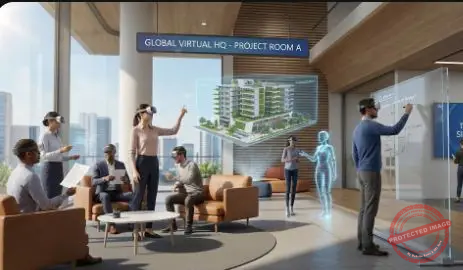
Extended reality is reshaping remote work by turning flat video calls into persistent virtual environments. By 2026, many organizations will maintain “virtual headquarters” where distributed teams meet, design, train, and socialize in richly rendered 3D spaces.
From video tiles to shared 3D presence
The limitations of traditional videoconferencing have become painfully clear: grid fatigue, shallow engagement, and weak cues for presence. XR—spanning VR, AR, and MR—is stepping in to provide richer spatial context and shared experiences.
Industry reports show that remote working has become a permanent fixture, with XR increasingly used to host virtual meeting rooms, interactive 3D whiteboards, and digital twins of products, facilities, or entire workspaces. Sapizon Technologies
Platforms such as Microsoft Mesh and Meta’s work-focused environments already allow employees to appear as avatars, interact with spatial content, and co-author ideas in shared 3D spaces. These environments will become more persistent and personalized, functioning as always-on “campuses” that remote workers can enter at any time.
Virtual headquarters as a new center of gravity
In 2026, a typical remote-first company might have an XR headquarters that mirrors a physical office layout including reception areas, project rooms, training spaces, and informal lounges. New hires will be onboarded through immersive tours, meeting not only their human managers but also AI agents that serve as guides, trainers, or context providers.
Design and engineering functions will benefit particularly from these virtual campuses. Teams will gather around life-sized product models, manipulate components in real time, and run simulations together, reducing the friction of sharing screens and static CAD files. XR collaboration platforms already highlight how being “in the room virtually” with context-aware tools can improve remote productivity and creativity. ENGAGE XR
Because these spaces are persistent rather than meeting-based, work can evolve continuously: artifacts remain pinned to virtual walls; project rooms hold the latest prototypes and documentation; and AI agents maintain an up-to-date narrative of what changed since each employee’s last visit.
Training, coaching, and frontline support with XR
Extended reality is also transforming training for both knowledge workers and frontline staff. Immersive simulations allow employees to practice complex procedures, crisis responses, or customer interactions in a safe, repeatable environment.
Remote technicians, for example, may wear AR headsets in the field while an expert or AI guide in a virtual command center sees what they see and overlays contextual instructions onto the physical environment. In manufacturing and industrial settings, XR-based training has been shown to reduce errors and accelerate skill acquisition compared with traditional methods, especially when combined with AI-driven adaptive scenarios. Medium
For distributed organizations, this means high-quality training no longer requires travel or co-location. XR will make it possible to deliver consistent, high-fidelity learning experiences across continents.
The hardware and network race
To support everyday XR for remote work, hardware must become lighter, more comfortable, and more affordable. The 2025–2026 device cycle is focused on mixed-reality headsets that can switch between immersive VR and passthrough AR modes, reducing the sense of isolation that earlier VR-only headsets created.
At the same time, network demands are rising. Persistent XR workspaces and digital twins require high bandwidth and low latency. This is driving deeper integration between XR platforms and edge-enabled, hybrid cloud architectures that offload rendering and simulation tasks closer to the user. STL Partners
For knowledge workers with limited connectivity, XR applications will increasingly support “foveated streaming” and dynamic quality scaling, focusing graphical fidelity where the user is looking while compressing less important areas to conserve bandwidth.
Ethics, inclusion, and accessibility in virtual offices
As XR becomes central to remote work, organizations must address inclusion and accessibility. Employees with motion sensitivity, visual impairments, or limited access to hardware cannot be excluded from critical collaboration simply because it has moved into immersive environments.
Designing accessible XR workflows involves offering non-immersive access modes (such as 2D desktop clients), tuning locomotion settings, and providing captioning and real-time translation within virtual environments. It also requires thoughtful policies on avatar representation, virtual behavior, and psychological safety.
Privacy is another frontier. XR collaboration tools capture fine-grained behavioral and biometric data—from eye movements to body posture—that could be misused if not carefully governed. Remote-first organizations will need clear data-use policies and robust security controls to prevent surveillance creep in virtual offices.
Closing thoughts and looking forward
By 2026, extended reality will no longer be a futuristic perk; it will underpin how remote teams collaborate, learn, and build culture. Persistent virtual headquarters will give distributed organizations a shared sense of place, immersive training will level up skills across geographies, and mixed-reality workspaces will blur the boundaries between physical and digital collaboration.
The organizations that succeed will be those that treat XR as an integrated part of their remote operating model, not a siloed experiment. That means tying XR platforms into AI agents, hybrid cloud, and security architectures, while also designing for inclusion, accessibility, and trust. Done well, XR can make remote work not just possible, but meaningfully better than being in the same room.
Co-Editors:
Dan Ray, Remote Technologies, Montreal, Quebec.
Peter Jonathan Wilcheck, Co-Editor, Miami, Florida.
References
The Future of XR: Key Trends Shaping Digital Reality in 2025 – Sapizon – https://sapizon.com/the-future-of-xr-key-trends-shaping-digital-reality-in-2025/
Virtual and Mixed Reality at Work: New Forms of Remote Collaboration – Invelon – https://invelon.com/en/virtual_and_mixed_reality_at_work/
The Future of Remote Collaboration – ENGAGE – https://engagevr.io/the-future-of-remote-collaboration/
Extended Reality (XR) in the Workplace: Redefining How We Work, Learn, and Collaborate – Medium / Tech Intelligence Series – https://medium.com/%40Nish_singh/extended-reality-xr-in-the-workplace-redefining-how-we-work-learn-and-collaborate-ffee1a6cf3af
Extended Reality in Business: Transforming Industries and Experiences in 2026 – Flam – https://flamapp.ai/blog/extended-reality-in-business-in-2026
#RemoteTechnologies #ExtendedReality #XRWorkspaces #VirtualHeadquarters #RemoteCollaboration #VRARMR #ImmersiveTraining #DigitalTwins #HybridWork #FutureOfOffices
Post Disclaimer
The information provided in our posts or blogs are for educational and informative purposes only. We do not guarantee the accuracy, completeness or suitability of the information. We do not provide financial or investment advice. Readers should always seek professional advice before making any financial or investment decisions based on the information provided in our content. We will not be held responsible for any losses, damages or consequences that may arise from relying on the information provided in our content.

 AAPL
AAPL AMD
AMD CIS.HA
 DELL
DELL IBM
IBM INTC
INTC MSFT
MSFT GOOG
GOOG HPE
HPE NVDA
NVDA TSLA
TSLA TMC
TMC MSI
MSI NOK
NOK ECDH26.CME
 OPEAZZX