


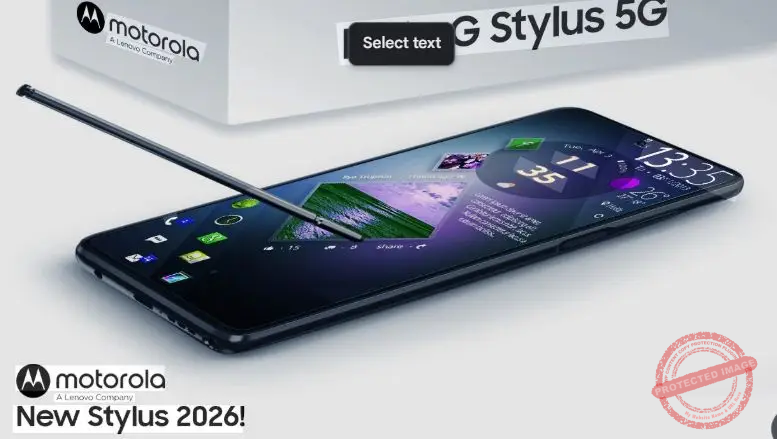
Blending premium design, practical intelligence, and a built-in stylus, Motorola’s Moto G Stylus 2026 redefines what mid-range mobility can be—delivering creativity and control at a price that undercuts the flagship establishment.
In 2026, Motorola is once again positioning itself as the brand that democratizes design. Following the success of its AI-driven flagship portfolio, the company’s Moto G Stylus 2026 arrives as a carefully tuned statement: high-end creativity and craftsmanship should be accessible to everyone. The device bridges two worlds—affordable practicality and aspirational sophistication—marking a return to Motorola’s founding principle that innovation should serve human expression, not corporate exclusivity.
The stylus phone segment—once a niche—has evolved into a creative productivity category in its own right. As consumers seek tools that help them ideate, annotate, and communicate visually, the Moto G Stylus 2026 embraces this shift with understated confidence. It’s not a flagship killer; it’s a flagship equalizer, giving students, artists, and small-business owners the same creative flexibility once reserved for luxury devices.
Affordable Premium — The Value Angle
Luxury Experiences Without Luxury Pricing
At the center of Motorola’s marketing narrative lies a bold proposition: that refinement, durability, and technology sophistication no longer require a four-figure investment. The Moto G Stylus 2026 embodies what Motorola calls “affordable premium”—the fusion of flagship essentials into a $399 package. A 120-Hz OLED display, vegan eco-leather finish, and AI-driven camera pipeline elevate the experience beyond expectations for its price point.
Internally, the device runs on Qualcomm’s Snapdragon 6 Gen 4 platform with optimized thermal efficiency and on-device machine-learning support. While the numbers won’t rival flagships, Motorola’s tuning emphasizes fluidity and endurance over synthetic benchmarks. The result is a smartphone that feels premium in daily interaction even if it costs half as much. As Motorola’s VP of Product Design notes, “Value is no longer defined by price—it’s defined by purpose.”
Externally, the stylus itself is central to this value story. In previous generations, the Moto G Stylus series offered a basic input tool; the 2026 iteration transforms it into a precision instrument. With improved pressure sensitivity, lower latency, and AI-assisted stroke correction, the stylus bridges the gap between casual note-taking and professional-grade sketching. By embedding creativity into its core value proposition, Motorola reframes affordability as an enabler of expression, not a limitation of performance.
The Creative’s Essential Tool
Empowering Everyday Imagination
Motorola’s campaign for the Moto G Stylus 2026 leans heavily on its creative identity. Advertising imagery shows the device not as a phone but as a canvas—a portal for ideas in motion. The company has positioned the stylus as “the simplest creative interface ever built into a phone.” For students, it means instant annotations and mathematical sketches on lecture notes. For artists and designers, pressure-sensitive drawing modes enable concept drafting on the go. For entrepreneurs, it becomes a productivity companion for signing PDFs or marking documents without touching a keyboard.
The software integration extends beyond basic apps. Motorola’s AI Notes Suite 2026 recognizes handwriting in real time, converting it into editable text and syncing automatically across Motorola’s cloud workspace. A new feature called “Gesture Intelligence” allows users to trigger shortcuts by drawing symbols on screen—an innovation that combines gesture control with creative freedom. Whether brainstorming storyboards or color-coding task lists, the Moto G Stylus 2026 positions the stylus as a gateway to productivity that feels as natural as pen and paper.
Crucially, Motorola’s decision to retain an integrated slot for the stylus reinforces its commitment to convenience. Unlike separate stylus accessories that are easy to misplace or require charging, the G Stylus approach keeps creative capability literally within reach. This pragmatism is a hallmark of Motorola’s design ethos: engineering that disappears into usefulness.
Tactile and Stylish Design
Form Meets Function, with Feeling
Motorola’s 2026 design language builds on the sensory minimalism introduced in its flagship series, but the Moto G Stylus 2026 gives that approach an attainable form. The device features a seamless back panel wrapped in textured eco-leather—a sustainable material engineered from recycled plant polymers that mimics the softness of fine-grain leather while remaining highly resistant to wear and moisture. This tactile finish delivers two advantages: superior grip and visual sophistication. It resists fingerprints, diffuses light subtly, and feels remarkably premium in the hand.
The aesthetic palette follows a modern-luxury direction, with colorways like “Graphite Gray” and “Lavender Mist,” hues designed to appeal to both professional and lifestyle users. Metallic accents around the camera array and stylus chamber add a touch of refinement, while the polished aluminum frame underscores structural integrity without excess weight. In a segment where most devices settle for glossy plastic shells, Motorola’s focus on sensory detail creates emotional value. The design tells a story of confidence and subtle individuality.
Beyond appearance, Motorola engineers have reimagined the ergonomics of the stylus experience. The lower curvature of the device is now contoured to guide the stylus naturally into its housing, while a new magnetic retention mechanism ensures durability over time. The result is effortless insertion and removal—an interaction that reinforces Motorola’s design philosophy that beauty should emerge from simplicity.
Reliable and Practical Performance
Dependability as a Design Principle
In a market increasingly obsessed with superlatives, Motorola’s Moto G Stylus 2026 is intentionally pragmatic. It doesn’t aim to break benchmarks—it aims to sustain experiences. Powered by Qualcomm’s Snapdragon 6 Gen 4 processor, paired with 8GB of RAM and 256GB of expandable storage, the device offers stable performance for multitasking, light creative work, and extended productivity sessions. Motorola’s software optimization layer, derived from the company’s lightweight My UX interface, ensures smooth operation without unnecessary background clutter.
The battery system reflects the same practical intelligence. A 5,000mAh cell paired with adaptive power distribution algorithms provides up to two full days of mixed use, even with frequent stylus engagement and display-on time. Fast-charging technology—now 45W via USB-C—means users can recover half the battery in under 30 minutes. The Moto G Stylus 2026 also retains legacy conveniences that many flagship devices have abandoned: a 3.5mm headphone jack, microSD expansion, and IP68 dust and water resistance. Each is an intentional design decision aimed at reliability, not cost-cutting.
Camera performance has also matured in this generation. A dual-lens setup, led by a 50MP primary sensor with optical image stabilization, is supported by Motorola’s AI-driven SceneIQ algorithm for adaptive color balance and low-light clarity. While not designed to compete with flagship camera arrays, the system consistently delivers clean, balanced images—a reflection of Motorola’s philosophy that usability trumps megapixels. In short, the Moto G Stylus 2026 offers competence without compromise.
Seamless Integration with the Motorola Ecosystem
Smart Connections, Simplified Living
The final layer of Motorola’s 2026 stylus story is connectivity. The Moto G Stylus integrates natively with the broader Motorola ecosystem, extending functionality through intelligent accessories and cross-device services. The most notable is its compatibility with the new Moto Tag 2 tracker, designed for asset tracking within Motorola’s Find My Device framework. Users can manage tags, wearables, and even Lenovo tablets from a unified dashboard—an approach that mirrors Apple’s ecosystem integration but maintains platform openness.
Motorola’s AI Synchrony framework also allows seamless workflow transitions between devices. Notes created with the stylus on the Moto G Stylus 2026 can instantly appear on a paired Lenovo laptop or tablet through the Moto Flow app, while the company’s Edge Display Link system lets users mirror their phone screen onto larger displays for sketching or editing. These features transform the Moto G Stylus from a budget creative tool into a modular part of a larger productivity ecosystem.
By focusing on interoperability and simplicity, Motorola reinforces its image as a brand that respects the user’s freedom of choice. In 2026, that distinction matters more than ever in a landscape crowded with closed ecosystems and proprietary limits.
Future Outlook
The Democratization of Creative Mobility
As Motorola extends its creative ecosystem, the Moto G Stylus 2026 marks a turning point in how mid-range devices influence the broader smartphone industry. Historically, stylus-equipped phones have existed as niche products—either too expensive to attract mass buyers or too limited to appeal to professionals. Motorola’s 2026 strategy changes that equation. By combining accessible pricing with meaningful functionality, the company is reshaping expectations of what creativity on a smartphone can look like.
Market analysts predict that the Moto G Stylus 2026 will play a key role in expanding Motorola’s share in the sub-$500 premium segment—a category projected to grow 22% year-over-year, driven by consumers who prioritize experience over specification sheets. Its success will not come from competing head-to-head with flagship models but from redefining what value feels like. The device’s tactile finish, capable stylus, and ecosystem integration create an emotional connection typically absent at this price point.
In many ways, the G Stylus 2026 embodies Motorola’s broader brand evolution. The company has embraced a hybrid identity—engineering precision paired with human warmth. This design philosophy has made it increasingly relevant in an industry often criticized for sterile minimalism. While competitors chase spectacle, Motorola focuses on resonance. Its devices are not just smart—they are relatable.
The Broader Strategy
From Products to Personality
Motorola’s creative strategy in 2026 is less about product diversification and more about emotional diversification. Every launch—from the Razr Ultra to the Stylus 2026—builds a narrative of individuality, utility, and authenticity. The company’s campaigns emphasize lifestyle storytelling over technical specification, using imagery that centers human creativity rather than product hero shots. This approach resonates deeply with digital natives seeking tools that align with their sense of identity and purpose.
In practical terms, Motorola’s emphasis on modular ecosystems and software longevity reinforces long-term engagement. The Moto G Stylus 2026 is guaranteed three years of OS updates and four years of security patches—a commitment that extends the device’s lifespan and reduces electronic waste. This forward-thinking support model reflects the company’s commitment to sustainability and consumer trust, ensuring that affordability does not come at the cost of responsibility.
2027 and Beyond
Creativity Without Barriers
Looking toward 2027, Motorola is expected to double down on cross-device creativity. Leaks suggest a new “Moto Creative Hub” app suite under development, integrating cloud-based sketch collaboration, digital journaling, and AI-enhanced note management. For G Stylus users, this could transform the device into a central creative hub across Lenovo PCs, tablets, and wearables. It’s a vision of creativity without boundaries—where ideas move freely, and inspiration becomes a continuous experience.
In a market where most mid-tier phones compete on incremental specs, Motorola’s approach is strikingly philosophical. The G Stylus 2026 isn’t trying to win on power alone—it’s winning on meaning. By redefining what accessible creativity feels like, Motorola has done more than build another stylus phone; it has built a gateway to expression. And in 2026, that might just be the smartest feature of all.
References
Counterpoint Technology Market Research, 2026 — Mid-Tier Smartphone Trends and Growth Outlook. https://www.counterpointresearch.com
Lenovo Environmental Innovation Report 2026 — Sustainable Materials and Design Integration. https://www.lenovo.com
IDC Global Mobile Device Tracker Q3 2026 — Sub-$500 Premium Device Growth. https://www.idc.com
Motorola Mobility Product White Paper, 2026 — Moto G Stylus Development Overview. https://www.motorola.com
McKinsey Consumer Electronics Review 2027 — Redefining Value in Mid-Tier Smartphones. https://www.mckinsey.com
Dan Ray, Co-Editor, Montreal, Quebec.
Peter Jonathan Wilcheck, Co-Editor, Miami, Florida.
#Motorola #MotoGStylus #AffordablePremium #CreativeTechnology #MobileDesign #StylusPhone #ProductivityOnTheGo #SustainableTech #MidRangeInnovation #Motorola2026
Post Disclaimer
The information provided in our posts or blogs are for educational and informative purposes only. We do not guarantee the accuracy, completeness or suitability of the information. We do not provide financial or investment advice. Readers should always seek professional advice before making any financial or investment decisions based on the information provided in our content. We will not be held responsible for any losses, damages or consequences that may arise from relying on the information provided in our content.

 AAPL
AAPL AMD
AMD CIS.HA
 DELL
DELL IBM
IBM INTC
INTC MSFT
MSFT GOOG
GOOG HPE
HPE NVDA
NVDA TSLA
TSLA TMC
TMC MSI
MSI NOK
NOK OPEAZZX