


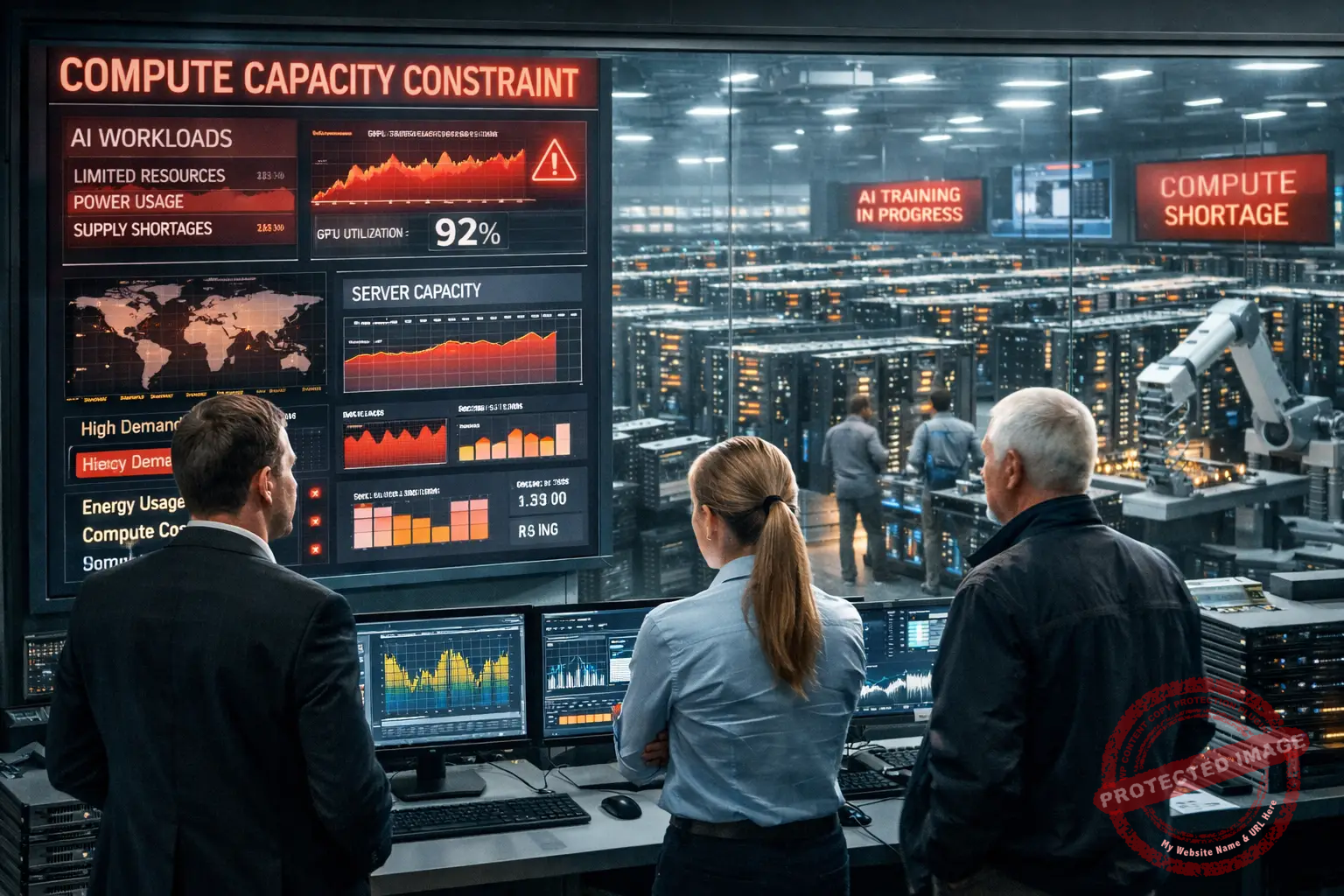
By 2026, computing power is no longer a background infrastructure concern but a strategic limiter that shapes what artificial intelligence, analytics, and digital services organizations can realistically deploy at scale.
The moment computing power stopped being invisible
For much of the cloud era, computing power was treated as an abstract utility. Enterprises assumed that if workloads grew, capacity would scale elastically and costs would be optimized later. That assumption is breaking down as organizations enter 2026. Artificial intelligence workloads, particularly large-scale training, inference, and simulation, have pushed compute demand beyond the steady curves that traditional capacity planning models were built to handle. What was once a procurement line item is now a board-level constraint shaping product roadmaps, security architectures, and even geographic expansion plans.
The shift is not purely technical. It reflects a broader reality that computing power has become a finite strategic resource, subject to supply chains, geopolitical pressures, energy availability, and workforce specialization. Organizations planning AI initiatives in 2026 must now consider whether sufficient compute exists to support those ambitions, and at what opportunity cost.
Why AI changed the economics of compute
Artificial intelligence did not simply increase compute demand; it altered its profile. Traditional enterprise applications were characterized by predictable usage patterns and modest performance requirements. AI workloads, by contrast, are spiky, parallel, and extremely resource-intensive. Training modern models consumes massive amounts of accelerated compute, while inference workloads demand low-latency performance at scale.
By 2026, most enterprises are not training foundational models, but they are fine-tuning, embedding, and operating AI systems that rely on underlying compute-intensive infrastructure. Even modest deployments can drive sustained utilization of specialized hardware. The result is that compute consumption no longer maps cleanly to business growth. A single successful AI feature can double infrastructure demand without a corresponding increase in revenue, forcing organizations to rethink return-on-investment models.
From cloud abundance to constrained planning
The public cloud promised infinite capacity, but 2026 planning cycles reveal practical limits. Hyperscale providers continue to invest aggressively, yet demand from AI, high-performance analytics, and national research initiatives often outpaces supply in specific regions or for specific hardware classes. Enterprises are encountering allocation delays, pricing volatility, and contract terms that prioritize long-term commitments over on-demand flexibility.
This environment pushes organizations toward more deliberate compute strategies. Rather than assuming capacity will always be available, CIOs and CTOs are modeling scenarios where compute scarcity affects deployment timelines. Procurement teams are being asked to secure multi-year capacity agreements, while architects design systems that can degrade gracefully when resources are constrained.
Specialized hardware reshapes enterprise architecture
By 2026, general-purpose processors are no longer sufficient for many AI-driven workloads. Accelerators, including GPUs and purpose-built AI chips, have become central to performance planning. This shift introduces complexity at every layer of the stack. Software must be optimized to take advantage of parallelism, while infrastructure teams manage heterogeneous environments with varying performance characteristics.
The operational implications are significant. Monitoring, capacity forecasting, and incident response all become more complex when workloads span multiple hardware types. Organizations that invested early in abstraction layers and workload portability are better positioned, while those with tightly coupled architectures face higher transition costs.
Energy and sustainability enter the compute conversation
Computing power in 2026 cannot be separated from energy considerations. AI workloads are energy-intensive, and as enterprises scale usage, power availability and efficiency become binding constraints. Data center operators are increasingly transparent about energy sourcing, cooling technologies, and regional power limitations, all of which influence where compute can be deployed.
For enterprises with sustainability commitments, the tension is acute. Leaders must balance the business value of AI initiatives against carbon targets and regulatory expectations. This is driving interest in workload scheduling that aligns compute usage with renewable energy availability, as well as investments in more efficient algorithms and hardware.
Security implications of compute concentration
As compute becomes more valuable, it also becomes a more attractive target. Concentrated pools of high-performance computing resources represent significant risk if compromised. By 2026, security teams are treating compute infrastructure itself as a critical asset requiring enhanced protection.
This includes stricter access controls for AI development environments, more granular monitoring of resource usage, and closer collaboration between infrastructure and security teams. Misuse of compute, whether through insider threats or external compromise, can have immediate financial and reputational consequences.
Public sector and national competitiveness
Governments are acutely aware that computing power underpins economic and strategic competitiveness. By 2026, public sector investments in national compute infrastructure are shaping market dynamics. Research institutions, startups, and enterprises alike are competing for access to publicly funded resources, often with policy-driven allocation criteria.
For enterprises operating in regulated industries or across borders, this introduces additional complexity. Data sovereignty requirements may dictate where compute can reside, while participation in public compute programs may come with compliance obligations. Navigating this landscape requires not only technical expertise but also regulatory awareness.
Talent scarcity and operational maturity
The human dimension of computing power is often underestimated. By 2026, skilled professionals who understand how to optimize AI workloads for performance and cost are in short supply. Organizations that treat compute as a strategic capability invest in training, tooling, and cross-functional teams that bridge infrastructure and application development.
Operational maturity becomes a differentiator. Enterprises with disciplined workload management, cost attribution, and performance optimization can extract more value from limited compute resources. Those without such practices risk spiraling costs and stalled initiatives.
Measuring value in a compute-constrained world
In 2026, success is not defined by raw compute consumption but by outcomes achieved per unit of compute. This shift forces organizations to adopt more sophisticated metrics that tie infrastructure usage to business results. Projects are evaluated not only on technical feasibility but on their efficiency and scalability under realistic capacity constraints.
This perspective encourages experimentation with smaller models, hybrid architectures, and edge processing where appropriate. It also fosters collaboration between business leaders and technologists, aligning expectations around what is feasible within available compute budgets.
Closing Thoughts and Looking Forward
As 2026 unfolds, computing power stands at the center of enterprise strategy rather than behind the scenes. Organizations that acknowledge its constraints and plan accordingly will be better positioned to deploy AI and advanced analytics responsibly and effectively. Those that cling to outdated assumptions of infinite capacity risk costly delays and missed opportunities. Looking forward, the winners will be those who treat computing power as a managed strategic asset, balancing ambition with realism in a landscape defined by finite resources.
References
The AI Hardware Crunch Is Just Getting Started. MIT Technology Review. https://www.technologyreview.com/2024/10/18/ai-hardware-crunch/
Why Data Center Power Is Becoming a Global Bottleneck. The Wall Street Journal. https://www.wsj.com/tech/data-centers-power-bottleneck-2024
The Economics of AI Compute in the Cloud Era. Harvard Business Review. https://hbr.org/2024/09/the-economics-of-ai-compute
Global Demand for Accelerated Computing. McKinsey & Company. https://www.mckinsey.com/industries/technology-media-and-telecommunications/our-insights/accelerated-computing-demand
Energy Use and Sustainability in AI Infrastructure. International Energy Agency. https://www.iea.org/reports/energy-and-ai
Dan Ray, Co-Editor, Montreal, Quebec.
Peter Jonathan Wilcheck, Co-Editor, Miami, Florida.
#ComputingPower, #EnterpriseAI, #AIInfrastructure, #CloudStrategy, #DataCenters, #DigitalTransformation, #TechLeadership, #FutureOfIT, #AIAdoption, #2026Technology
Post Disclaimer
The information provided in our posts or blogs are for educational and informative purposes only. We do not guarantee the accuracy, completeness or suitability of the information. We do not provide financial or investment advice. Readers should always seek professional advice before making any financial or investment decisions based on the information provided in our content. We will not be held responsible for any losses, damages or consequences that may arise from relying on the information provided in our content.

 AAPL
AAPL AMD
AMD CIS.HA
 DELL
DELL IBM
IBM INTC
INTC MSFT
MSFT GOOG
GOOG HPE
HPE NVDA
NVDA TSLA
TSLA TMC
TMC MSI
MSI NOK
NOK OPEAZZX