


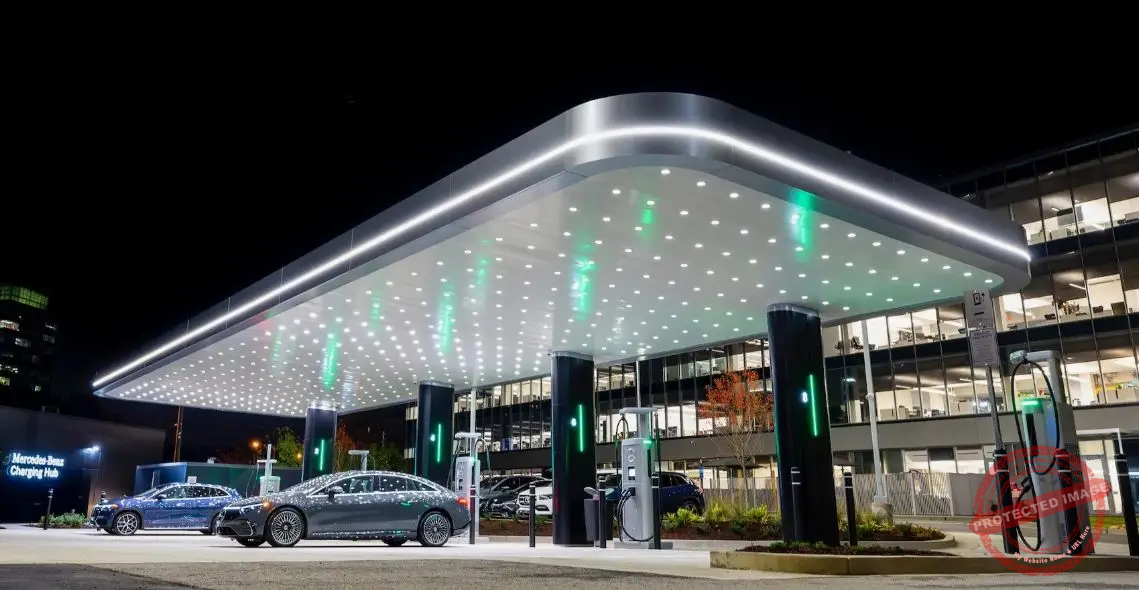
The idea of charging an EV simply by parking over a pad has long captured the imagination of drivers and city planners. By 2026, wireless charging will remain a minority of total EV energy delivered. Still, it is poised to become a mainstream option for home garages, taxi ranks, depots, and select public streets. Inductive systems embedded in pavement or mounted on parking surfaces remove cables, reduce clutter, and open new models for automated fleets.
How wireless (inductive) charging works
Wireless charging relies on electromagnetic induction between two coils: one buried or mounted in the ground and the other attached to the vehicle. When the system is activated, alternating current in the ground coil generates a magnetic field that induces current in the vehicle coil, which is then converted to DC and used to charge the battery.
Recent industry surveys describe wireless EV charging as moving toward higher efficiency, often in the mid- to high-90 percent range at realistic alignments, closing the gap with conventional plug-in systems. QuikRev Standardization efforts aim to ensure interoperability between vehicles and pads, so that a taxi equipped with a receiver could charge at any compatible curbside bay or depot.
Static wireless charging in homes and depots
The first wave of wireless deployments focuses on static charging: vehicles parked in a fixed spot for a defined period. Residential systems promise cable-free garages where drivers park over a pad and walk away. For public depots and fleets, wireless pads reduce the risk of damaged connectors and allow automated or robotic parking systems to handle vehicles without human intervention.
Wireless charging is particularly attractive for fleets of taxis, ride-hailing vehicles and autonomous shuttles that cycle through short dwell times throughout the day. Instead of plugging in manually for each stop, vehicles can pick up small bursts of energy during queues at ranks or while waiting at designated stops, smoothing their state of charge and reducing the need for long, dedicated fast-charging breaks.
Public pilots and wireless streets
Cities and transportation departments are experimenting with installing inductive pads in public streets. In Detroit, for example, a quarter-mile segment of 14th Street has been equipped with wireless charging coils that charge vehicles as they drive over the roadway at low speeds, marking one of the first real-world uses of such technology in the United States. Michigan
While most near-term applications focus on parked or slowly moving vehicles, these projects create the engineering and regulatory templates for more ambitious dynamic charging corridors. Municipalities must tackle questions about safety, electromagnetic exposure, maintenance responsibilities, and how to bill drivers who receive power automatically while parked on a city street.
Technical and economic challenges
Despite its elegance, wireless charging faces significant headwinds. Installation costs for in-ground pads can be high, particularly when streets must be dug up and resurfaced. Precision alignment systems add cost to vehicles, and performance can degrade if drivers park too far off-center. In snowy or debris-prone environments, keeping the pad clear is an ongoing challenge.
Several studies and pilots note that the business case improves in high-utilization, professional settings such as bus depots or logistics hubs, where reduced wear on connectors and labor savings from automated operation offset higher capital expenditure. Pulse Energy For private homes, wireless charging may remain a premium convenience feature, appealing particularly to drivers with accessibility needs or design-conscious garages.
Integrating wireless charging into smart energy systems
Wireless charging does not exist in a vacuum. The same smart energy management platforms being developed for cabled chargers can also orchestrate wireless pads. Fleet operators can control when pads are energized, which vehicles receive priority, and how energy flows are coordinated with on-site solar and stationary batteries. Advanced platforms already highlight the importance of optimizing grid connections, renewable inputs and local storage to meet EV demand while reducing costs. Driivz
Standard protocols and real-time data will be critical. For example, taxi cooperatives or robotaxi operators may wish to expose their wireless charging schedules to mobility platforms, allowing congestion pricing or booking systems to steer vehicles to less-loaded bays. In the long run, wireless pads embedded in public infrastructure could become part of broader digital twins of city energy systems, feeding into forecasts and simulations.
Closing thoughts and looking forward
By 2026, wireless EV charging will still represent a small slice of the global charging pie, but it will be significantly more visible than today. Home systems will appeal to convenience-focused early adopters, while depots and professional fleets will pilot large-scale deployments where automation and reduced hardware wear justify the investment. Public wireless streets will remain experimental, but they will lay the groundwork for dynamic corridors and inform new urban design standards.
The success of wireless charging will hinge on interoperability, cost reduction, and clear value propositions beyond novelty. If suppliers can standardize hardware, simplify installation and prove long-term reliability, the idea of simply parking and letting invisible fields refill the battery will become less science fiction and more everyday routine. In that world, the EV charging experience may finally fade into the background, as seamless and invisible as the Wi-Fi networks that underpin today’s digital lives.
Gut Azzit, Co-Editor EV Charging, Montreal, Quebec.
Peter Jonathan Wilcheck, Co-Editor, Miami, Florida.
References
Reference 1) “Wireless EV Charging 2025: Companies, Costs, Efficiency,” QuikRev, https://quikrev.com/wireless-electric-car-charger/ QuikRev
Reference 2) “Wireless charging for EVs in 2025: a revolutionary guide,” Pulse Energy, https://pulseenergy.io/blog/wireless-charging-for-evs-in-2025-a-revolutionary-guide Pulse Energy
Reference 3) “Wireless Charging Roadway,” Michigan Department of Transportation, https://www.michigan.gov/mdot/travel/mobility/initiatives/wireless-charging-roadway Michigan
Reference 4) “Meeting the Need for Energy with Smart Energy Management for EV Charging Networks,” Driivz, https://driivz.com/wp-content/uploads/2024/09/SmartEnergyManagement-Sept2024.pdf Driivz
Reference 5) “Smart Electric Vehicle Charging Approaches for Demand Response,” Energies (MDPI), https://www.mdpi.com/1996-1073/17/24/6273 MDPI
#EVCharging #WirelessCharging #InductiveCharging #EVFleets #SmartCharging #TaxiCharging #DepotCharging #EVInfrastructure #ElectricMobility #EnergyManagement
Post Disclaimer
The information provided in our posts or blogs are for educational and informative purposes only. We do not guarantee the accuracy, completeness or suitability of the information. We do not provide financial or investment advice. Readers should always seek professional advice before making any financial or investment decisions based on the information provided in our content. We will not be held responsible for any losses, damages or consequences that may arise from relying on the information provided in our content.

 AAPL
AAPL MSFT
MSFT GOOG
GOOG TSLA
TSLA AMD
AMD IBM
IBM TMC
TMC IE
IE INTC
INTC MSI
MSI NOK
NOK DELL
DELL ECDH26.CME