


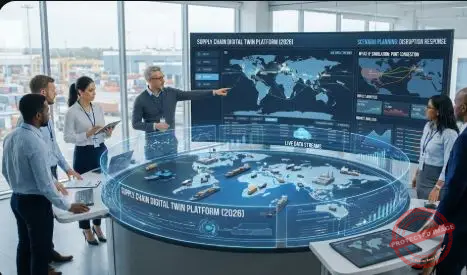
Virtual replicas move from concept slides to real operational decisions
Digital twins promised a lot when the term first entered the supply chain vocabulary: a virtual replica of a network that updates in real time, mirrors physical operations, and allows planners to test “what if” scenarios safely before acting in the real world. In 2026, the technology will finally mature beyond prototypes and marketing demos. Digital twins are becoming an everyday tool for scenario planning, risk management, and continuous optimization.
From digital shadows to true twins
Early projects often conflated dashboards or offline simulation models with digital twins. Academic research has highlighted the importance of distinguishing between simple simulations, digital shadows that passively mirror some data, and full digital twins that continuously synchronize with the physical supply chain and can influence it.ScienceDirect
A true twin ingests real-time data from ERP systems, transportation platforms, IoT sensors, and external sources like weather and market feeds. It then uses this data to maintain a living model of flows, constraints, and capacities. Decisions made in the twin—such as re-routing shipments or changing production schedules—can be executed automatically or sent as recommendations to operating systems.ProvisionAI
Market momentum and integration into platforms
The market for logistics and supply chain digital twins is expanding rapidly. Estimates value the digital twin logistics market at over a billion dollars in the early 2020s, with projected double-digit compound annual growth rates through the next decade as companies seek higher efficiency and agility.ProvisionAI
Major supply chain software vendors have integrated digital twin capabilities into their planning and execution suites. Gartner’s recent outlook suggests that AI-enabled digital twins will help a large share of enterprises shift from reactive to predictive logistics planning in the coming years, underscoring the strategic role of these technologies.Medium
Use cases: from capacity planning to disruption playbooks
The most common twin deployments in 2026 focus on three areas.
First, network design and capacity planning: companies use twins to test facility locations, transportation modes, and inventory policies before committing capital. By simulating peak-season demand, port disruptions, or carrier pricing changes, they can quantify trade-offs in service, cost, and emissions.
Second, operational scenario planning: twins allow planners to experiment with alternate routes, carrier selections, or sourcing decisions for upcoming weeks or months. Rather than relying on static optimization runs, they can iteratively test multiple scenarios and see how KPIs respond.
Third, disruption response: when a plant outage, cyberattack, or weather event hits, a digital twin can serve as the cockpit for exploring mitigation options. Planners can simulate how different actions—ramping up production elsewhere, expediting shipments, reallocating inventory—will impact fill rates and margins before executing them.SCMR+2The Intellify
Data, modeling, and governance challenges
Building an effective twin is not trivial. It requires detailed modeling of processes, lead times, constraints, and cost structures across suppliers, plants, warehouses, and transportation lanes. Inaccurate assumptions or missing data can lead to misleading results.
Organizations are responding by treating twin development as a cross-functional effort involving planners, engineers, IT, and finance. They are investing in data integration, standardizing master data across regions, and establishing governance councils to decide which model assumptions are authoritative. Many start with a limited scope—such as a single region or product family—before scaling to a global representation.ScienceDirect
AI-enhanced twins and logistics “co-pilots”
The frontier in 2026 lies in combining digital twins with AI and optimization algorithms. Instead of manually exploring scenarios, planners can ask AI agents to search the twin for the best combination of levers—capacity adjustments, sourcing changes, and routing options—to achieve specific objectives.25madison.com
In logistics, AI-enabled twins can automatically identify bottlenecks and propose schedule or routing changes. Some organizations are extending this concept to “AI logistics twins,” where predictive models continuously feed into the twin and generate recommended playbooks for recurring disruption categories, from port congestion to raw material shortages.Medium
Measuring ROI and scaling the approach
CFOs understandably want to see clear returns from digital twin investments. Leading adopters report benefits in reduced inventory, increased service levels, and faster time-to-recover during disruptions. The real value, however, often lies in better decisions rather than direct cost savings alone.
To track impact, organizations define KPIs such as forecast accuracy improvements, reduction in stock-out incidents, lead-time variability, and emissions per order served. They compare outcomes for decisions tested in the twin against historical baselines, gradually building a library of proven use cases.The Intellify –
Scaling twins across regions and business units requires careful architecture choices. Some firms favor a unified global twin, while others deploy federated twins that synchronize via shared data models. Whichever approach they choose, governance and change management are as important as the technology itself.
Closing thoughts and looking forward
By 2026, digital twins will sit at the heart of the most sophisticated supply chains, serving as a shared “single source of truth” for planning and operations. The organizations that succeed will not treat twins as static digital replicas but as living systems that evolve with their networks and strategies.
As AI agents become better at exploring enormous scenario spaces, digital twins will help companies navigate not only day-to-day operations but also long-range questions such as reshoring, decarbonization roadmaps, and product portfolio redesign. In a world of constant disruption, the ability to safely rehearse the future may become one of the most valuable capabilities a supply chain organization can possess.
References
Digital Twins in Supply Chain Management: Scope and Challenges – International Journal of Production Economics (ScienceDirect) – https://www.sciencedirect.com/science/article/abs/pii/S0925527325003275 ScienceDirect
The Role of Digital Twins in Modern Supply Chain Optimization – ProvisionAI – https://provisionai.com/digital-twins-in-supply-chain/ ProvisionAI
Digital Twins & Supply Chain Management: ROI, Use Cases and Roadmap – The Intellify – https://theintellify.com/digital-twins-scm-roi-roadmap/ The Intellify –
Using Digital Twins to Master Supply Chain Volatility – Supply Chain Management Review – https://www.scmr.com/article/using-digital-twins-to-master-supply-chain-volatility SCMR
Digital Twins vs. AI Logistics Twins: Which Will Define the Future of Supply Chain Management? – Medium – https://medium.com/%40webelightsolutions/digital-twins-vs-ai-logistics-twins-which-will-define-the-future-of-supply-chain-management-c08a78512abf Medium
Dan Ray, Supply Chain Management, Montreal, Quebec.
Peter Jonathan Wilcheck, Co-Editor, Miami, Florida.
#DigitalTwins #SupplyChainSimulation #ScenarioPlanning #NetworkDesign #RiskManagement #AIAndOptimization #LogisticsTwin #SupplyChainVolatility #ResilientNetworks #PlanningControlTower
Post Disclaimer
The information provided in our posts or blogs are for educational and informative purposes only. We do not guarantee the accuracy, completeness or suitability of the information. We do not provide financial or investment advice. Readers should always seek professional advice before making any financial or investment decisions based on the information provided in our content. We will not be held responsible for any losses, damages or consequences that may arise from relying on the information provided in our content.

 AAPL
AAPL MSFT
MSFT GOOG
GOOG TSLA
TSLA AMD
AMD IBM
IBM TMC
TMC IE
IE INTC
INTC MSI
MSI NOK
NOK DELL
DELL ECDH26.CME