


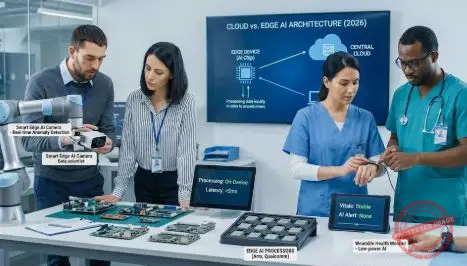
As IoT surges toward more than 21 billion connected devices by the end of 2025, a growing share of the intelligence is moving out of the cloud and into the devices themselves.IoT Analytics Specialized Edge AI chips are transforming sensors, cameras and gateways into self-contained decision makers, able to analyze data in milliseconds without sending every byte back to a distant data center.
Smarter endpoints for a denser IoT world
In traditional IoT architectures, devices collect data and ship it to centralized clouds for processing. That model worked when deployments were smaller, latency requirements were modest and bandwidth was relatively cheap. In 2026, none of those assumptions hold. Networks are clogged with video streams, control loops are tightening in factories and vehicles, and privacy regulations are forcing companies to minimize unnecessary data transfer.
Edge AI chips step into that pressure cooker with dedicated accelerators for neural networks, signal processing and sensor fusion. Instead of streaming a full video feed, a smart camera powered by an Edge AI SoC can identify anomalies, track specific objects and transmit only metadata or short clips for human review. In healthcare, wearable devices with low-power AI processors filter noisy physiological signals on the wrist or chest, sending concise alerts to clinical dashboards rather than raw waveforms.
Chip vendors are racing to make on-device AI more accessible. Arm recently expanded its Flexible Access licensing program to include its latest Armv9 edge AI platform, lowering the barrier for startups and OEMs to design custom chips optimized for on-device inference.Reuters Qualcomm, for its part, is doubling down on the maker and embedded community with its acquisition of Arduino, integrating microcontroller-class boards into a broader edge AI stack and launching a new Arduino Uno Q board built around a Qualcomm CPU.Tom’s Hardware
From microcontrollers to micro data centers
The most striking trend in 2026 is the range of form factors now hosting Edge AI. At one end are tiny microcontrollers with kilobytes of RAM that can still run optimized models for keyword detection, anomaly detection or basic gesture recognition. At the other end are “micro data centers in a box” sitting at cell towers, factory floors or hospital campuses, packing GPUs and NPUs that crunch real-time data from thousands of endpoints.
These layers complement, rather than replace, the cloud. Training still happens in centralized environments, often with synthetic data or federated learning to respect privacy. Once models are trained, they are distilled and quantized to run efficiently on edge devices. Over-the-air update pipelines push new versions to fleets of equipment, turning factories, vehicles, and buildings into continually improving systems.
Latency, bandwidth, and privacy advantages
For many IoT scenarios, the case for Edge AI is straightforward. An autonomous guided vehicle in a warehouse cannot afford the latency of a round trip to the cloud to decide whether to brake. A robotic arm performing quality inspection must detect defects in milliseconds as parts move along the line. A home voice assistant must recognize wake words and basic commands even when the internet connection is spotty.
By doing more on the device, organizations cut bandwidth costs and reduce cloud compute bills. They also simplify compliance with privacy regimes that limit the amount of identifiable data that can be moved off-site. Instead of transmitting images of people, devices can send anonymized features or decisions, keeping sensitive content local unless an incident demands escalation.
Design and lifecycle challenges
Edge AI does not come free. Developers face tight power budgets, limited memory and the need to support devices in the field for a decade or more. Model optimization, hardware-aware neural architecture search, and careful workload partitioning between devices, edge gateways, and the cloud become core skills.
Security is another concern. An AI-enabled camera is not only a potential surveillance tool; it is also a high-value target. Hardware root of trust, secure boot, encrypted model storage and signed OTA updates are becoming standard expectations for Edge AI chip platforms. Industry guidance on zero-trust architectures for IoT increasingly emphasizes authenticated, continuously verified devices, regardless of whether they run AI workloads.Cloud Security Alliance
Healthcare and health management implications
For health management, Edge AI chips are a quiet revolution. Consider a hospital that deploys smart infusion pumps, connected beds, patient-worn sensors, and imaging devices. Edge AI enables each endpoint to detect anomalies immediately: a pump that deviates from its usual pattern, a bed that registers risky patient movements, a sensor that signals early arrhythmias. Rather than flooding central systems with torrents of raw data, the hospital receives prioritized alerts, risk scores and compressed clinical insights.
In community health, low-power wearables and home medical devices can run continuous inference to detect early warning signs of chronic disease exacerbations. That enables earlier interventions without overwhelming clinicians with noise, especially when combined with digital twins of patients or populations that model likely trajectories based on these edge signals.
Closing Thoughts and Looking Forward
By 2026, Edge AI chips will be as fundamental to IoT as wireless radios are today. Their spread is reshaping architectures, business models and even regulatory debates about where intelligence should live. For enterprises in health management and beyond, the strategic question is no longer whether to adopt Edge AI, but how aggressively to redesign products and operations around it. Those who master the art of combining on-device intelligence with robust, secure cloud backends will define the next decade of IoT innovation.
Reference sites:
State of IoT 2025: Number of connected IoT devices growing 14% to 21.1 billion globally – IoT Analytics – https://iot-analytics.com/number-connected-iot-devices/ IoT Analytics
Arm expands AI licensing program to boost on-device AI market share – Reuters – https://www.reuters.com/business/arm-expands-ai-licensing-program-boost-on-device-ai-market-share-2025-10-20/ Reuters
Qualcomm acquires Arduino to make AI development more accessible – Tom’s Hardware – https://www.tomshardware.com/tech-industry/qualcomm-acquires-arduino-to-make-ai-development-more-accessible-microcontroller-makers-hardware-becomes-the-foundation-of-mobile-tech-giants-edge-ai-stack Tom’s Hardware
State of enterprise IoT in 2025: Market recovery, AI integration, and upcoming regulations – IoT Analytics – https://iot-analytics.com/state-of-enterprise-iot-2025-market-recovery-ai-integration-and-upcoming-regulations/ IoT Analytics
How modern enterprises are using IoT data to spur innovation – IBM – https://www.ibm.com/think/insights/how-modern-enterprises-are-using-iot-data-to-spur-innovation IBM
Mark Samuel, Contributor, Health Management, Montreal, Quebec.
Peter Jonathan Wilcheck, Co-Editor, Miami, Florida.
#IoT #EdgeAI #OnDeviceAI #SmartDevices #HealthTech #Wearables #IndustrialIoT #AIChips #RealTimeAnalytics #ConnectedHealth
Post Disclaimer
The information provided in our posts or blogs are for educational and informative purposes only. We do not guarantee the accuracy, completeness or suitability of the information. We do not provide financial or investment advice. Readers should always seek professional advice before making any financial or investment decisions based on the information provided in our content. We will not be held responsible for any losses, damages or consequences that may arise from relying on the information provided in our content.
 AAPL
AAPL MSFT
MSFT GOOG
GOOG TSLA
TSLA AMD
AMD IBM
IBM TMC
TMC IE
IE INTC
INTC MSI
MSI NOK
NOK DELL
DELL ECDH26.CME