


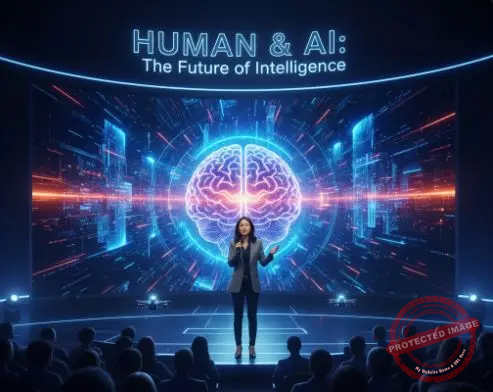
From online micro-courses to AI tutors in hospitals, a new learning era is reshaping careers and classrooms
1. Why Everyone Suddenly Wants to “Learn AI”
If you glance at the most popular online courses of 2024 and 2025, a pattern jumps out: AI is everywhere. Google’s AI Essentials became the single most popular online course of 2024, surpassing the combined enrollments of thousands of new courses on other major platforms, a sign that learners across the world are scrambling to understand and apply AI. Class Central+1
This surge isn’t just a tech fad. Multiple global reports agree on one thing: AI skills are now core economic currency.
-
The World Economic Forum’s Future of Jobs Report 2025 lists AI and big data as the fastest-growing skill categories across industries. World Economic Forum+1
-
LinkedIn’s Workplace Learning Report 2024 finds that people “crave AI skills,” and organizations increasingly see AI training as a top retention and development strategy. LinkedIn Learning
-
A 2025 analysis of AI education demand highlights mastering AI as a “critical competency” across virtually every sector, not just tech. Validated Insights
In other words, learning AI is no longer just for aspiring machine learning engineers—it’s becoming a baseline expectation for everyone from product managers to healthcare leaders.
The challenge now isn’t whether to learn AI, but how: What do people actually need to understand? Where should they start? And how can they learn in ways that are deep and durable, not just superficial buzzword fluency?
2. What “AI Literacy” Really Means
AI literacy is often misunderstood as “knowing how to code neural networks.” In reality, it is a layered capability that looks different depending on who you are and what you do.
At a broad level, a well-rounded AI-literate professional tends to understand:
-
Principles – What AI and machine learning actually are, where the data comes from, how models learn patterns, and why they sometimes fail.
-
Capabilities and limits – What AI can reasonably do today (summarize, classify, generate) and where it is unreliable, biased, or fragile.
-
Applications in context – How AI shows up in their specific domain, whether that is marketing, logistics, health, finance, or education.
-
Ethics and governance – Privacy, bias, explainability, and safety issues around deploying AI at scale.
The Stanford AI Index 2024 emphasizes that AI adoption is growing faster than talent pipelines and governance frameworks, creating a pressing need for broad-based AI understanding—not merely for technical specialists. Stanford HAI+1
That’s why the world’s learning ecosystems are being reshaped around three intertwined learning tracks:
-
Deep technical expertise (AI and ML engineering, data science)
-
Applied AI in domain contexts (healthcare, business, public sector, etc.)
-
Cross-cutting AI literacy for everyone (principles, ethics, prompting, and tool use)
3. Learning Paths for the Technical Track: ML, Data Science, and Beyond
For those who want to build AI systems—machine learning engineers, data scientists, MLOps specialists—the learning journey is intensive but increasingly structured. Reports on the ML engineering market show strong growth: the sector is projected to expand dramatically through 2030, reflecting both rising data volumes and industry demand. 365 Data Science
Most effective technical learning paths share a similar spine:
1. Foundations: Math, Code, and Data
Learners start with:
-
Solid programming skills (usually Python), including working with data libraries like NumPy and pandas.
-
Core math and statistics: linear algebra, probability, optimization, and basic statistical inference.
These foundations remain non-negotiable. Even as tools like AutoML simplify some steps, understanding the underlying math gives engineers the judgment to choose the right models and debug failures.
2. Supervised, Unsupervised, and Deep Learning
Next comes the heart of machine learning:
-
Classical algorithms (regression, trees, clustering, dimensionality reduction)
-
Deep learning architectures (feedforward networks, CNNs, RNNs, transformers)
-
Training, evaluation, and model selection practices
Online platforms like Coursera and others now host high-quality specializations in these areas, often created by companies and universities that are also deploying AI at scale. Coursera+1
3. Systems and MLOps
Real-world AI is not just about models; it is about pipelines and reliability. As a result, technical learners are increasingly expected to understand:
-
Data engineering and pipelines
-
Model deployment, monitoring, and retraining
-
Tools for experiment tracking, reproducibility, and governance
Ironically, one of the best ways to learn all this is by applying AI to the learning process itself: using AI tools to generate code scaffolds, review documentation, and simulate system designs, while still taking responsibility for the final architecture and quality.
4. The Non-Engineer’s AI Learning Journey
The majority of people who need to “learn AI” will never write a line of model code—and that’s fine. Their value lies in combining domain expertise with AI capabilities.
For these professionals—product managers, HR leaders, marketers, operations managers—the learning journey looks different:
1. Conceptual understanding, not derivations
They need a practical grasp of:
-
Differences between rule-based automation, traditional analytics, and modern machine learning
-
How training data shapes behavior and how bias enters systems
-
The meaning of metrics like accuracy, recall, precision, and why they matter in real decisions
2. Tool fluency in context
Non-technical learners focus on what they can do with AI today:
-
Using generative models for content drafting, brainstorming, and translation
-
Leveraging analytics and prediction tools to support decisions
-
Designing workflows where AI agents handle routine steps, and humans handle exceptions and judgment calls
Here, the goal isn’t to learn every model type; it is to learn how to ask better questions, interpret AI outputs, and integrate them intelligently into daily work. That is why AI prompting and agent orchestration are increasingly being taught alongside broader business education.
3. Ethics, compliance, and risk awareness
Because non-technical professionals often sit closer to end-users and customers, they need strong intuition about responsible AI use: where consent, transparency, and human review are non-negotiable, and when an AI system should never be the final decision-maker.
5. AI in Healthcare: A Case Study in Applied Learning
No sector illustrates the AI learning revolution more clearly than healthcare. On one side, AI promises improvements in diagnostics, workflow efficiency, and patient outcomes. On the other, mistakes can be literally life-or-death, and ethical stakes are high.
Medical schools, universities, and professional organizations are scrambling to build specialized AI learning pathways:
-
Harvard Medical School offers an “AI in Health Care: From Strategies to Implementation” executive program that trains health leaders to design and oversee AI projects responsibly. Harvard Medical Continuing Education
-
The Mayo Clinic’s AI Foundations and Applications for Emerging Digital Healthcare Leaders course helps clinicians and administrators understand AI technologies in their professional context. Mayo Executive Education
-
Johns Hopkins University runs an AI in healthcare certificate program focused on applying AI for better patient care and strategic outcomes. JHU Great Learning
-
A systematic review of AI in health education recommends embedding AI training directly into health curricula rather than treating it as an optional add-on. PMC
New initiatives keep appearing. In 2025, Adtalem Global Education and Google Cloud announced a credential program to train healthcare students and professionals to use cloud-based AI tools like Gemini and Vertex AI in clinical settings, explicitly covering ethics, patient safety, and workflow integration. Reuters
What’s striking is that these programs rarely try to turn doctors into machine learning engineers. Instead, they focus on interpretation, governance, and practical integration: how to evaluate AI tools, how to balance algorithmic recommendations with clinical judgment, and how to design workflows where AI reduces burnout instead of adding complexity.
Healthcare is a preview of what will happen in other fields: domain-specific AI learning pathways that blend technical literacy, ethics, and process redesign.
6. Learning With AI: Co-Pilots, Tutors, and Study Partners
A major shift in 2025 is that AI is not just the subject of learning—it is also the medium. AI tutors, copilots, and chat-based assistants are now part of the everyday study experience for millions of learners.
Used thoughtfully, AI can drastically accelerate learning:
-
Explain complex concepts at varying levels of difficulty
-
Generate practice problems, quizzes, or case studies tailored to your field
-
Summarize dense research papers or documentation into digestible notes
-
Role-play as a patient, customer, stakeholder, or interviewer
However, emerging research and student feedback show that how AI is used matters as much as whether it is used. A UK study in 2025 found that while 80% of pupils regularly use AI for schoolwork, over 60% believe it is eroding their ability to study—making tasks “too easy” and discouraging deeper thinking. The Guardian
The difference between AI as a crutch and AI as a coach often comes down to intention:
-
If you ask AI to “write my assignment,” you outsource the thinking.
-
If you ask AI to “generate three different explanations and then quiz me,” you deepen your understanding.
The most effective AI learners adopt a few simple rules:
-
Use AI to clarify, not replace core readings and exercises.
-
Treat AI outputs as drafts or starting points, not authoritative answers.
-
Frequently switch from consuming AI responses to producing your own reasoning, summaries, or solutions.
In other words, they use AI to create more opportunities for active learning, not less.
7. Building a Personal AI Learning Strategy
Given the noise and abundance of resources, a personal strategy helps keep learning focused and sustainable. A simple, realistic approach might look like this:
Step 1: Define your “why” in concrete terms
Instead of “I want to learn AI,” try:
-
“I want to automate reports in my operations role.”
-
“I want to evaluate AI tools my team is buying.”
-
“I want to pivot into entry-level data science within two years.”
A clear purpose narrows down course choices and practice projects. Reports on AI education demand stress that aligning AI learning with real career goals keeps motivation high and avoids “course collection” without application. Validated Insights
Step 2: Mix structured courses with messy real-world practice
Courses give foundations; real projects create depth. For example:
-
Take a foundational AI or ML course, then immediately apply it to a small dataset from your industry.
-
Combine an online data science track with a volunteer project, internship, or internal analytics task at work.
Research on data science and AI career trends shows that hands-on experience—however small—signals capability far more effectively than certificates alone. The JetBrains Blog
Step 3: Schedule micro-learning, not heroic sprints
Most people cannot sustain multi-hour daily study forever. Instead, 30–60 minutes of focused, AI-enabled learning a few times a week—combined with deliberate practice at work—often leads to better outcomes over 6–12 months than short-lived bursts of intensity.
Closing Thoughts and Looking Forward
Learning in the AI era is not about chasing every new tool or model; it is about building an adaptable, AI-aware mindset. The most resilient learners are those who:
-
Understand fundamental AI principles well enough to question and interpret outputs
-
Learn how AI applies in their specific domain, whether that is healthcare, logistics, law, or creative work
-
Use AI as a study partner rather than a shortcut, preserving and strengthening their own capacity for deep thought
Global research suggests that AI will disrupt tens of millions of jobs while creating many more, but those opportunities will flow disproportionately to people and organizations that invest in learning. World Economic Forum The divide is no longer just between those who “know tech” and those who don’t; it is between those who continuously learn with AI and those who treat it as a passing trend.
In this context, learning AI is not a one-time project—it is a career-long habit. The good news is that the tools to learn have never been more accessible: world-class courses, interactive labs, AI tutors, and domain-specific programs are available to anyone with an internet connection and curiosity.
The next few years will be defined by how we use these tools: to dull our effort and outsource our thinking, or to deepen our understanding, sharpen our skills, and design more humane, intelligent systems. If we choose the latter, AI will not just change what we know—it will change how we learn, and by extension, who we can become.
References
-
The Future of Jobs Report 2025
World Economic Forum.
https://www.weforum.org/publications/the-future-of-jobs-report-2025 -
Workplace Learning Report 2024
LinkedIn Learning.
https://learning.linkedin.com/content/dam/me/business/en-us/amp/learning-solutions/images/wlr-2024/LinkedIn-Workplace-Learning-Report-2024.pdf -
The 2024 AI Index Report
Stanford Institute for Human-Centered Artificial Intelligence (HAI).
https://hai.stanford.edu/ai-index/2024-ai-index-report -
The 100 Most Popular Online Courses (2025 Edition)
Class Central.
https://www.classcentral.com/report/most-popular-courses-2025 -
Artificial Intelligence in Health Education and Practice
Shishehgar, S. et al., Journal article via NCBI/PMC.
https://pmc.ncbi.nlm.nih.gov/articles/PMC12183008/
Author: Serge Boudreaux – AI Hardware Technologies, Montreal, Quebec
Co-Editor: Peter Jonathan Wilcheck – Miami, Florida
#AI learning, #AI skills, #machine learning education, #data science training, #AI in healthcare, #AI literacy, #online AI courses, #AI upskilling, #generative #AI tutoring, #future-ready workforce
Post Disclaimer
The information provided in our posts or blogs are for educational and informative purposes only. We do not guarantee the accuracy, completeness or suitability of the information. We do not provide financial or investment advice. Readers should always seek professional advice before making any financial or investment decisions based on the information provided in our content. We will not be held responsible for any losses, damages or consequences that may arise from relying on the information provided in our content.

 AAPL
AAPL MSFT
MSFT GOOG
GOOG TSLA
TSLA AMD
AMD IBM
IBM TMC
TMC IE
IE INTC
INTC MSI
MSI NOK
NOK DELL
DELL ECDH26.CME