


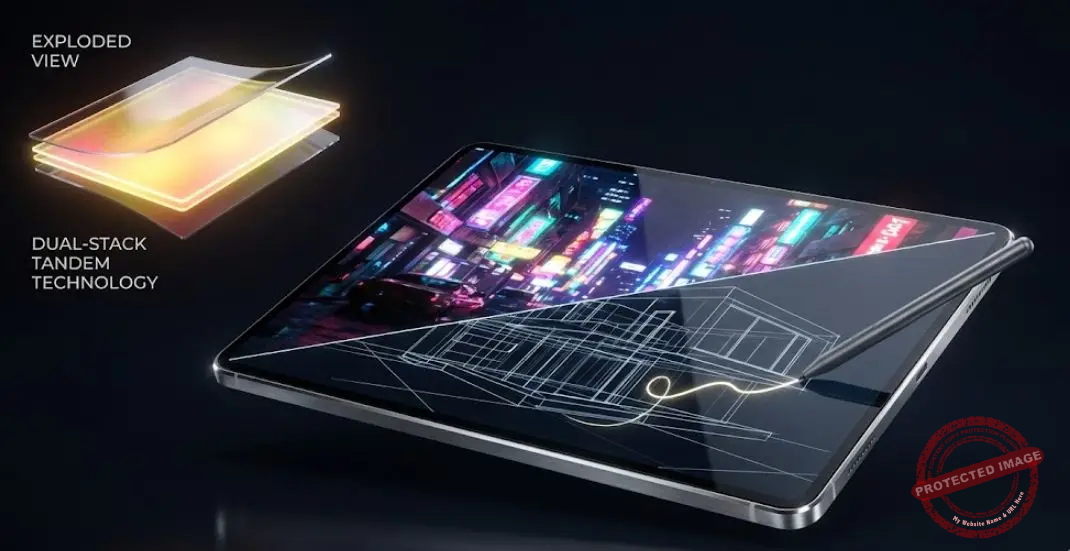
Tablet makers will spend 2026 turning screens into their strongest differentiator, pushing OLED, mini-LED, and tandem OLED panels from the high end into the mid-range and even education fleets. What used to be a laptop-only or TV-class feature set is becoming the new baseline for serious tablets.
Apple’s latest iPad Pro models already show where the industry is headed. The Ultra Retina XDR panel uses tandem OLED – two stacked OLED layers – to hit 1,000 nits full-screen brightness and up to 1,600 nits peak HDR, with a claimed contrast ratio of 2,000,000:1, all in a thinner chassis than the LCD generation it replaces. Apple+2Apple Samsung’s Galaxy Tab line, Lenovo’s OLED 2-in-1 designs and a growing crowd of Chinese OEMs are following suit, turning HDR tablet screens into the norm rather than an upsell.
From workhorse LCD to OLED showpiece
For more than a decade, tablet displays have been constrained by LCD. Panels improved in resolution and color gamut, but black levels, blooming, and HDR performance lagged far behind TVs and high-end laptops. By 2026, this imbalance will be corrected.
Tandem OLED in particular is a genuine inflection point. Early reviews of OLED iPad Pros highlight not just the punchier colors and perfect blacks users expect from OLED, but also the way double-layer construction enables higher sustained brightness without compromising longevity. OTOFLY+2Apple That combination finally makes OLED suitable for productivity in bright offices and retail environments, as well as for outdoor field work where traditional OLED tablets could wash out.
Mini-LED remains important too, especially in larger-format tablets and 2-in-1 PCs. Thousands of individually controlled backlight zones allow LCD-based tablets to approximate OLED’s contrast, while delivering strong peak brightness and reduced risk of burn-in for static UI elements such as toolbars and control panels. For price-sensitive segments like education, a mini-LED LCD panel may be the preferred compromise.
Higher refresh, higher resolution, higher expectations
Display specs are no longer just about pixel density. Tablet customers in 2026 are comparing refresh rates and color workflows the way they once compared CPU cores.
Premium tablets now ship with 120 Hz or adaptive ProMotion-style refresh as standard, making scrolling smoother and stylus input more natural. Apple, Samsung and Lenovo all promote their high-refresh modes as enablers for sketching, note-taking and competitive gaming. Apple Amazon Reference-mode presets, borrowed from professional monitors, let creators trust that what they see on the tablet will match what appears on calibrated studio displays.
Even mid-range 5G tablets sold into business and EDU channels are adopting AMOLED or high-quality IPS displays with wide color gamuts and higher resolutions, often paired with detachable keyboards and pens. A recent business-focused buying guide noted that “affordable premium” tablets now combine Snapdragon processors, AMOLED screens and bundled keyboards at prices that used to buy only basic 10-inch slates. Accio
Creators, gamers, and field workers feel the difference
For creators, the display upgrade wave is transformative. Color-accurate OLED tablets with pen support become viable tools for on-set grading, concept art and mobile photography workflows. A director can preview HDR footage on location, while a designer refines packaging artwork with confidence in the color pipeline.
Gamers benefit from high refresh rates, faster response times and deeper contrast, bringing tablet gaming closer to the feel of handheld consoles. Combined with powerful new SoCs and better cooling, 2026 tablets are finally delivering console-class visuals without tethering to a TV.
In the field, rugged tablets with brighter, more efficient panels and higher contrast are easier to read in sunlight and consume less power over a shift. Even industrial-grade Windows tablets that emphasize durability over aesthetics are starting to adopt higher-resolution IPS or mini-LED for better legibility of complex dashboards and maps. Amazon
Trade-offs: burn-in, repairability, and price pressure
All of this visual luxury comes with challenges. OLED still carries burn-in risk when UI elements are static for long periods, a genuine concern in kiosk, point-of-sale and automotive deployments. Manufacturers are countering with aggressive pixel-shifting, UI design tweaks, and warranty policies, but IT buyers will watch closely to see how these panels age.
Repairability is another sticking point. Ultra-thin OLED tablets with laminated glass and glued batteries can be expensive to service, putting pressure on OEMs to provide extended coverage or modular designs in enterprise-focused models.
Finally, as more brands adopt OLED and mini-LED, price differentiation becomes harder. By late 2026, a “premium” display will be expected even in tablets below $600, squeezing margins unless vendors find other ways to upsell, such as AI features, storage tiers or accessories.
Closing thoughts and looking forward
By 2026, display technology will have become the front line of competition in the tablet market. OLED, mini-LED, and tandem OLED panels reset customer expectations for brightness, contrast, and responsiveness, while setting the stage for even more exotic innovations, such as micro-OLED and mixed-reality sidecar modes.
The next frontier will be how software and services exploit these screens. Expect more HDR-native mobile games, DCI-P3-calibrated creative tools, and streaming tiers explicitly optimized for tablet HDR. As displays approach the limits of human perception, the battle for tablet differentiation will shift deeper into AI-powered experiences, connectivity, and ecosystem integration – but sharp, vivid screens will remain the anchor that makes those advances feel tangible.
Apple unveils stunning new iPad Pro with M4 chip and Apple Pencil Pro – Apple Newsroom – https://www.apple.com/newsroom/2024/05/apple-unveils-stunning-new-ipad-pro-with-m4-chip-and-apple-pencil-pro/
iPad Pro – Apple – https://www.apple.com/ipad-pro/
iPad Pro 2024 vs 2025 — Performance, Design, and Everything You Need to Know – Benks Blog – https://www.benks.com/blogs/benks-blog/ipad-pro-2024-vs-2025-performance-design-and-everything-you-need-to-know
Top Selling 5G Tablets with SIM & Keyboard – Accio Business – https://www.accio.com/business/top-selling-5g-tablet-with-sim-and-keyboard
How to Choose the Best 5G Tablet for Your Needs in 2024 – Alibaba SmartBuy – https://smartbuy.alibaba.com/buyingguides/5g-tablet
Author and Co-Editor:
John Felsen, – Gadgets: Tablets/Notebooks, Montreal, Quebec;
Peter Jonathan Wilcheck, Co-Editor, Miami, Florida.
#Tablets #TabletDisplays #OLED #MiniLED #TandemOLED #iPadPro #GalaxyTab #CreativeWorkflows #GamingTablets #TabletTrends2026
Post Disclaimer
The information provided in our posts or blogs are for educational and informative purposes only. We do not guarantee the accuracy, completeness or suitability of the information. We do not provide financial or investment advice. Readers should always seek professional advice before making any financial or investment decisions based on the information provided in our content. We will not be held responsible for any losses, damages or consequences that may arise from relying on the information provided in our content.

 AAPL
AAPL MSFT
MSFT GOOG
GOOG TSLA
TSLA AMD
AMD IBM
IBM TMC
TMC IE
IE INTC
INTC MSI
MSI NOK
NOK DELL
DELL ECDH26.CME