


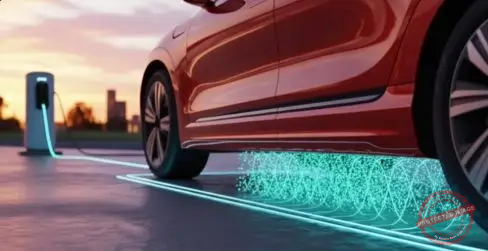
Resonant inductive charging pads, dynamic power roads and grid-aware software are about to change what it means to “plug in” an electric vehicle.
On a frosty winter night in early 2026, a delivery van noses into its depot outside Paris and simply stops over a painted rectangle on the concrete. There is no charge cable to connect, no connector to knock free with a careless boot. As the driver walks away, a pad in the floor wakes up, locks onto a receiver plate under the van using resonant inductive coupling, and begins pushing ten kilowatts of energy across an air gap the size of a fist. A few kilometers away, a stretch of motorway embedded with similar coils quietly tops up electric trucks at highway speeds. Traffic cameras, lane sensors and grid controllers stitch it all together into a single smart system that sees vehicles, chargers and asphalt as one connected organism.
This is the world that standards bodies, startups and infrastructure giants are racing toward as 2026 approaches. The enabling technology is resonant inductive coupling, a refinement of classic inductive charging that lets EVs charge efficiently over larger air gaps and small misalignments while keeping efficiency within striking distance of wired Level 2 chargers. The SAE J2954 standard, which defines wireless power transfer for light duty EVs up to 11 kilowatts and is built explicitly around resonant inductive coupling, reached its latest revision in August 2024 and is now the reference point for automakers planning 2026 model launches. Wikipedia+1
FROM GARAGE PADS TO GLOBAL STANDARDS
Resonant inductive coupling is not a new physics trick, but it has finally been codified in a way that the car industry can build around. J2954 defines wireless power classes WPT 1, 2 and 3, at 3.7, 7.7 and 11 kilowatts respectively, roughly matching Level 2 AC charging. It also sets expectations for efficiency: around eighty five percent end to end, and in some test configurations, higher, even with vertical separations of up to 250 millimeters between ground pad and vehicle receiver. Wikipedia+2ijsred.com+2
The standard goes beyond raw power levels. It specifies how the ground assembly pad and vehicle assembly communicate, using Bluetooth and positioning systems to help drivers (or software) park precisely over the pad. A newer alignment method called the Differential Inductive Positioning System, or DIPS, was added in the 2024 update to let vehicles themselves, including autonomous models, triangulate the pad position and handle the parking without human guesswork. That matters for a future where robotaxis glide into wireless bays on their own, charge, then rejoin the fleet without any cables dragged across sidewalks. Wikipedia+1
Automakers are now moving from pilot programs to real products. Porsche, for example, is preparing to ship an optional 11 kilowatt inductive system with the 2026 Cayenne Electric, using a chunky floor unit and a receiver plate tuned to the new standards. The system uses ultra wideband and a surround view parking display to guide the car into position, then starts charging automatically once the resonant link is locked in. It is one of the first mass market signals that resonant wireless charging is not just a science project but a differentiating feature for premium EVs. TechRadar
STATIC RESONANCE: PARKING BECOMES A POWER ZONE
In the near term, the most visible impact of resonant inductive coupling will be static wireless charging in driveways, garages and parking lots. A resonant pad sunk into the concrete can push power across a gap of eight to twenty five centimeters, enough to tolerate uneven surfaces, snow, ice and misalignment without chewing up efficiency. Bolt Earth+2witricity.com+2 For drivers, it changes the daily habit from “remember to plug in” to “remember to park over the pad,” a much easier behavior to automate with parking assistance, valet robots or simple wheel guides.
Fleet operators see even more upside. In depots where vans or taxis return to the same bay each night, resonant pads eliminate wear on connectors and cables and allow vehicles to start charging the moment they are in place, without waiting for staff to walk the line plugging everything in. Ruggedized pads designed by companies like WiTricity are already rated for outdoor use, all weather exposure and repeated heavy vehicle loads, and can be retrofitted to connect to existing AC or DC infrastructure. witricity.com+1
By 2026, analysts expect these static wireless systems to be where most of the wireless EV charging revenue sits. Market research from several firms pegs the wireless EV charging segment at roughly eighty to one hundred million dollars in 2025, with projections toward half a billion dollars globally by 2030, a compound annual growth rate north of forty percent. wawt.tech+3Mordor Intelligence+3Straits Research+3 The fastest growth is expected in commercial installations, where the combination of convenience, automation and reduced maintenance has a clear payback.
DYNAMIC ROADS: RESONANT COILS UNDER ASPHALT
Static pads, however, are only half the story. The more audacious vision for resonant inductive coupling sits under highway asphalt in the form of dynamic electric road systems. Here, segments of roadway are laced with coils tuned to the same resonant frequency range as vehicle receivers. As cars and trucks drive over them, the system detects the vehicle, energizes the segment and pumps power up into the moving chassis.
In late 2025, a 1.5 kilometer stretch of the A10 motorway near Paris became the highest profile demonstration of that concept. As part of the Charge as You Drive initiative involving Electreon, Gustave Eiffel University and infrastructure group Vinci, the road was fitted with induction coils capable of delivering instantaneous charges of up to 300 kilowatts to vehicles equipped with receivers, with sustained power around 200 kilowatts under steady conditions. THRIVE Project+3TechRadar+3PR Newswire+3 During the pilot, a truck, a van, a passenger car and a coach all took turns topping up while moving at highway speeds, turning the road into a rolling extension of the grid.
For heavy duty trucks and coaches, that kind of dynamic charging could be transformative. If long haul vehicles can pick up meaningful energy every dozen kilometers, they can carry smaller battery packs for the same range, cutting vehicle weight and cost while reducing demand for battery raw materials. Even at lower power levels, dynamic sections placed on steep grades, bottlenecks or crucial freight corridors could offload stress from fast charge hubs and spread energy demand over time. Electreon+1
SMART INFRASTRUCTURE: WHEN CHARGERS TALK TO CITIES
The real shift in 2026 will be when resonant inductive coupling stops being seen as a gadget feature and starts being recognized as a building block of smart infrastructure. Dynamic and static pads are essentially edge devices in a much larger system that includes traffic management, grid control, and city data platforms.
In many pilot projects, wireless charging hardware is tied directly into roadway sensors, traffic lights and cameras. A pad can report whether a bay is occupied, which vehicle is present and how much power it is pulling. Traffic engineers can combine that information with congestion data to decide when to slow vehicles into charging zones or route them to different lanes. Grid operators, in turn, can adjust pad duty cycles and power levels based on real time grid conditions, smoothing spikes in demand from hundreds of vehicles charging at once. Articles on wireless charging and smart infrastructure point to early deployments in Europe, the United States and Asia where charging segments, sensors and communications gear are engineered as one platform rather than bolt ons. wawt.tech+1
Looking ahead to 2026, this integration is where value begins to multiply. A logistics hub might integrate resonant depot pads with its yard management system so that the vehicles that need to leave first always get top charging priority. Municipalities could bundle access to dynamic road segments into congestion pricing schemes, charging fleets more to tap into high power lanes at peak times but less at night, turning the roadway into a flexible energy and revenue instrument instead of just a static asset.
ECONOMICS, PATENTS AND THE RACE TO SCALE
Behind the scenes, a patent and standards race is underway. Wireless EV charging market reports talk about a surge in intellectual property filings for resonant inductive systems, coil topologies, foreign object detection algorithms and interoperability layers, as suppliers jockey for licensing positions. One recent analysis projects the wireless EV charging market passing four billion dollars annually by the mid 2030s, with resonant inductive systems dominating over capacitive or permanent magnet gear approaches. PR Newswire+1
For automakers, the calculus is changing too. Until recently, wireless charging looked like a niche add on for tech enthusiasts. Now it is increasingly seen as part of the broader convenience and automation story. In car wireless charging for phones has already become a standard feature across mid range models, and its own market is expected to quadruple between 2024 and 2033. Grand View Research+1 Translating that expectation to vehicles themselves, especially at premium price points, is an obvious next step.
Cities and utilities, meanwhile, are weighing the long term economics of retrofitting roads and depots. The up front cost of cutting channels, laying coils and backing them with robust power electronics is high, and retrofit projects can be disruptive. But proponents argue that when viewed over decades and spread across many vehicle lifecycles, dynamic and static resonant systems can lower total infrastructure cost by reducing the need for bulky roadside chargers, minimizing street clutter and enabling more flexible use of space. wawt.tech+2wawt.tech+2
EFFICIENCY, SAFETY AND PUBLIC TRUST
No discussion of resonant inductive coupling for EVs is complete without addressing efficiency and safety. Wired DC fast chargers can reach round trip efficiencies above ninety four percent; J2954 class systems are slightly lower, around eighty five percent, thanks to air gaps and coupling losses. Wikipedia+2ijsred.com+2 Critics worry that scaling millions of pads and dynamic segments could add up to significant energy waste. Proponents counter that better alignment, adaptive control, and the reduction of idle fast charger losses will close much of the gap, especially in everyday Level 2 style use cases where convenience matters more than squeezing out every last percentage point of efficiency.
Safety has both electromagnetic and physical dimensions. Resonant inductive systems must meet strict standards for stray fields and thermal performance, ensuring that people, pets and metallic objects are not exposed to harmful conditions. Dynamic roads, in particular, need sophisticated foreign object detection and real time control so that power is only delivered when a compatible vehicle is present and properly aligned. Early reports from the French dynamic road pilot emphasize layered safety mechanisms and continuous monitoring to reassure regulators and the public. TechRadar+2Electrek+2
There is also the softer question of trust. Drivers need to believe that wireless systems will work reliably even in rain, snow and slush, that they will not quietly damage their batteries, and that charging status is as transparent as with a cable. That means user interfaces that clearly show when a resonant link is established, how fast energy is flowing and how much it costs, and that provide clear fallbacks to wired charging when something is wrong.
CLOSING THOUGHTS AND LOOKING FORWARD
By 2026, resonant inductive coupling is unlikely to have erased charge cables from the EV landscape, but it will have redrawn where—and how—those cables are used. The combination of J2954 style static pads in garages and depots, early dynamic road segments on key freight and commuter routes, and integration with smarter city and grid systems will mark a turning point: charging becomes a background service rather than a foreground chore. Automakers like Porsche, infrastructure innovators in France, Sweden, Germany and the United States, and a crowded field of startups all point in the same direction, even if their timelines differ. wawt.tech+3TechRadar+3TechRadar+3
The next decade will decide whether resonant inductive charging remains a premium convenience and a handful of showcase highways, or whether it matures into a foundational layer of smart transport infrastructure. That outcome will depend less on whether the physics works—demos on real roads and in real vehicles show that it does—and more on whether regulators, utilities, cities and automakers can align on who pays, who benefits and how to share the data and energy that flow through these systems. Either way, as 2026 gets underway, the ground under our EVs is literally and figuratively changing, humming softly with resonant fields that promise to make plugging in feel like a relic of the combustion era.
References
SAE / Wikipedia – “SAE J2954 – Wireless power transfer standard for electric vehicles” – https://en.wikipedia.org/wiki/SAE_J2954 Wikipedia+1
TechRadar – “Forget charging stations – this French highway can wirelessly charge EVs faster than Tesla’s Supercharger network” – https://www.techradar.com/vehicle-tech/hybrid-electric-vehicles/forget-charging-stations-this-french-highway-can-wirelessly-charge-evs-faster-than-teslas-supercharger-network TechRadar+1
WAWT.tech – “Powering the Future Highways: Wireless Charging Meets Smart Infrastructure” – https://wawt.tech/2025/11/03/powering-the-future-highways-wireless-charging-meets-smart-infrastructure/ wawt.tech
TechRadar – “Porsche beats Tesla to wireless inductive charging, as Cayenne Electric is first with the tech” – https://www.techradar.com/vehicle-tech/hybrid-electric-vehicles/porsche-beats-tesla-to-wireless-inductive-charging-as-cayenne-electric-is-first-with-the-tech TechRadar
Mordor Intelligence – “Wireless EV Charging Market Size and Share (2025–2030)” – https://www.mordorintelligence.com/industry-reports/global-wireless-charging-market-industry Mordor Intelligence
resonant inductive coupling, wireless EV charging, SAE J2954, dynamic charging roads, electric road systems, smart EV infrastructure, inductive charging pads, autonomous EV charging, smart highways 2026, wireless charging market growth.
Post Disclaimer
The information provided in our posts or blogs are for educational and informative purposes only. We do not guarantee the accuracy, completeness or suitability of the information. We do not provide financial or investment advice. Readers should always seek professional advice before making any financial or investment decisions based on the information provided in our content. We will not be held responsible for any losses, damages or consequences that may arise from relying on the information provided in our content.

 AAPL
AAPL MSFT
MSFT GOOG
GOOG TSLA
TSLA AMD
AMD IBM
IBM TMC
TMC IE
IE INTC
INTC MSI
MSI NOK
NOK DELL
DELL ECDH26.CME