


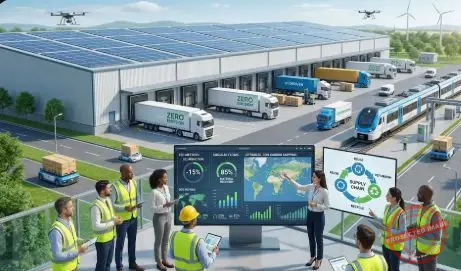
ESG metrics, circular flows, and low-carbon logistics take center stage in 2026
Sustainability has shifted from a corporate social responsibility slide to a hard business requirement. Regulators are tightening disclosure rules, investors scrutinize emissions and human-rights practices, and customers increasingly expect brands to back up green claims with real data. In this environment, supply chain leaders in 2026 are turning to technology to track, reduce, and redesign environmental and social impacts.
ESG pressure reshapes supply chain priorities
Supply chains are responsible for a significant share of many companies’ greenhouse gas emissions, as well as major social and governance risks. Recent analyses highlight how new regulations and stakeholder expectations are forcing organizations to develop more robust ESG strategies specifically focused on procurement, logistics, and supplier management.National Law Review
In response, companies are building sustainability into core supply chain KPIs rather than treating it as an afterthought. Emissions per shipment, route, or product, supplier compliance scores, and waste metrics now sit alongside on-time delivery and cost. Boards expect regular updates on progress toward science-based targets, and investors increasingly reward firms that demonstrate credible decarbonization pathways.National Law Review
Route optimization and mode shifts for lower emissions
Technologies that optimize transportation routes and inventory placement are among the most immediate sustainability levers. Advanced planning and optimization tools can reduce empty miles, identify multimodal options that balance speed with carbon impact, and consolidate loads more effectively.StockIQ Technologies
Real-time visibility data from IoT sensors and telematics provides the input for these models, allowing them to incorporate traffic, congestion, and dwell times. Companies are also using analytics to identify opportunities for mode shifts—from air to sea or from road to rail—when service levels allow, often achieving significant emissions reductions with manageable trade-offs in transit time.Logistics Viewpoints
Circular supply chains and reverse logistics
Linear “take-make-dispose” models are gradually giving way to circular approaches in which materials are reused, refurbished, or recycled. Logistics technology plays a crucial role here, orchestrating reverse flows of products and materials, tracking condition data, and determining the most sustainable disposition options.Logistics Viewpoints
Digital platforms are emerging to manage complex reverse logistics networks, from consumer returns and repair programs to asset recovery and component harvesting. Combined with product design for durability and modularity, these systems enable companies to recover more value from items that would previously have been discarded, while reducing the environmental footprint of new production.Logistics Viewpoints
AI and advanced analytics for sustainable planning
Emerging research demonstrates how advanced machine learning models can be applied directly to sustainability challenges. Techniques such as convolutional neural networks and BiLSTM architectures can optimize inventory and routing decisions to improve both efficiency and sustainability metrics simultaneously.ScienceDirect
AI is also being used to analyze supplier data, ESG reports, and external signals to assess risk and performance. This enables procurement teams to prioritize suppliers that align with environmental and social standards, while identifying hotspots where engagement or diversification may be required. By combining ESG scoring with traditional cost and reliability metrics, organizations can make balanced sourcing decisions that support long-term resilience.National Law Review
Transparency, traceability, and trust
Technologies that enhance transparency—such as IoT, digital twins, and in some cases blockchain—help organizations trace goods from origin to end customer. This level of traceability is essential for verifying claims about sustainable materials, ethical labor practices, and deforestation-free sourcing.StockIQ Technologies
Brands are increasingly communicating this information to consumers through QR codes, digital product passports, or online portals. However, transparency must be underpinned by robust verification and governance; otherwise, companies risk accusations of greenwashing. Third-party audits, standardized reporting frameworks, and independent certifications help validate digital traceability data.National Law Review
Closing thoughts and looking forward
By 2026, sustainability-focused solutions in supply chain management will be central to business strategy rather than peripheral. The most advanced organizations will leverage technology not just to comply with regulations but to differentiate themselves—offering lower-carbon products, more transparent sourcing, and resilient circular models that reduce dependency on virgin materials.
As climate and geopolitical risks intensify, sustainable supply chains will be more robust. Leaders will embed ESG objectives directly into planning algorithms, supplier scorecards, and performance reviews. With regulators tightening rules and stakeholders demanding more, the ability to measure, manage, and continuously reduce supply chain impacts will be a core determinant of competitiveness.
References
ESG and Supply Chains in 2024: Key Trends, Challenges and Future Outlook – National Law Review – https://natlawreview.com/article/esg-and-supply-chains-2024-key-trends-challenges-and-future-outlook National Law Review
2024 Supply Chain ESG Guide – SupplyChainBrain – https://www.supplychainbrain.com/publications/2/editions/28 Supply Chain Brain
Circular Supply Chains: Leveraging Technology for Sustainable Resource Management – Logistics Viewpoints – https://logisticsviewpoints.com/2025/08/04/circular-supply-chains-leveraging-technology-for-sustainable-resource-management/ Logistics Viewpoints
Sustainable Supply Chain Planning: Trends and Innovations – StockIQ – https://stockiqtech.com/blog/sustainable-supply-chain-planning/ StockIQ Technologies
Improving Efficiency and Sustainability via Supply Chain Analytics – Technological Forecasting & Social Change (ScienceDirect) – https://www.sciencedirect.com/science/article/pii/S0040162524006395 ScienceDirect
Dan Ray, Supply Chain Management, Montreal, Quebec.
Peter Jonathan Wilcheck, Co-Editor, Miami, Florida.
#SustainableSupplyChain #ESG #CircularEconomy #GreenLogistics #RouteOptimization #LowCarbonTransport #SupplierESG #ReverseLogistics #ClimateResilience #Decarbonization
Post Disclaimer
The information provided in our posts or blogs are for educational and informative purposes only. We do not guarantee the accuracy, completeness or suitability of the information. We do not provide financial or investment advice. Readers should always seek professional advice before making any financial or investment decisions based on the information provided in our content. We will not be held responsible for any losses, damages or consequences that may arise from relying on the information provided in our content.
 AAPL
AAPL MSFT
MSFT GOOG
GOOG TSLA
TSLA AMD
AMD IBM
IBM TMC
TMC IE
IE INTC
INTC MSI
MSI NOK
NOK DELL
DELL ECDH26.CME