


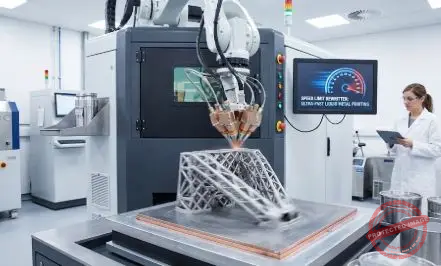
Speed has long been the Achilles’ heel of 3D printing. While additive manufacturing excels at complexity and customization, it has often struggled to match the throughput of casting, molding or machining. That narrative is changing quickly as ultra-fast processes—from liquid metal printing to continuous photopolymerization—push 3D printing closer to true production-line speeds.
Manufacturers now see a future in which large metal structures, functional electronics and consumer goods can be printed in minutes rather than hours. The resulting shift is less about replacing every factory with printers and more about strategically deploying new processes where speed, flexibility and digital control provide a competitive edge.
Liquid metal printing leaps forward
In early 2024, researchers at MIT unveiled a liquid metal printing (LMP) process that deposits molten aluminum into a bed of glass beads, where it rapidly solidifies into 3D structures. The team reports that LMP is at least 10 times faster than comparable metal additive processes and could approach production rates of tens of kilograms per hour with further optimization, rivaling injection molding and die casting in throughput for certain geometries. MIT News
Liquid metal jetting systems are also moving into commercial deployment. Platforms such as ElemX melt aluminum wire and eject droplets onto a heated substrate, thereby eliminating many of the powder-handling and post-processing steps associated with traditional laser powder bed fusion. Integrated monitoring systems adjust parameters in real time to maintain print quality, reducing downtime and scrap. ADDiTEC
These approaches are beautiful for industries that need mid-volume production of robust, lightweight metal parts—such as aerospace, automotive and heavy machinery—without the full capital and safety burden of powder-based systems.
Continuous photopolymerization and CLIP-style processes
On the polymer side, continuous processes like Carbon’s Digital Light Synthesis, powered by its Continuous Liquid Interface Production (CLIP) technology, have demonstrated that 3D printing doesn’t have to be synonymous with layer-by-layer stepping. CLIP uses controlled photopolymerization and an oxygen “dead zone” to continuously pull parts from a resin bath, dramatically increasing speed while delivering smooth surface finishes. carbon3d.com
The commercial implications are visible on store shelves. Adidas, for example, has expanded its line of 3D-printed footwear, with fully 3D-printed Climacool shoes slated for global launch. Earlier generations of Adidas 4D products used CLIP-derived processes for midsoles; new models push further, using additive manufacturing for more of the shoe’s structure to achieve lightweight, latticed designs that would be impossible to mold. The Verge
For brands, ultra-fast photopolymerization unlocks a new balance between customization and scale. They can run shorter, more varied production runs, adjust designs quickly and even explore localized or on-demand manufacturing closer to end markets.
Large-scale parts in minutes, not hours
The convergence of liquid metal and continuous photopolymerization is reshaping expectations around part size and complexity. Research on liquid-phase metal printing suggests that the fast, inexpensive production of customized orthopedic implants and devices could soon be feasible, lowering barriers to patient-specific solutions. PMC At the same time, industrial resin printers with expanded build volumes are tackling larger housings, jigs, and fixtures in single, continuous builds.
Fast processes are also finding their way into hybrid cells that combine 3D printing with machining, inspection and finishing in the same workflow. Here, ultra-fast printing delivers near-net-shape geometry, while downstream tools achieve final tolerances and surface characteristics, enabling manufacturers to capitalize on both speed and precision.
Challenges in quality, materials and economics
Speed does not solve everything. Liquid metal processes must contend with challenges in surface finish, microstructure control, and dimensional accuracy. Coarse resolutions often require machining, adding time and cost back into the process. Photopolymers, meanwhile, face ongoing questions about long-term mechanical performance, creep and environmental stability, particularly in demanding applications.
Economically, firms must weigh the cost of new hardware, materials and training against productivity gains. Trend reports suggest that the overall 3D printing market is growing rapidly, with businesses increasingly using additive manufacturing for end-use parts rather than just prototypes. However, adoption remains application-specific rather than universal. Protolabs
Ultra-fast systems are also data-intensive. They benefit from AI-driven monitoring and control to maintain quality at high throughput, adding another layer of technical sophistication that manufacturers must manage.
Closing thoughts and looking forward
Ultra-fast and liquid metal 3D printing are not simply incremental upgrades; they are part of a broader rethinking of how additive manufacturing competes with traditional processes. The next wave of deployments will likely focus on targeted use cases where speed, digital agility and complex geometry combine to create clear business value—lightweight structural parts, high-value consumer products and mission-critical components that benefit from rapid iteration.
Over time, as materials mature and quality control becomes more autonomous, it is reasonable to expect additive production cells that operate at near-continuous duty cycles, flexing between product variants and integrating tightly with upstream design and downstream logistics systems. In that future, speed is no longer 3D printing’s weakness; it becomes one of its main selling points.
Reference sites
Researchers demonstrate rapid 3D printing with liquid metal – MIT News – https://news.mit.edu/2024/researchers-demonstrate-rapid-3d-printing-liquid-metal-0125
New liquid metal printing process is 10X faster – 3Dnatives – https://www.3dnatives.com/en/new-liquid-metal-printing-process-is-10x-faster-310120244/
Liquid Phase 3D Printing: How This New Technology Can Reshape Orthopedic Implants – Journal of Orthopaedic Translation (via PubMed Central) – https://pmc.ncbi.nlm.nih.gov/articles/PMC9107545/
DLS 3D Printing Technology – Carbon – https://www.carbon3d.com/carbon-dls-technology
3D Printing Trend Report 2024 – Protolabs – https://www.protolabs.com/resources/guides-and-trend-reports/3d-printing-trend-report/
Randy Johnson, Contributor, 3D Printing, Montreal, Quebec.
Peter Jonathan Wilcheck, Co-Editor, Miami, Florida.
#3DPrinting #LiquidMetalPrinting #CLIP #DigitalLightSynthesis #AdditiveManufacturing #Industrial3DPrinting #HyperfastManufacturing #Aluminum3DPrinting #ProductionScaleAM #FutureOfManufacturing
Post Disclaimer
The information provided in our posts or blogs are for educational and informative purposes only. We do not guarantee the accuracy, completeness or suitability of the information. We do not provide financial or investment advice. Readers should always seek professional advice before making any financial or investment decisions based on the information provided in our content. We will not be held responsible for any losses, damages or consequences that may arise from relying on the information provided in our content.

 AAPL
AAPL MSFT
MSFT GOOG
GOOG TSLA
TSLA AMD
AMD IBM
IBM TMC
TMC IE
IE INTC
INTC MSI
MSI NOK
NOK DELL
DELL ECDH26.CME