


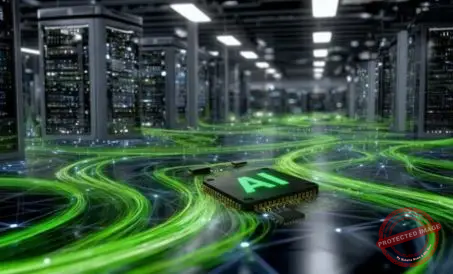
How AI chips are pushing data centers — and the grid — to the limit.
AI’s Growing Appetite for Power
Training and serving ever-larger AI models is driving a sharp rise in data center electricity use. The International Energy Agency estimates global data center demand could exceed 1,000 TWh by 2026, roughly doubling in just a few years, with AI a major contributor. Data Center Frontier+2IEA
Reports warn that without efficiency gains and clean energy, AI-heavy data centers could rival heavy industries in power use and emissions, especially in regions where facilities cluster on already stressed grids. MIT Sloan+3The Guardian+3Reuters
Liquid Cooling and Rack-Scale Superchips
One path forward is smarter hardware and cooling. NVIDIA’s Blackwell-based GB200 NVL72 is a liquid-cooled rack-scale system that packs 72 Blackwell GPUs into a single NVLink domain, with NVIDIA claiming up to 25× the performance at the same power compared with air-cooled H100 deployments. FiberMall+3NVIDIA+3NVIDIA
By moving to direct liquid cooling, data centers can increase compute density, shrink floor space, and significantly cut cooling energy and water usage—critical in regions where data centers already consume a large share of local electricity and water. NVIDIA Blog
Energy-Aware Designs and Partnerships
Chip makers and infrastructure vendors are collaborating on reference architectures that treat energy as a first-class design constraint. Schneider Electric, for example, has teamed up with NVIDIA to create AI-ready data center blueprints that support extremely high rack power densities while targeting around 20% cuts in cooling energy and faster deployment times. Business Insider
These designs mix efficient power distribution, advanced cooling, and close integration with GPU platforms, giving operators a roadmap to scale out AI clusters without simply multiplying their energy bills.
Hardware–Software Co-Design for Efficiency
Academic and industry work increasingly points to hardware–software co-design as the key to sustainable AI:
-
Specialized accelerators tuned for throughput per watt.
-
Algorithms and compilers that minimize memory movement and exploit low-precision formats.
Recent surveys of sustainable AI training show that co-design—optimizing models, runtimes and accelerators together—can deliver far larger efficiency gains than hardware or software tweaks alone. arXiv+2Arbisoft
Closing Thoughts and Looking Forward
AI hardware is at a crossroads:
-
One path leads to skyrocketing power demand and grid stress.
-
The other to denser, more efficient architectures paired with cleaner energy and smarter cooling.
The likely reality will be a mix—but the trajectory is not fixed. Choices about chip design, data center architecture, regulation and energy sourcing over the next 3–5 years will determine whether “AI factories” become an environmental liability or a showcase for efficient digital infrastructure.
Reference Sites
-
“AI has high data center energy costs — but there are solutions” – MIT Sloan Management Review – https://mitsloan.mit.edu/ideas-made-to-matter/ai-has-high-data-center-energy-costs-there-are-solutions
-
“Energy Demand from AI” – International Energy Agency (IEA) – https://www.iea.org/reports/energy-and-ai/energy-demand-from-ai
-
“AI: Five charts that put data-centre energy use and emissions into context” – CarbonBrief – https://www.carbonbrief.org/ai-five-charts-that-put-data-centre-energy-use-and-emissions-into-context/
-
“GB200 NVL72: The Blackwell Rack-Scale Architecture” – NVIDIA – https://www.nvidia.com/en-us/data-center/gb200-nvl72/
-
“Blackwell Platform Boosts Water Efficiency by Over 25x” – NVIDIA Blog – https://blogs.nvidia.com/blog/blackwell-platform-water-efficiency-liquid-cooling-data-centers-ai-factories/
Author: Serge Boudreaux – AI Hardware Technologies, Montreal, Quebec
Co-Editor: Peter Jonathan Wilcheck – Miami, Florida
#AI energy consumption, #liquid cooling, #GB200 NVL72, #sustainable AI, #data center power, #IEA report, #rack-scale systems, #co-design efficiency, #cooling technology, #green computing
Post Disclaimer
The information provided in our posts or blogs are for educational and informative purposes only. We do not guarantee the accuracy, completeness or suitability of the information. We do not provide financial or investment advice. Readers should always seek professional advice before making any financial or investment decisions based on the information provided in our content. We will not be held responsible for any losses, damages or consequences that may arise from relying on the information provided in our content.

 AAPL
AAPL AMD
AMD CIS.HA
 DELL
DELL IBM
IBM INTC
INTC MSFT
MSFT GOOG
GOOG HPE
HPE NVDA
NVDA TSLA
TSLA TMC
TMC MSI
MSI NOK
NOK ECDH26.CME
 OPEAZZX