
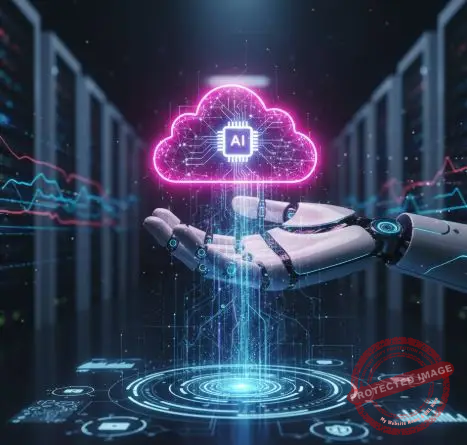
How AIOps and Sovereign AI are rewiring the data backbone of modern AI centers.
From Manual Runbooks to Self-Optimizing Storage
For years, storage operations were powered by runbooks, capacity meetings, and “hero admins” who knew exactly which array would fill up next. That model is breaking under AI’s weight.
AI data centers juggle petabytes of fast-moving data across flash, disk, and cloud tiers, while thousands of GPUs expect a constant stream of training and inference inputs. The sheer scale makes manual tuning almost impossible.
That’s where AI for storage operations comes in. Enterprise Storage Forum describes AIOps for storage as combining AI and advanced analytics with traditional IT operations to automate provisioning, performance tuning, anomaly detection, and capacity planning across heterogeneous storage systems. Enterprise Storage Forum
Instead of admins reacting to tickets, machine learning engines ingest telemetry from arrays, switches, hypervisors, and apps—then predict issues, recommend actions, or execute them automatically. In parallel, governments and enterprises are redefining where that data is allowed to live through Sovereign AI, insisting that key datasets and models stay inside specific borders or jurisdictions. CIO+2TechTarget+2
Together, AIOps and Sovereign AI are quietly reshaping the way storage is built, operated, and governed in AI-era data centers.
Predictive Maintenance: Fixing Storage Before It Breaks
Traditional monitoring tells you when something is wrong. AI-powered operations aim to tell you before it goes wrong.
Modern AIOps platforms use algorithms to analyze years of historical metrics—latency, queue depths, error codes, vibration data from drives, controller utilization—and learn what “normal” looks like for each array or SAN fabric. When patterns drift, they flag risk long before performance collapses.
-
Enterprise Storage Forum highlights predictive failure detection and anomaly spotting as core AIOps capabilities for storage, reducing outages and manual troubleshooting. Enterprise Storage Forum
-
A Quinnox capacity-planning guide shows how AIOps models can forecast when specific volumes or clusters will hit thresholds, letting teams expand or rebalance before users ever see a “disk full” error. Quinnox
At the micro level, there’s a similar trend around SAN and NVMe fabrics. A detailed Medium case study on SAN storage predictive capacity planning explains how ML models ingest historical I/O, growth rates, and workload signatures to recommend adding shelves, changing RAID layouts, or moving workloads—turning what used to be a quarterly spreadsheet exercise into a continuously updated forecast. Medium
The payoff is twofold: fewer surprises, and less over-provisioning “just in case.”
AI-Driven Tiering and Resource Allocation
Capacity is one problem; placement is another. As AI pipelines mix hot embeddings, cold training corpora, regulatory archives, and edge caches, deciding what lives on which tier becomes a full-time job. AIOps is increasingly taking that job.
CloudSoda’s 2025 guide to AI-ready data management describes advanced storage analytics that:
-
Track real-time utilization, access patterns, and performance bottlenecks.
-
Use predictive analytics to recommend or automate “right-sizing” data placement across flash, object, and archive tiers. CloudSoda
Instead of static ILM (information lifecycle management) rules, AI systems watch how specific datasets are actually used—who accesses them, how often, from where—and then move them accordingly. Hot training data can be pulled up to NVMe near GPUs; stale logs can drift into low-cost object stores or HAMR-based archives.
SNIA’s new Storage.AI initiative, launched in 2025 with backing from AMD, Dell, IBM, NetApp, Pure, Samsung, Seagate and others, aims to standardize some of these behaviors. The project coordinates open specifications for AI-specific data services—placement, caching, prefetching, and movement—meant to work across vendors and clouds. Network World+1
The long-term vision: storage fabrics that continuously re-organize themselves to match AI workloads, rather than forcing AI teams to manually manage LUNs and share trees.
Toward Autonomous Infrastructure: AIOps in the Data Center Stack
AI isn’t just managing disks; it’s increasingly orchestrating entire data center environments—power, cooling, and storage as one connected system.
Several trends are converging:
-
AIOps platforms, as outlined by Selector and Motadata, are shifting from reactive alerting to predictive analytics, intelligent correlation, and automated remediation—spotting patterns across logs, metrics, and traces and taking action without human intervention. Selector+2Motadata+2
-
DataBank’s 2024 analysis of AI-powered predictive analytics shows how ML models can drive dynamic resource allocation and automated performance tuning across hybrid IT—adjusting storage allocations, network parameters, and caching policies based on predicted demand. DataBank | Data Center Evolved
-
Google famously used DeepMind AI to optimize its data center cooling systems, cutting cooling energy use by around 40% and then moving to fully autonomous control under human supervision. blog.google+2Siemens Assets+2
That same logic is now coming for storage:
-
Vendors are embedding AI in storage management consoles to generate recommended actions (“rebalance this volume,” “migrate this dataset to a different tier,” “expand this cluster before Q4 traffic spike”). Enterprise Storage Forum+1
-
Infrastructure providers like Vertiv are acquiring AI software companies (e.g., Waylay) to deliver generative-AI–driven monitoring and optimization across power, cooling, and IT systems together—with storage performance and capacity as key signals in the loop. Barron’s+1
We’re moving toward partial “lights-out” operations, where human operators set guardrails and objectives, and AI agents continuously tune the environment—including storage—to meet them.
Sovereign AI: Geography Becomes a Storage Policy
While AIOps tackles how storage runs, Sovereign AI reshapes where and under whose rules it runs.
TechTarget defines Sovereign AI as AI services—often generative—that confine their infrastructure and operations within a specific nation’s borders to comply with local privacy, governance, and regulatory regimes. TechTarget CIO adds that this intersects deeply with data sovereignty, localization, and residency laws that dictate which jurisdictions may host specific types of data. CIO
Dell’s 2025 Sovereign AI white paper argues that by 2027, 60% of national governments in the Asia–Pacific region will embed sovereignty requirements into AI procurement, explicitly evaluating data governance, residency controls, and operational assurance. Dell+1 Bank of America, cited in Dell’s blog, estimates Sovereign AI could represent roughly 15% of annual global AI infrastructure spending—around a $50 billion market each year. Dell
For storage, Sovereign AI translates into very concrete demands:
-
Certain datasets must remain in-country or in specific provinces, sometimes with strict controls on cross-border replication and remote administration.
-
Encryption keys and metadata often must be controlled by domestic entities, even when infrastructure is co-located or cloud-hosted.
Storage fabrics that used to be designed purely for performance and cost efficiency must now be carved into Sovereign zones—logically unified, but physically and legally constrained.
AI-Driven Storage Governance: Policy as Code
Meeting sovereignty and governance requirements manually is painful at scale. AI is starting to help here, too.
CIO’s 2025 analysis of data sovereignty and AI stresses the need for distributed infrastructures where data placement and movement are governed by fine-grained policies—mapping each dataset to its allowed jurisdictions and processing contexts. CIO
In many modern stacks, those policies are codified in metadata and “policy-as-code” engines. AI can then:
-
Classify data (for example, identifying personal, health, or financial information) and automatically tag it with relevant residency and retention requirements. Astera+1
-
Suggest compliant placements or detect violations—such as a backup copy drifting into a non-approved region or a cache replicating into a restricted zone.
SNIA and the Open Compute Project’s recent partnership explicitly calls for open, vendor-neutral solutions to coordinate storage, memory, and networking for AI data centers, with governance and data services as first-class considerations. DataCenterDynamics+1
Add AIOps on top, and you get a picture of self-governing storage: systems that not only balance performance and cost, but also continuously check their own compliance posture against evolving regulatory and contractual rules.
Designing AI-Native, Sovereign Storage Architectures
So what does an AI-driven, sovereignty-aware storage design actually look like in 2026? A few patterns are emerging.
First, multicloud and hybrid are the default. Dell’s recent analysis of multicloud file storage emphasizes unified file/object namespaces that span on-prem, colocation, and public cloud while enforcing security and compliance policies centrally. Dell SNIA’s Storage.AI effort adds AI-specific semantics—like “keep all training data for this sovereign LLM within Region X, and stage only anonymized subsets into Region Y for analytics.” Network World+1
Second, observability is embedded. AIOps platforms ingest logs, performance metrics, configuration states, and metadata from storage systems across all those locations. Selector and Motadata both describe next-gen AIOps as providing AI-driven observability and insights—granular visibility into distributed systems, powered by anomaly detection and correlation. Selector+2Motadata+2
Third, control loops are closing:
-
Predictive models anticipate capacity and performance needs per region, per workload. Quinnox+2Medium+2
-
Policy engines enforce sovereign and security rules. CIO+2TechTarget+2
-
Automation layers orchestrate migrations, tiering, snapshots, and replication, asking humans for approval only when risk or ambiguity is high. Enterprise Storage Forum+2CloudSoda+2
The result isn’t a fully “self-driving data center” yet—but it’s a long way from spreadsheets and manual zoning.
Closing Thoughts and Looking Forward
AI in storage operations is moving fast along two axes: autonomy and authority.
-
Autonomy comes from AIOps—AI systems that can observe, predict, and act on storage health and performance across complex, hybrid infrastructures.
-
Authority comes from Sovereign AI and data governance—political and legal frameworks that dictate where data may live and who controls it.
Over the next few years, expect to see:
-
Wider deployment of AIOps platforms purpose-built for storage, with increasingly aggressive automation of tiering, capacity management, and anomaly response. Enterprise Storage Forum+2Flexential+2
-
Sovereign AI clouds and regions multiplying, each with storage stacks architected from day one for local residency, renewable power, and tight governance. TechTarget+3Dell+3IT Pro+3
-
Standards bodies like SNIA and OCP pushing common models for AI-ready, sovereign-aware storage data services—so that policy and automation can span vendors and geographies. Network World+1
In the end, the most successful AI data centers won’t just have the fastest GPUs. They’ll have storage fabrics that think—continuously optimizing themselves while keeping every byte exactly where it’s allowed to be.
Reference Sites
-
“AIOps: How to Use AI for Storage Management” – Enterprise Storage Forum
https://www.enterprisestorageforum.com/management/aiops/ Enterprise Storage Forum -
“Mastering Storage Optimization: A Comprehensive Guide to AI-Ready Data Management in 2025” – CloudSoda
https://cloudsoda.io/mastering-storage-optimization-a-comprehensive-guide-to-ai-ready-data-management-in-2025/ CloudSoda -
“Data sovereignty and AI: Why you need distributed infrastructure” – CIO
https://www.cio.com/article/4015553/data-sovereignty-and-ai-why-you-need-distributed-infrastructure.html CIO -
“Sovereign AI explained: Everything you need to know” – TechTarget
https://www.techtarget.com/whatis/feature/Sovereign-AI-explained TechTarget -
“SNIA launches Storage.AI to address AI data infrastructure bottlenecks” – NetworkWorld
https://www.networkworld.com/article/4033580/snia-launches-storage-ai-to-address-ai-data-infrastructure-bottlenecks.html Network World+1
Author: Serge Boudreaux – AI Hardware Technologies, Montreal, Quebec
Co-Editor: Peter Jonathan Wilcheck – Miami, Florida
AIOps, storage automation, predictive maintenance, sovereign AI, data sovereignty, AI data centers, policy-as-code, Storage.AI, autonomous infrastructure, storage governance
Post Disclaimer
The information provided in our posts or blogs are for educational and informative purposes only. We do not guarantee the accuracy, completeness or suitability of the information. We do not provide financial or investment advice. Readers should always seek professional advice before making any financial or investment decisions based on the information provided in our content. We will not be held responsible for any losses, damages or consequences that may arise from relying on the information provided in our content.
 AAPL
AAPL AMD
AMD CIS.HA
 DELL
DELL IBM
IBM INTC
INTC MSFT
MSFT GOOG
GOOG HPE
HPE NVDA
NVDA TSLA
TSLA TMC
TMC MSI
MSI NOK
NOK OPEAZZX