


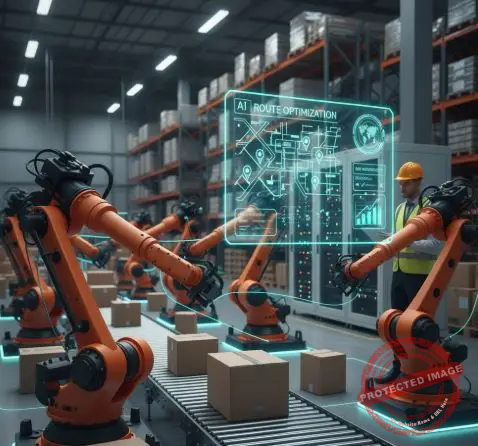
How next-generation fulfillment centers are becoming AI-driven, robot-dense engines for online retail.
From Static Warehouses To Cyber-Physical Fulfillment Engines
Once, e-commerce fulfillment centers looked like scaled-up stockrooms: long aisles, paper pick lists, pallet jacks, and workers walking miles per shift. That model is disappearing fast. The new generation of facilities are cyber-physical systems where software, robots, sensors, and humans operate as a tightly orchestrated whole.
The stakes are high. Global analysts estimate the warehouse automation market at roughly 30 billion dollars in 2025, with projections that it could more than double to over 60 billion dollars by 2030 as e-commerce volumes and labor shortages converge. Mordor Intelligence+2LogisticsIQ A growing share of that spending is targeted squarely at fulfillment centers handling direct-to-consumer orders.
Instead of bolting automation onto legacy processes, leading retailers are redesigning buildings from the ground up to be automation-first: higher ceilings for dense storage, mezzanines to stack workflows vertically, and floor layouts optimized for the paths of autonomous mobile robots rather than pallet trucks.
Robots Take The Aisles
The most visible symbol of this transformation is the robot. Fulfillment centers are deploying fleets of autonomous mobile robots that ferry totes and racks, shuttle systems that move bins at blistering speed, and robotic arms that can pick, sort, and induct packages into various streams.
Analysts and vendors alike describe a rapid acceleration in robot shipments into supply chains, with some expecting annual growth rates that could approach 50 percent for certain categories through 2030. McKinsey & Company Retailers use these robots to compress pick times from minutes to seconds, reduce walking distances for workers, and stabilize operations during peak seasons.
News from major retail brands underlines how central automation has become. One department-store chain recently opened its largest and most automated warehouse in North Carolina, using dense storage systems and robots from multiple providers to cut order cycle times from almost two days to under one. The Wall Street Journal The facility consolidates orders for both online customers and stores, turning logistics into a core differentiator in its turnaround plan.
The Hidden Brain: AI-Enabled Warehouse Management
Hardware is only half the story. The real leap forward comes from AI-enabled warehouse management systems that can ingest torrents of data from scanners, robots, sensors, and order streams and then make fine-grained decisions in real time.
Leading cloud and supply-chain software providers emphasize how AI now optimizes slotting, predicts demand, automates wave planning, prioritizes at-risk orders, and dynamically assigns work to humans and machines. Oracle+2Körber These systems move the operation from reactive firefighting to predictive orchestration.
As e-commerce networks become more complex—with regional hubs, micro-fulfillment sites, and ship-from-store locations—this intelligence is essential. AI looks across the network, not just a single building, deciding where to hold inventory, which node should handle each order, and how to route parcels to hit delivery promises at the lowest possible cost.
Labor Pressures, Safety, And The Automation Debate
Automation’s rise is inseparable from labor dynamics. Warehouses face persistent hiring challenges, high turnover, and demanding peak seasons. Robots promise a way to maintain service levels without constantly adding headcount.
At the same time, recent reporting suggests at least one e-commerce giant is exploring automation at a scale that could reduce hundreds of thousands of future warehouse roles in the United States over the next decade, even as order volumes continue to grow. New York Post Internal documents reportedly show executives carefully managing language and community relations around automation plans, aware of public concerns about job quality and displacement.
Meanwhile, companies highlight safety benefits. New robotic storage systems reduce the need to climb, stretch, or repeatedly lift heavy items by bringing goods to workers at ergonomic stations. Early data from large operators points to measurable reductions in certain injury types when robots take on the most physically punishing tasks. AP News
Designing Resilient, Multi-Node Fulfillment Networks
Automation is also a resilience play. The shocks of recent years—from pandemic-era surges to transportation disruptions—exposed the fragility of over-optimized, single-node distribution models. In response, retailers are deploying a mix of mega-fulfillment centers, smaller regional nodes, and store-adjacent micro-fulfillment sites.
Automation allows these nodes to punch above their weight. A single highly automated facility can process orders for dozens of stores or metro areas; a dark store with dense robotic storage can support same-day deliveries across a city. Network-level software coordinates how these nodes share work and inventory, creating redundancy and agility that manual networks struggle to match. Körber
Closing Thoughts And Looking Forward
Fulfillment centers are evolving from static warehouses into dynamic, automated engines at the core of e-commerce strategy. Robots handle the repetitive and physically demanding tasks; AI orchestrates flows across buildings and networks; humans step into roles focused on oversight, troubleshooting, and continuous improvement.
Over the next decade, the leaders in online retail will likely be those who treat fulfillment as a strategic innovation platform rather than a cost of doing business. They will blend automation with thoughtful workforce strategies, invest heavily in data and AI, and design resilient networks that can absorb shocks while still delivering in one or two days—or sooner.
References
Warehouse Automation Market – Grand View Research – https://www.grandviewresearch.com/industry-analysis/warehouse-automation-market-report
Warehouse Automation Market to Reach $55 Billion by 2030, Driven by E-Commerce and Supply Chain Transformation – LogisticsIQ / PR Newswire – https://www.prnewswire.com/news-releases/warehouse-automation-market-to-reach-55-billion-by-2030-driven-by-e-commerce-and-supply-chain-transformation—logisticsiq-302252709.html
Warehouse Automation Market Size and Growth – LogisticsIQ – https://www.thelogisticsiq.com/research/warehouse-automation-market
Getting Warehouse Automation Right – McKinsey & Company – https://www.mckinsey.com/capabilities/operations/our-insights/getting-warehouse-automation-right
AI and Warehouse Automation: The Future of Fulfillment – Körber Supply Chain – https://www.koerber.com/en/insights-and-events/supply-chain-insights/ai-warehouse-automation
Author: Claire Gauthier – eCommerce Technologies, Montreal, Quebec
Co-Editor: Peter Jonathan Wilcheck – Miami, Florida
#FulfillmentCenters #WarehouseAutomation #EcommerceLogistics #AutonomousMobileRobots #AIWarehouseManagement #OrderFulfillment #SupplyChainResilience #LogisticsInnovation #RetailTechnology #DistributionCenters
Post Disclaimer
The information provided in our posts or blogs are for educational and informative purposes only. We do not guarantee the accuracy, completeness or suitability of the information. We do not provide financial or investment advice. Readers should always seek professional advice before making any financial or investment decisions based on the information provided in our content. We will not be held responsible for any losses, damages or consequences that may arise from relying on the information provided in our content.
 AAPL
AAPL AMD
AMD CIS.HA
 DELL
DELL IBM
IBM INTC
INTC MSFT
MSFT GOOG
GOOG HPE
HPE NVDA
NVDA TSLA
TSLA TMC
TMC MSI
MSI NOK
NOK OPEAZZX