


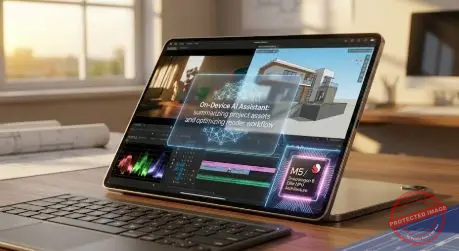
The biggest story in 2026 tablets is not just faster chips, but what those chips enable: real laptop workloads, rich AI assistants and complex games running entirely on a fanless slab of glass.
Apple’s M-series chips have already blurred the line between tablet and notebook, and the latest iPad Pros with M5 silicon deliver desktop-class CPU and GPU performance in a thin chassis, alongside dramatically enhanced AI throughput. MacRumors+1 On the Android side, Qualcomm’s Snapdragon 8 Elite Gen 5 platform and related laptop-class Snapdragon X-series parts promise large performance gains and a big leap in NPU capability, designed explicitly for always-on, on-device AI. Qualcomm+2heise online+2
From companion tablet to primary computer
For years, the conventional wisdom was that tablets were “second devices” – good for content consumption, note-taking and light email, but not for heavy lifting. That logic breaks down when a tablet’s benchmark scores rival or exceed recent ultrabooks.
Qualcomm’s new Snapdragon X2 Elite Extreme, destined for thin Windows devices by early 2026, has already outscored Apple’s M4 and top Intel Core Ultra parts in leaked benchmarks, while delivering strong GPU and NPU performance on battery. Windows Central+2PhoneArena+2 When that level of silicon arrives in 2-in-1s and detachable tablets, users in fields like consulting, design and software development will be able to live off a single device that switches seamlessly between laptop and tablet modes.
On the Apple side, the M5 iPad Pro now shares silicon pedigree with Mac laptops. Creatives can edit multi-stream 4K footage, process massive RAW photo libraries and run complex audio sessions without ever touching a fan-cooled machine. MacRumors+1 Combined with Stage Manager-style multi-window interfaces and more mature file management, tablets are finally crossing the line from companion to primary productivity machines for many professionals.
On-device AI becomes table stakes
The CPU and GPU races matter, but NPUs and AI accelerators may matter more. Snapdragon 8 Elite Gen 5’s Hexagon NPU is significantly faster and more efficient than its predecessor, tuned for personalized, continuously adapting AI experiences that stay on the device. Qualcomm+2PhoneArena+2 Apple’s M-series similarly invests heavily in Neural Engine capacity, and 2025-era M5 marketing already emphasizes local intelligence as a differentiator. MacRumors+1
In practice, “AI-ready” tablets in 2026 are doing far more on their own. Summarizing long documents, transcribing multi-speaker meetings, translating video calls in real time, and cleaning up photos and audio without hitting the cloud become routine. AI copilots live in system-level UI, suggesting actions, sorting files, and pre-loading apps based on context.
Most critically, sensitive use cases – like healthcare tablets storing protected data or field-service devices with proprietary CAD files – can benefit from AI without sending data to external servers. That combination of performance and privacy will be a major adoption trigger in regulated industries.
Gaming, emulation and creative apps push the envelope
When tablet SoCs offer console-like GPU performance and advanced cooling designs, gaming becomes a headline feature rather than an afterthought. Snapdragon 8 Elite Gen 5 and successors bring hardware-accelerated ray tracing, advanced upscaling and high-refresh output, while M-series iPads lean on Metal optimizations and cross-platform engines. Qualcomm+1
Developers are responding with more ambitious titles: AAA ports, cloud-assisted games that blend local rendering with server-side assets, and creative apps that use AI to fill in textures, animations and story beats. Artists can render complex 3D scenes, while music producers stack more plug-ins in DAWs built for touch and pen.
Even emulation gains legitimacy in certain ecosystems, allowing tablets to stand in as “universal consoles” for retro and indie content, though platform policies will dictate how far that trend runs.
Power, thermals and the fanless frontier
The risk in pushing laptop workloads into fanless tablets is thermal headroom. Vendors are experimenting with vapor chambers, graphite layers, and chassis-level heat spreading to sustain high performance without running too hot to hold.
Qualcomm in particular emphasizes sustained performance while on battery as a differentiator over x86 laptops. Windows Central Apple’s efficiency narratives similarly focus on doing more within tight thermal envelopes. MacRumors+1
Enterprise buyers will demand real-world data, not just peak benchmark scores. Expect to see more standardized tests around “performance per watt over an eight-hour workday” and “frames per second at fixed skin temperature” as tablet performance matures.
Closing thoughts and looking forward
By the end of 2026, the phrase “tablet-class performance” will mean something very different from what it meant five years earlier. ARM-based SoCs from Apple and Qualcomm are rewriting expectations for what a silent, battery-powered slab of glass can do, with AI accelerators turning that compute into practical productivity gains rather than just benchmark numbers.
The next step will be deeper software adaptation. Operating systems and apps must fully embrace asymmetric compute, offloading background work to NPUs, scheduling tasks around battery forecasts, and exposing user-friendly controls over where AI runs and what data it touches. As those layers mature, tablets will stand not just as laptop replacements, but as arguably the most balanced form factor for an AI-first, mobile-centric workforce.
Qualcomm Snapdragon 8 Elite Gen 5, the World’s Fastest Mobile System-on-a-chip – Qualcomm – https://www.qualcomm.com/news/releases/2025/09/snapdragon-8-elite-gen-5–the-world-s-fastest-mobile-system-on-a
Qualcomm announces the Snapdragon 8 Elite Gen 5 – The Verge – https://www.theverge.com/tech/784997/qualcomm-snapdragon-8-elite-gen-5
Qualcomm Snapdragon 8 Elite (Gen 4) Benchmarks – NanoReview – https://nanoreview.net/en/soc/qualcomm-snapdragon-8-gen-4
Snapdragon X2 Elite Extreme crushes Apple M4, Intel, and AMD in new benchmarks – Windows Central – https://www.windowscentral.com/hardware/qualcomm/snapdragon-x2-elite-extreme-crushes-apple-m4-intel-and-amd-in-new-benchmarks
iPad Pro Roundup – MacRumors – https://www.macrumors.com/roundup/ipad-pro/
Author and Co-Editor:
John Felsen, – Gadgets: Tablets/Notebooks, Montreal, Quebec;
Peter Jonathan Wilcheck, Co-Editor, Miami, Florida.
#Tablets #M5Chip #Snapdragon8Elite #OnDeviceAI #NPUs #ProductivityTablets #GamingTablets #ARMPerformance #2in1Devices #TabletTrends2026
Post Disclaimer
The information provided in our posts or blogs are for educational and informative purposes only. We do not guarantee the accuracy, completeness or suitability of the information. We do not provide financial or investment advice. Readers should always seek professional advice before making any financial or investment decisions based on the information provided in our content. We will not be held responsible for any losses, damages or consequences that may arise from relying on the information provided in our content.

 AAPL
AAPL AMD
AMD CIS.HA
 DELL
DELL IBM
IBM INTC
INTC MSFT
MSFT GOOG
GOOG HPE
HPE NVDA
NVDA TSLA
TSLA TMC
TMC MSI
MSI NOK
NOK OPEAZZX