


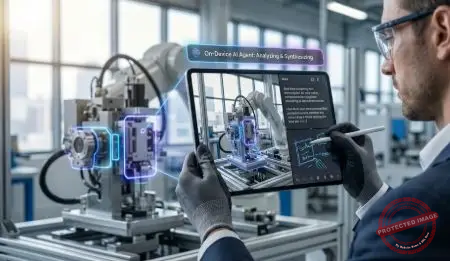
Performance and displays grab headlines, but AI will quietly become the most important competitive battleground for tablets in 2026. The combination of powerful NPUs, optimized software stacks and richer sensor data is turning tablets into context-aware assistants that anticipate needs rather than simply responding to taps.
Qualcomm’s Snapdragon 8 Elite Gen 5 platform, with a significantly faster and more efficient Hexagon NPU, was designed explicitly for “personalized, continually adapting AI experiences” that stay on device. Qualcomm+2PhoneArena+2 Apple’s M-series Neural Engines are evolving along similar lines, with the M5 generation delivering dramatically higher AI throughput for generative workloads compared to earlier chips. MacRumors+1
From smart features to AI-native workflows
Early “AI features” in tablets were often limited to camera enhancements, autocorrect and basic voice assistants. In 2026, AI becomes foundational to entire workflows.
Note-taking apps transcribe handwritten and spoken input in real time, then automatically structure it into to-do lists, summaries and knowledge graphs. Creative tools generate storyboards, color palettes and background art based on plain-language prompts. Productivity suites summarize long email threads and documents, suggest reply drafts and highlight the most critical paragraphs for quick review.
Because modern NPUs can run large models locally, many of these experiences no longer require a constant internet connection. That matters for tablets used on factory floors, in hospitals and on aircraft, where connectivity can be limited or sensitive data cannot leave the device. Qualcomm+1
Multimodal input turns tablets into sensor hubs
Tablets have always sat at the intersection of touch, pen, camera and microphone. In 2026, multimodal AI allows them to understand these inputs together rather than separately.
A field engineer can point the rear camera at a piece of equipment, describe a problem verbally and sketch on the screen. An on-device model combines visual recognition, speech understanding and structured knowledge to suggest likely issues, highlight critical components and generate a maintenance report draft.
In classrooms, students can film a science experiment, annotate the footage with a stylus and ask natural-language questions about what they observe. The tablet responds with explanations, simulations and further reading, all tailored to their level.
For creatives, multimodal models let them rough out scenes with a mix of sketches, sample images and voice notes, then refine them iteratively using text prompts and pen edits.
Privacy, governance and transparency become critical differentiators
As AI permeates more workflows, enterprises and regulators will scrutinize how tablet vendors handle privacy, model governance and transparency. On-device processing is a strong first step, reducing reliance on external data centers, but questions remain about training data, bias mitigation and user control.
Vendors that can provide clear documentation about model behavior, offer granular controls over which apps can access AI capabilities, and integrate with broader governance frameworks will gain an edge in regulated sectors such as finance, healthcare and public services.
Expect to see tablet management consoles that treat AI as a first-class citizen: IT teams will be able to whitelist certain AI models, enforce data retention rules for generated content, and audit which prompts and content types are used on corporate devices.
AI as a differentiator for mid-range and education tablets
While flagship tablets showcase cutting-edge AI features, mid-range and education-focused devices will benefit as well. Hardware-efficient models can run on modest NPUs, enabling local translation, reading assistance, math tutoring and writing support without premium price tags.
Educational platforms will package AI tutors that adapt to each student’s progress, running securely on school-issued tablets with no persistent cloud profiles. Special-education use cases, such as communication boards and personalized learning plans, will benefit from models tuned to individual needs and sensitivities.
In emerging markets, offline-capable AI will help bridge gaps where connectivity is expensive or unreliable, turning affordable tablets into powerful learning and business tools.
Closing thoughts and looking forward
AI will quietly turn tablets from passive screens into proactive partners. By 2026, users will expect their tablet to understand context, anticipate needs and help them think, not just display apps. The winners in this race will not only have the fastest NPUs, but also the most thoughtful integration of AI into everyday workflows, with robust safeguards and user control.
Looking ahead, we can expect even tighter coupling between tablet AI and cloud intelligence, with models that hand off between local and remote execution depending on task size, sensitivity and latency. As that happens, the distinction between “tablet app” and “AI agent running on a tablet” will blur, giving rise to entirely new categories of work and creativity on these devices.
References
Qualcomm Snapdragon 8 Elite Gen 5, the World’s Fastest Mobile System-on-a-chip – Qualcomm – https://www.qualcomm.com/news/releases/2025/09/snapdragon-8-elite-gen-5–the-world-s-fastest-mobile-system-on-a
Qualcomm Snapdragon 8 Elite Gen 5: More power, more AI, more multimedia – Heise Online – https://www.heise.de/en/news/Qualcomm-Snapdragon-8-Elite-Gen-5-More-power-more-AI-more-multimedia-10668204.html
Snapdragon 8 Elite Gen 5: The name, the power, the why – Qualcomm (via Reddit summary) – https://www.reddit.com/r/Android/comments/1npnktv/snapdragon_8_elite_gen_5_the_worlds_fastest/
iPad Pro Roundup – MacRumors – https://www.macrumors.com/roundup/ipad-pro/
iPad Pro 2024 vs 2025 — Performance, Design, and Everything You Need to Know – Benks Blog – https://www.benks.com/blogs/benks-blog/ipad-pro-2024-vs-2025-performance-design-and-everything-you-need-to-know
Author and Co-Editor:
John Felsen, – Gadgets: Tablets/Notebooks, Montreal, Quebec;
Peter Jonathan Wilcheck, Co-Editor, Miami, Florida.
#Tablets #OnDeviceAI #NPUs #MultimodalAI #AITutors #ProductivityApps #CreativeWorkflows #EdgeAI #PrivacyByDesign #TabletTrends2026
Post Disclaimer
The information provided in our posts or blogs are for educational and informative purposes only. We do not guarantee the accuracy, completeness or suitability of the information. We do not provide financial or investment advice. Readers should always seek professional advice before making any financial or investment decisions based on the information provided in our content. We will not be held responsible for any losses, damages or consequences that may arise from relying on the information provided in our content.

 AAPL
AAPL AMD
AMD CIS.HA
 DELL
DELL IBM
IBM INTC
INTC MSFT
MSFT GOOG
GOOG HPE
HPE NVDA
NVDA TSLA
TSLA TMC
TMC MSI
MSI NOK
NOK OPEAZZX