


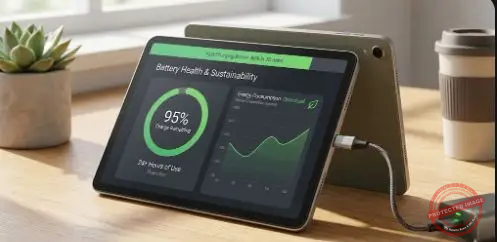
All the performance and AI intelligence in the world is useless if a tablet dies before the workday ends. In 2026, battery technology, charging speed and energy efficiency are becoming core pillars of tablet strategy, intertwined with broader sustainability goals.
The 2024–2025 iPad Pro refresh showed how a more efficient OLED display and M-series chip could deliver better real-world battery life even without dramatically larger cells. Reviewers noted that after movie playback tests, the M4 iPad Pro with its new OLED screen retained more charge than previous LCD-based models, illustrating the compound benefits of self-emissive panels and efficient silicon. OTOFLY
Android and Windows tablets are following suit, adopting more efficient SoCs, advanced power-management firmware and radios that intelligently balance 5G, Wi-Fi 6E and Wi-Fi 7 usage. Android Police+2TechRadar
All-day tablets become table stakes
The old marketing promise of “up to 10 hours of use” is no longer enough. Hybrid workers, field technicians and students expect their tablets to last from first meeting to final video call without hugging a wall outlet.
Manufacturers are targeting more realistic “mixed-use” scenarios in their design: video conferencing, browser-heavy research, app switching and occasional gaming. Efficiency improvements come from several directions, including smaller process nodes for CPUs and GPUs, smarter display drivers that lower refresh rates for static content, and radios that aggressively sleep when not needed. Apple+2MacRumors
Rugged tablets used in logistics and industrial settings increasingly offer hot-swappable batteries or higher-capacity packs, acknowledging that a device that dies mid-shift is worse than one that weighs a bit more. Amazon
Fast charging and the march toward universal standards
Fast-charging technology borrowed from smartphones is becoming standard in tablets. USB-C Power Delivery remains the baseline, but vendors are also experimenting with proprietary acceleration within thermal and battery-health limits.
For business and education deployments, consistency often matters more than absolute peak speed. The goal is to guarantee that a 15-minute charge break can add hours of useful battery life, using chargers that are compatible across tablets, laptops and some phones. As USB-C becomes nearly universal and initiatives like USB PD 3.x and beyond mature, multi-device charging stations in classrooms and offices become easier to deploy.
Wireless charging for tablets is finally moving beyond niche accessories. While inductive charging of large batteries is less efficient than plugging in, the convenience of simply dropping a tablet onto a desk pad – especially in shared hot-desk environments – is enticing. As wireless power standards evolve and furniture-integrated chargers spread from phones to laptops, tablets will naturally be included.
Sustainability: Longevity, repairability, and energy profiles
Sustainability is increasingly a purchase criterion, especially in public sector and enterprise deals. Tablet vendors are responding on multiple fronts.
First, energy-efficient chips and displays reduce the carbon footprint of daily use. Second, designs that support battery replacement and modular repair can extend a tablet’s service life by years, reducing e-waste. Some rugged tablets already emphasize replaceable batteries and components, a trend likely to move upstream as regulations around right-to-repair tighten. Amazon
Third, software plays a role. OS-level tools that report energy use by app, recommend optimizations, and enforce low-power policies during off-hours can measurably reduce fleet-wide consumption in large organizations.
Finally, vendors are experimenting with more recycled materials in casings and packaging, carbon-neutral shipping options, and take-back programs for end-of-life devices. For tablet buyers balancing ESG commitments with technology upgrades, these details matter.
Closing thoughts and looking forward
By 2026, “all-day battery” will no longer be a differentiator; it will simply be expected. The real competition will be in how gracefully tablets handle edge cases: heavy AI workloads, extended 5G streaming, hot climates, and multi-user scenarios in education and retail.
Looking forward, improvements in solid-state batteries, silicon anodes and advanced charging algorithms could bring another leap in energy density and charge cycles later in the decade. Until then, the most significant wins will come from system-level optimization: aligning displays, radios, CPUs, NPUs, and software so they sip power together rather than fight it. Tablets that get this right will not just last longer; they will feel calmer, cooler, and more reliable – the kind of device users reach for without a second thought.
Referneces
iPad Pro 2024 Review: Thin Tablet, M4 Chip and OLED Display – Otofly Blog – https://www.otofly.co/blogs/news/ipad-pro-2024-review-thin-tablet-m4-chip-and-oled-display
Apple unveils stunning new iPad Pro with M4 chip and Apple Pencil Pro – Apple Newsroom – https://www.apple.com/newsroom/2024/05/apple-unveils-stunning-new-ipad-pro-with-m4-chip-and-apple-pencil-pro/
iPad Pro – Apple – https://www.apple.com/ipad-pro/
Vanquisher 2024Q4 Rugged Tablet PC for Enterprise Mobile Field Work – Amazon – https://www.amazon.com/Vanquisher-2024Q4-Launched-Enterprise-Technology/dp/B0DQWLBPDS
5G Internet of Things – Transforma Insights – https://transformainsights.com/5g-iot
Author and Co-Editor:
John Felsen, – Gadgets: Tablets/Notebooks, Montreal, Quebec;
Peter Jonathan Wilcheck, Co-Editor, Miami, Florida.
#Tablets #BatteryLife #FastCharging #WirelessCharging #EnergyEfficiency #RuggedTablets #Sustainability #ESG #USBTypeC #TabletTrends2026
Post Disclaimer
The information provided in our posts or blogs are for educational and informative purposes only. We do not guarantee the accuracy, completeness or suitability of the information. We do not provide financial or investment advice. Readers should always seek professional advice before making any financial or investment decisions based on the information provided in our content. We will not be held responsible for any losses, damages or consequences that may arise from relying on the information provided in our content.

 AAPL
AAPL AMD
AMD CIS.HA
 DELL
DELL IBM
IBM INTC
INTC MSFT
MSFT GOOG
GOOG HPE
HPE NVDA
NVDA TSLA
TSLA TMC
TMC MSI
MSI NOK
NOK ECDH26.CME
 OPEAZZX