


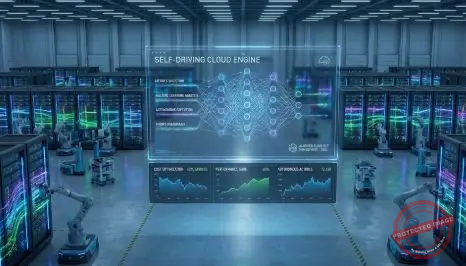
AI-driven platforms are turning cloud cost management into a self-driving discipline, where software learns, predicts, and automatically tunes infrastructure to hit both performance and budget targets.
From dashboards to decisions
For more than a decade, cloud cost management has essentially meant human experts reading dashboards, interpreting usage reports, and manually adjusting instance counts, storage tiers, and commitments. That approach worked when cloud footprints were smaller and release cycles were slower. In 2026, with multi-cloud architectures, Kubernetes, serverless functions, and AI workloads becoming increasingly complex, manual approaches simply cannot keep up.
This is why autonomous cloud optimization platforms are gaining momentum. These tools plug into your cloud accounts, observe behavior across workloads, and then automatically make fine-grained adjustments to rightsizing, autoscaling, and purchasing options such as reserved instances and savings plans. Rather than limiting themselves to recommendations, they are designed to execute changes themselves within guardrails defined by FinOps and platform teams.
Vendors like Sedai position their platforms as “self-driving clouds,” promising 30–50 percent cost savings or 30–75 percent performance gains by continuously learning from live production traffic and autonomously tuning resources. Sedai+1 The big idea is simple but powerful: instead of waiting for this month’s bill to identify over-provisioned resources, the system optimizes in real time as patterns shift.
Inside the autonomous optimization engine
Under the hood, autonomous platforms rely on a stack of observability, machine learning, and policy engines. First, they ingest metrics from cloud providers and application monitoring tools: CPU, memory, disk I/O, latency, error rates, user traffic, and increasingly business KPIs such as revenue per transaction or cost per API call. This gives the platform the raw data it needs to model how workloads behave under different conditions.
Machine learning models then analyze historical and real-time data to identify safe optimization opportunities. For example, they might detect that a particular microservice never exceeds 25 percent CPU utilization during business hours, even under peak load, and recommend shrinking the instance size or reducing replica counts. Once the models are confident, the system can automatically apply those changes during off-peak windows, rolling them back if error rates or latency exceed thresholds. Sedai describes this as closed-loop optimization, where AI continuously monitors, acts, and validates. Sedai+1
Autonomous platforms also evaluate purchasing strategies. They can rebalance portfolios of reserved instances, committed-use discounts, and spot capacity, ensuring commitment levels track demand trends and avoiding the classic problem of over-committed contracts. Some tools integrate directly with cloud billing APIs to simulate the cost impact of different commitment choices before executing them, turning financial engineering into an automated function.
Use cases across Kubernetes, serverless and data platforms
In 2026, the most compelling deployments of autonomous optimization are happening in high-complexity environments where human tuning becomes a bottleneck. Kubernetes clusters are a prime example. With thousands of pods, dozens of node groups, and multiple regions, manually right-sizing all of this is nearly impossible. AI-driven platforms now use granular per-pod metrics to adjust CPU and memory requests, autoscaling thresholds, and node group compositions in real time, dramatically reducing over-provisioning while maintaining SLOs. IBM’s Kubecost-based offering, for instance, focuses on giving teams real-time Kubernetes cost visibility and optimization levers at this level of detail. Apptio+1
Serverless workloads are another fertile ground. Because functions such as AWS Lambda or Azure Functions are billed per request and per duration, small inefficiencies in memory configuration or cold-start behavior can add up to significant costs at scale. Autonomous platforms track usage patterns, adjust memory allocations, and even recommend code-level changes to reduce execution time, all while monitoring performance regressions.
Data and AI platforms are the newest frontier. As organizations run larger Databricks, Snowflake, and AI training clusters, autonomous systems can pause idle workspaces, scale clusters down between jobs, and adjust storage tiers based on access patterns. Sedai recently extended its autonomous optimization capabilities to Databricks, highlighting how AI-driven cost management is moving deep into data engineering stacks. HPCwire+1
Governance, guardrails, and human control
The idea of software making live changes to production infrastructure understandably makes many CIOs nervous. That is why governance and guardrails are becoming critical design principles for autonomous cloud optimization.
Most platforms allow FinOps, security, and platform engineering teams to define policies that constrain what the AI can do. For example, teams might cap the maximum downsize percentage for any instance class, restrict changes during business hours, or require approvals for certain resource types or critical workloads. Policy-as-code frameworks are increasingly common, allowing these rules to be version-controlled, tested, and reused across environments. Harness’s FinOps tooling, for example, combines AI-driven recommendations with policy enforcement and automated remediation, branding it as “Governance-as-Code.” Harness.io+1
Just as critical is the AI’s observability. Modern platforms provide detailed logs of the changes they made, the savings achieved, and the performance impact observed. This transparency is essential for building trust with engineering teams, who need to understand why a particular workload was resized or a commitment portfolio adjusted. Over time, as teams see stable savings without reliability issues, they typically expand the scope of autonomous actions.
How CIOs measure ROI in 2026
By 2026, the business case for autonomous optimization is shifting from pure cost reduction to a broader story about efficiency, resilience, and innovation capacity. Cost savings remain central: vendors routinely highlight customers achieving 20–40 percent lower cloud bills through a combination of rightsizing, commitment optimization, and waste elimination. Apptio
However, CIOs are also measuring benefits in terms of time saved by engineers, improved predictability of cloud spend, and the ability to scale AI and data initiatives without adding proportional headcount. When an AI platform handles the routine tuning, SRE and platform teams can focus on designing better architectures, improving developer experience, or enabling new regions and product lines.
Importantly, autonomous optimization works best when paired with strong FinOps practices: clear cost ownership, shared KPIs between finance and engineering, and transparency into unit economics, such as cost per customer or per feature. As Apptio and IBM emphasize in their Cloudability messaging, the goal is to make cloud a competitive advantage by aligning financial management with technical execution. Apptio Nexright
Closing Thoughts and Looking Forward
By 2026, autonomous cloud optimization platforms are redefining what it means to manage cloud costs. Instead of teams reacting to bills, AI engines continuously adjust infrastructure to stay within guardrails, capture savings opportunities, and protect performance. For organizations embracing multi-cloud, Kubernetes, and AI workloads, these platforms are rapidly becoming essential infrastructure in their own right.
The next phase will likely blend autonomous optimization with carbon-aware scheduling, dynamic risk models, and deeper integration into CI/CD pipelines, so that cost-smart decisions happen before code is even deployed. Enterprises that establish strong governance, invest in FinOps culture, and treat these platforms as strategic capabilities rather than tactical tools will be best positioned to turn the “self-driving cloud” into a durable competitive edge.
Reference sites
Sedai Autonomous Optimization – Sedai – https://www.sedai.io/capabilities/autonomous-optimization
Autonomous Cloud Management Platform | AI-Powered Cloud Optimization – Sedai – https://www.sedai.io/
Sedai: Autonomous Cloud Computing Optimization – Intellyx – https://intellyx.com/2025/07/01/sedai-autonomous-cloud-computing-optimization/
AI-Powered Cloud Cost Optimization: Strategies, Tools & Best Practices – CloudChipr – https://cloudchipr.com/blog/ai-cost-optimization
Cloud Cost Management & Optimization Solutions – IBM Apptio Cloudability – https://www.apptio.com/solutions/cfm/ccmo/
Benoit Tremblay, Author, Tech Cost Management, Montreal, Quebec;
Peter Jonathan Wilcheck, Co-Editor, Miami, Florida.
#CloudCostManagement #FinOps #AutonomousCloud #AICostOptimization #MultiCloud #Kubernetes #CloudGovernance #Rightsizing #CloudSavings #PlatformEngineering
Post Disclaimer
The information provided in our posts or blogs are for educational and informative purposes only. We do not guarantee the accuracy, completeness or suitability of the information. We do not provide financial or investment advice. Readers should always seek professional advice before making any financial or investment decisions based on the information provided in our content. We will not be held responsible for any losses, damages or consequences that may arise from relying on the information provided in our content.
 AAPL
AAPL AMD
AMD CIS.HA
 DELL
DELL IBM
IBM INTC
INTC MSFT
MSFT GOOG
GOOG HPE
HPE NVDA
NVDA TSLA
TSLA TMC
TMC MSI
MSI NOK
NOK ECDH26.CME
 OPEAZZX