


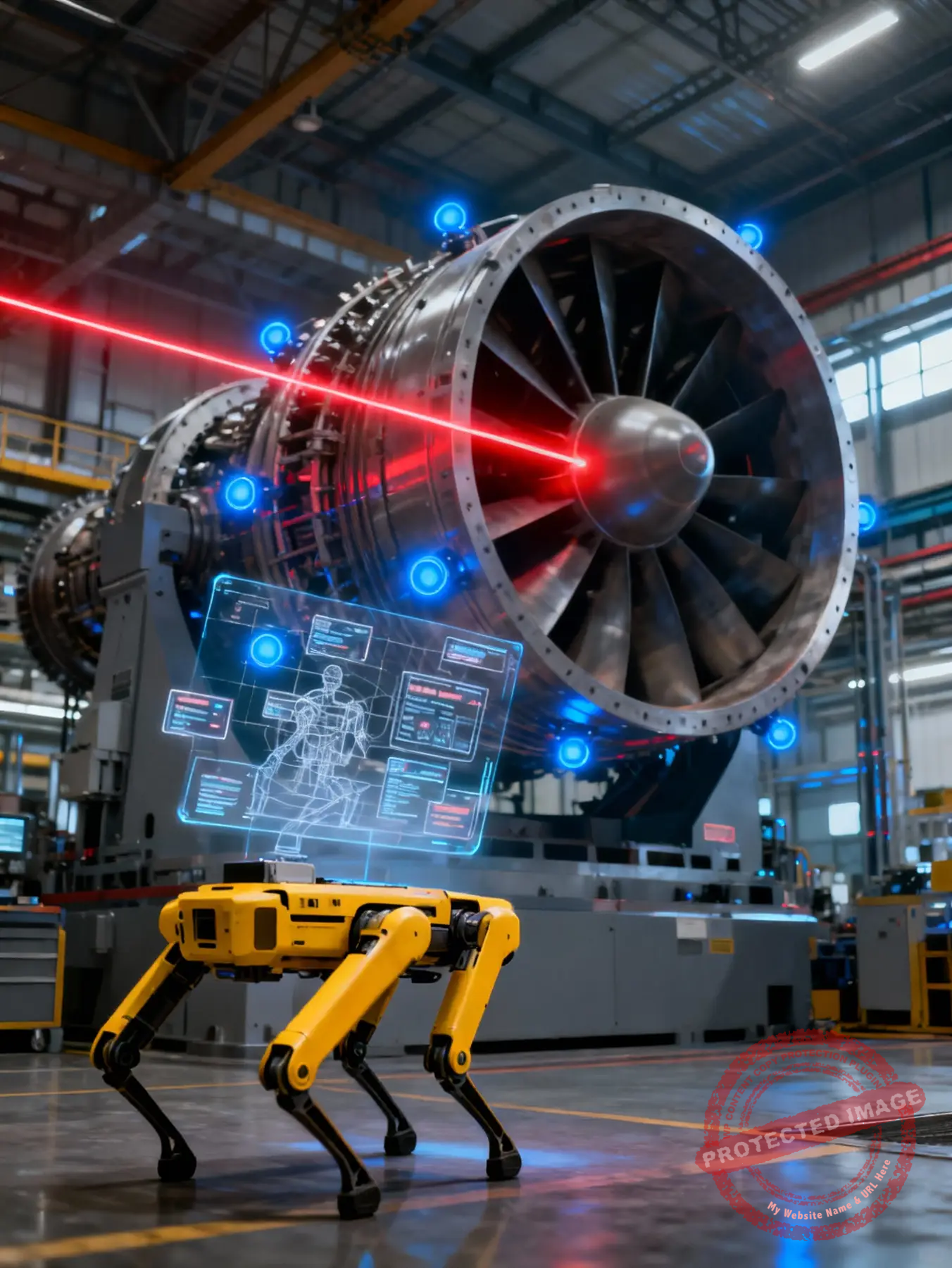
Physical AI is moving from science fiction to plant floor reality. In 2026, networks of smart sensors, edge devices, robots, and drones will not merely report asset conditions; they will increasingly decide and act. For EAM teams, this means the asset base itself becomes a semi-autonomous participant in maintenance operations.
The rise of sensing-rich, self-reporting assets
Industrial IoT and edge computing are already standard in many new-build plants, but adoption is now accelerating into brownfield environments as sensor prices fall and wireless networks mature. Market researchers link much of EAM’s double-digit growth to the integration of AI and IoT, as organizations deploy condition monitoring across rotating equipment, HVAC, fleets, and critical infrastructure. Grand View Research
Physical AI layers machine learning and decision logic directly on top of this sensing fabric. Instead of streaming all data to a distant cloud, edge nodes on pumps, substations, or conveyor segments preprocess signals, detect anomalies, and, in some cases, automatically trigger local actions such as ramping down a motor or switching to a redundant path.
In EAM terms, this turns assets into cooperative participants. Intelligent field devices can request service when needed, send enriched diagnostics to the work order, and temporarily adjust their behavior to mitigate risk while waiting for human intervention.
Drones, robots, and inspection swarms
By 2026, robotic inspection is expected to be routine in many high-risk or hard-to-reach environments. Facilities and infrastructure reports already show growing use of mobile robots, quadrupeds, and UAVs for inspecting roofs, tank farms, transmission lines, and offshore assets. Totalmobile
Integrated with EAM, these inspection platforms become extensions of the asset record rather than standalone gadgets. A digital agent can dispatch a drone to verify a suspect hot spot detected by infrared sensors, then automatically upload video, thermal imagery, and measurements to the asset’s history. If thresholds are exceeded, work orders and permits are raised without a human ever having to touch the keyboard.
Robotic process automation on the operational side complements this physical automation. Bots reconcile meter readings, cross-check invoices with work logs, and synchronize asset hierarchies between EAM, GIS, and ERP systems, shrinking the administrative overhead that has long plagued maintenance departments.
Edge-native digital twins for real-time decision support
Physical AI and intelligent sensing networks are tightly intertwined with the spread of digital twins. Analysts emphasize that the most valuable twins are not static 3D models but live, data-fed systems running at the edge, where latency is measured in milliseconds rather than seconds. IEEE Computer Society
Edge-native twins allow EAM agents to simulate “what-if” scenarios when anomalies arise. Suppose a vibration pattern suggests impending bearing failure. In that case, the twin can estimate how long the asset can safely operate, how energy consumption will change, and which other assets will be affected. The AI agent then weighs options: derate the asset, reroute load, or schedule immediate shutdown.
EAM vendors are increasingly partnering with simulation specialists to embed these capabilities. SAP’s predictive engineering insights, enabled by Ansys, is one long-running example of engineering-grade models being linked to asset records for predictive maintenance decisions. Ansys
Cyber-physical risk, safety, and resilience
As more decisions move to the edge, the attack surface expands. A compromised sensor network can now do more than falsify measurements; it could, in theory, trigger real-world actions by causing devices to shut down unexpectedly or mask unsafe conditions. That is pushing EAM leaders to work more closely with cybersecurity and safety functions.
Zero-trust architectures, secure boot for edge devices, signed firmware updates, and continuous anomaly detection on control traffic are becoming standard in critical industries. EAM and OT security logs are starting to converge, enabling teams to correlate unusual maintenance events with suspicious network behavior.
At the same time, physical AI enhances resilience. Smart grids, rail systems, and water networks can reconfigure themselves under fault conditions, isolating damaged sections and preserving service elsewhere. In this context, EAM becomes a central cockpit for orchestrating both planned maintenance and emergency reconfiguration.
Closing thoughts and looking forward
The story of physical AI in EAM is not one of replacing people with machines. It is about embedding intelligence where it can act fastest: on the asset, in the robot, at the edge. Human experts increasingly supervise fleets of semi-autonomous devices and agents, focusing on strategy, complex troubleshooting, and innovation rather than repetitive inspection rounds.
By 2026, organizations that treat physical AI and sensing networks as core infrastructure—not optional add-ons—will be better positioned to deliver safer operations, lower downtime, and more sustainable asset performance. The asset base will not just be operated; it will actively co-manage its own health.
Reference sites:
IoT, Edge, and Digital Twins: The New Playbook for Maintenance – IEEE Computer Society – https://www.computer.org/publications/tech-news/trends/new-playbook-for-maintenance
Enterprise Asset Management Market Size and Share – Mordor Intelligence – https://www.mordorintelligence.com/industry-reports/enterprise-asset-management-market
Facilities Management Trends for 2026 – Totalmobile – https://www.totalmobile.com/blog/facilities-management-trends
How Digital Twins Optimize the Performance of Your Assets – IBM – https://www.ibm.com/think/insights/digital-twin-asset-management
SAP Adds Digital Twin Technology to Asset Management – IoT World Today – https://www.iotworldtoday.com/connectivity/sap-adds-digital-twin-technology-to-asset-management
Co-Editor: John Felsen, – Gadgets: Tablets/Notebooks, Montreal, Quebec;
Peter Jonathan Wilcheck, Co-Editor, Miami, Florida.
#PhysicalAI #SmartSensing #IoTAssets #EdgeComputing #DigitalTwins #EAM2026 #RoboticInspection #PredictiveMaintenance #IndustrialIoT #OperationalResilience
Post Disclaimer
The information provided in our posts or blogs are for educational and informative purposes only. We do not guarantee the accuracy, completeness or suitability of the information. We do not provide financial or investment advice. Readers should always seek professional advice before making any financial or investment decisions based on the information provided in our content. We will not be held responsible for any losses, damages or consequences that may arise from relying on the information provided in our content.

 AAPL
AAPL AMD
AMD CIS.HA
 DELL
DELL IBM
IBM INTC
INTC MSFT
MSFT GOOG
GOOG HPE
HPE NVDA
NVDA TSLA
TSLA TMC
TMC MSI
MSI NOK
NOK OPEAZZX