


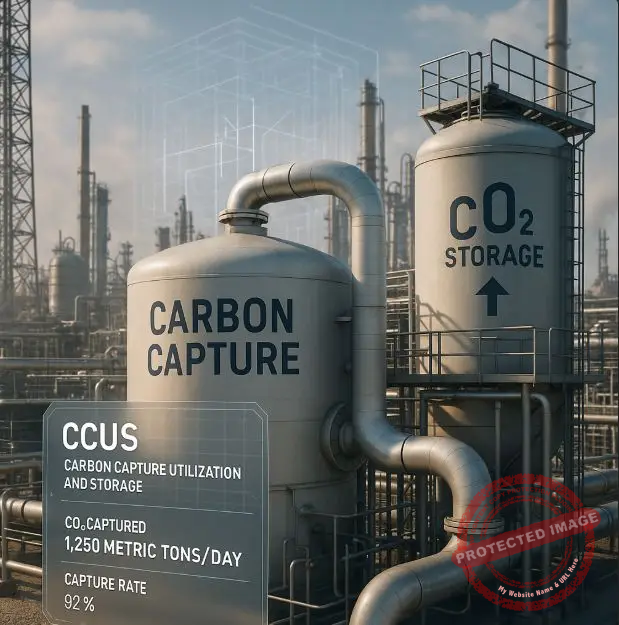
CCUS moves from slide decks to steel and concrete as climate policy tightens.
From marginal technology to the central decarbonization lever
For years, carbon capture, utilization, and storage (CCUS) sat on the margins of corporate climate strategies, criticized as expensive and unproven. That picture is changing rapidly as governments attach tax incentives, standards, and regulatory requirements to CCUS deployment, especially for hard-to-abate sectors such as cement, steel, refining, and chemicals. IEA
Recent policy shifts in markets like the United States require coal and gas plants to adopt carbon capture technology to meet steep emissions reduction goals over the coming decade, fundamentally reshaping investment decisions and ESG roadmaps for utilities and heavy industry. KnowESG
CCUS projects reach new milestones
The project pipeline is no longer theoretical. International energy agencies track dozens of first-of-a-kind CCUS projects that have reached final investment decision or entered construction in recent years, including natural-gas power plants, waste-to-energy facilities and large industrial emitters. IEA
In Europe, Norway’s Northern Lights project has begun injecting CO₂ into offshore reservoirs, creating a commercial storage hub for emitters across the region. Reuters In North America, regulators have approved large underground storage projects linked to multi-state CO₂ pipeline networks serving ethanol plants and other emitters, as companies race to lock in tax credits and ESG-aligned revenue streams. AP News
ESG integration: reporting, taxonomy alignment and just transition
For ESG teams, CCUS is evolving from an engineering issue to a disclosure and governance challenge. Companies are under pressure to demonstrate that captured CO₂ volumes are real, verifiable and aligned with credible net-zero pathways. Climate-aligned taxonomies increasingly distinguish between CCUS applications that enable long-term decarbonization and those that mainly prolong fossil-fuel use. OGCI
Investors and NGOs are asking hard questions about environmental integrity, long-term liability for storage sites and the distributional impacts of CCUS projects on local communities and indigenous lands. Proponents argue that CCUS can preserve industrial jobs while reducing emissions, but critics warn that poorly governed projects risk becoming expensive greenwashing, or even turning regions into “carbon dumping grounds.” The Guardian+1
Technology and market outlook to 2026
On the technology side, research continues into new solvents, sorbents, membranes and process designs to cut capture costs and energy penalties. Utilization pathways—from synthetic fuels and chemicals to building materials—are being tested for scalability and lifecycle performance. A recent scientific review emphasizes that CCUS capacity must expand by nearly ninety times between 2022 and mid-century to align with 1.5-degree scenarios, underscoring both the scale of the opportunity and the risk of under-delivery. ScienceDirect
Markets for CO₂ storage and transport services are emerging, with long-term contracts and regulated tariffs reminiscent of gas pipeline systems. Legal specialists highlight the growing complexity of CCUS transaction structures, from tax-equity financing around Section 45Q credits to cross-border transport agreements. Akin – Akin, an Elite Global Law Firm
Closing thoughts and looking forward
By 2026, CCUS will be a litmus test for the credibility of heavy-industry decarbonization plans. Companies that approach CCUS as a tightly governed component of broader transformation strategies—paired with efficiency, electrification and renewables—can position it as a powerful ESG asset. Those that treat it as a stand-alone license to continue high-carbon operations are likely to face growing skepticism from investors, regulators and communities.
The deciding factors will be transparency, community engagement and rigorous measurement. As more CCUS projects move from policy announcements to operating assets, ESG frameworks will need to evolve quickly to track not just tonnes of CO₂ captured but long-term storage integrity, local impacts and contribution to a just transition.
Reference sites
Carbon Capture Utilisation and Storage – International Energy Agency – https://www.iea.org/energy-system/carbon-capture-utilisation-and-storage IEA
CCUS Projects Around the World Are Reaching New Milestones – International Energy Agency Commentary – https://www.iea.org/commentaries/ccus-projects-around-the-world-are-reaching-new-milestones IEA
Carbon Capture, Utilization and Storage as a Decarbonization Lever – Oil and Gas Climate Initiative – https://www.ogci.com/wp-content/uploads/2024/05/CCU-Report-vf.pdf OGCI
Carbon Capture and Storage: Gaining Ground, Despite Challenges – ING Think – https://think.ing.com/articles/carbon-capture-storage-outlook-2025-gaining-ground-despite-challenges/ ING Think
CCUS Handbook: Legal and Regulatory Considerations – U.S. Department of Commerce – https://cldp.doc.gov/sites/default/files/2024-04/CCUS%20Handbook.pdf CLDP
Co-Editor: Benoit Tremblay, Author, Tech Cost Management, Montreal, Quebec;
Peter Jonathan Wilcheck, Co-Editor, Miami, Florida.
#ESG #CCUS #CarbonCapture #NetZero #Decarbonization #IndustrialTransition #ClimatePolicy #EnergyTransition #Sustainability #JustTransition
Post Disclaimer
The information provided in our posts or blogs are for educational and informative purposes only. We do not guarantee the accuracy, completeness or suitability of the information. We do not provide financial or investment advice. Readers should always seek professional advice before making any financial or investment decisions based on the information provided in our content. We will not be held responsible for any losses, damages or consequences that may arise from relying on the information provided in our content.

 AAPL
AAPL AMD
AMD CIS.HA
 DELL
DELL IBM
IBM INTC
INTC MSFT
MSFT GOOG
GOOG HPE
HPE NVDA
NVDA TSLA
TSLA TMC
TMC MSI
MSI NOK
NOK OPEAZZX