


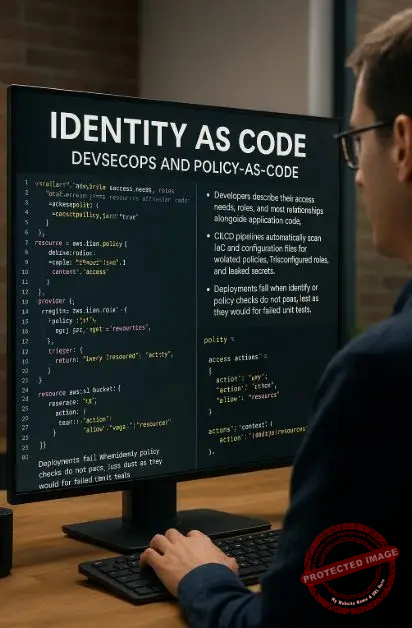
As DevOps, cloud, and IaC mature, identity is being pulled squarely into the software delivery lifecycle. In 2026, the most advanced IAM programs treat access policies the same way they treat application code: versioned, peer-reviewed, and automatically tested in pipelines. The result is a world where every deployment carries its own access guardrails, and “identity as code” becomes the backbone of DevSecOps.
From DevOps to DevSecOps to DevSecIdentity
DevSecOps has already become the accepted path to embed security controls into build and release processes instead of bolting them on at the end.urolime.com For IAM, this means shifting from sporadic entitlement reviews and security audits to continuous enforcement:
Developers describe their access needs, roles, and trust relationships alongside application code.
CI/CD pipelines automatically scan IaC and configuration files for violated policies, misconfigured roles, and leaked secrets.SentinelOne gomboc.ai
Deployments fail when identity or policy checks do not pass, just as they would for failed unit tests.
IAM is no longer a separate gate at the end; it is part of every commit, merge, and rollout.
Policy-as-code: Guardrails instead of gates
Policy-as-code takes the IaC idea and applies it to security and compliance rules. Major cloud providers and security vendors now recommend expressing IAM constraints – such as allowed regions, required encryption, or forbidden public endpoints – as code that can be automatically evaluated by policy engines.Amazon Web Services, Inc.+2HashiCorp | An IBM Company
In 2026, IAM teams increasingly publish reusable policy libraries that encode zero-trust principles, regulatory requirements, and internal standards. These libraries become shared building blocks for platform teams and application squads. When a developer proposes a new IAM role or data access pattern in Terraform or another IaC tool, policy-as-code engines immediately validate it.
If the role grants broad administrative privileges, violates least privilege, or exposes sensitive data, the pipeline rejects it before it ever reaches production. Misconfigurations that would previously linger for months are now blocked in minutes.SentinelOne
Multicloud, hybrid, and the need for consistent policies
Enterprises are adopting multi-cloud and hybrid architectures to optimize cost, resilience, and sovereignty, but this also multiplies IAM complexity. Each cloud provider brings its own IAM model, permission language, and tooling, making manual policy management brittle and error-prone. Recent guidance on multi-cloud security emphasizes consistent policy enforcement, automated configuration checks, and centralized visibility across providers.Apriorit Reva University Race
Policy-as-code is emerging as the only scalable way to express security intent once and enforce it everywhere. Identity teams increasingly define high-level zero-trust controls – such as “no workloads with public admin interfaces” or “all data stores must be encrypted at rest” – in a unified policy layer that maps down to provider-specific IAM constructs.
This model also supports fine-grained identity segmentation: workloads, AI agents, CI runners, and microservices are grouped by business domain, risk profile, and regulatory regime, and policies apply consistently wherever they run.
AI-assisted IAM policy design and verification
Designing good IAM policies is notoriously hard. Real-world permission graphs are dense, and human administrators easily overlook “dark permissions” that are rarely used but still exploitable. Researchers are turning to AI – specifically, graph learning and optimization – to help generate and optimize IAM policies that reduce unnecessary access while preserving functionality.arXiv
In parallel, AI-driven DevSecOps platforms increasingly analyze IaC, container manifests, and CI/CD logs to spot dangerous patterns, such as overbroad roles or unusual privilege escalations in test environments.arXiv+2OX Security In 2026, these tools will more often propose concrete fixes: recommended least-privilege roles, safer scoped tokens, and alternative designs that align with zero-trust principles.
That is the “copilot for IAM” moment: developers get real-time suggestions on how to implement secure access in code, while security teams get continuous assurance that policies are being followed in every pipeline.
Closing thoughts and looking forward
By 2026, identity as code is no longer a buzzword. Organizations that fully embrace DevSecOps and policy-as-code treat IAM as a living, testable artifact of their software stack. Identity constraints, compliance rules, and zero-trust principles are captured in policy libraries and enforced in every environment, from developer laptops to production clusters and edge locations.
The upside is not just fewer breaches; it is a smoother developer experience. Instead of waiting for manual approvals, teams work within guardrails that allow rapid delivery with built-in security. IAM teams evolve from rule enforcers to platform builders, curating shared components and AI-assisted tools that help everyone deliver secure-by-default systems.
References
Enforce Permissions and Compliance by Using Policy as Code – AWS Security Blog – https://aws.amazon.com/blogs/security/governance-at-scale-enforce-permissions-and-compliance-by-using-policy-as-code/
Policy as Code, Explained – HashiCorp Blog – https://www.hashicorp.com/blog/policy-as-code-explained
Infrastructure as Code (IaC) Security: 10 Best Practices – Spacelift Engineering Blog – https://medium.com/spacelift/infrastructure-as-code-iac-security-10-best-practices-70811d0064e5
Infrastructure as Code (IaC) Security: A Comprehensive Guide – Gomboc.ai – https://www.gomboc.ai/blog/the-comprehensive-guide-to-understanding-infrastructure-as-code-security
What Is DevSecOps Automation? Benefits and Best Practices – Wiz.io Academy – https://www.wiz.io/academy/what-is-devsecops-automation
Co-Editor, Benoit Tremblay, IT Security Management, Montreal, Quebec.
Peter Jonathan Wilcheck, Co-Editor, Miami, Florida.
#identityascode #devsecops #policyascode #zerotrustIAM #multicloudsecurity #iacsecurity #leastprivilege #cloudgovernance #secureSDLC #complianceautomation
Post Disclaimer
The information provided in our posts or blogs are for educational and informative purposes only. We do not guarantee the accuracy, completeness or suitability of the information. We do not provide financial or investment advice. Readers should always seek professional advice before making any financial or investment decisions based on the information provided in our content. We will not be held responsible for any losses, damages or consequences that may arise from relying on the information provided in our content.
 AAPL
AAPL AMD
AMD CIS.HA
 DELL
DELL IBM
IBM INTC
INTC MSFT
MSFT GOOG
GOOG HPE
HPE NVDA
NVDA TSLA
TSLA TMC
TMC MSI
MSI NOK
NOK OPEAZZX