


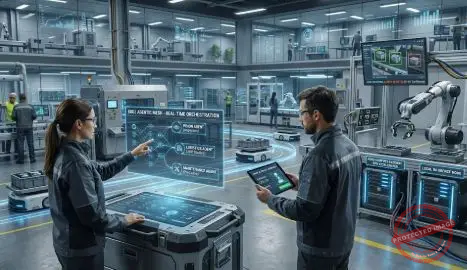
In 2026, the most important characteristic of an edge platform will not be how many cores it has or how many sensors it connects. It will be how much intelligence it can execute locally. AI and machine learning are moving from centralized training environments into gateways, routers, industrial controllers, cameras, and vehicles, transforming the edge into a distributed mesh of decision engines.
Edge AI becomes a mainstream workload
Edge AI used to mean simply offloading inference from the cloud to reduce latency or bandwidth. Today it has grown into a whole ecosystem. Market analysts estimate that the global edge AI segment is worth over twenty billion dollars in 2025 and is on track for strong double-digit growth into the 2030s as more enterprises deploy AI models where data is produced. Precedence Research
This growth is not limited to one industry. In manufacturing, computer-vision models running on edge gateways inspect products for defects, detect unsafe conditions and monitor assembly lines in real time. In energy, predictive models on substation equipment forecast load and identify anomalies in distribution networks. In retail, smart shelves equipped with small edge devices track inventory and customer interactions to optimize stock and layout.
Edge AI frameworks have matured as well. Lightweight inference engines, quantization and pruning techniques allow sophisticated models to run on relatively modest hardware. Some vendors are experimenting with on-device fine-tuning, enabling models to adapt to local conditions over time while periodically synchronizing updates with a central server. This hybrid learning pattern lets enterprises respect latency and privacy constraints without sacrificing global performance improvements. Software Development Company – N-iX
From single models to agentic AI at the edge
The next wave is not just about single models making isolated predictions. It is about agentic AI systems operating on the edge as autonomous workflows. Agentic AI describes collections of specialized agents that coordinate to achieve goals, combining perception, reasoning, planning and action. www.trendmicro.com+4Amazon Web Services, Inc.+4Akamai+4
On a factory floor in 2026, this might mean a vision agent monitoring conveyor belts, a maintenance agent tracking equipment health, a logistics agent optimizing material flow and a safety agent enforcing rules. An orchestration layer assigns tasks, reconciles conflicting recommendations and escalates decisions when human approval is needed. In a smart building, separate agents may manage HVAC, lighting, access control and occupancy analytics, collaborating through a local agent framework running on an edge appliance.
The appeal of agentic designs is that they can handle complex, evolving workflows without requiring all logic to be encoded in brittle rules. They can experiment, evaluate and refine their own strategies under constraints defined by human operators, while keeping the sensing and actuation loops close to the physical environment.
However, there are risks. Analysts warn that many early “agentic AI” projects are over-hyped or poorly scoped, and a significant portion may be cancelled over the next few years due to cost and integration challenges. Reuters Successful deployments will be those that focus on bounded domains with clear objectives, robust guardrails and tight integration into existing operational technology.
Designing AI-first edge architectures
Building AI-first edge platforms requires a different mindset than merely connecting devices and sending data upstream. Architects need to think about hardware, software and connectivity as an integrated stack optimized for model execution.
At the hardware level, 2026 edge devices will commonly include specialized accelerators such as GPUs, NPUs or dedicated tensor cores. These units must balance performance, power consumption and thermal constraints, especially in fanless enclosures or outdoor environments.
At the software level, containerized microservices and orchestration tools will manage hundreds or thousands of models running across fleets of devices. DevOps will merge with MLOps into a unified “EdgeOps” practice that handles model versioning, rollout strategies, telemetry collection, rollback and compliance documentation.
At the connectivity level, systems must gracefully degrade when links are slow or unavailable. Local models should continue to operate autonomously, buffering data and reconciling state with the cloud when connectivity returns. This is crucial in remote industrial sites, transport systems and emergency response scenarios.
Security also needs to be AI-aware. Attackers can attempt to manipulate edge models through adversarial inputs, data poisoning or model theft. Enterprises will deploy techniques such as adversarial training, runtime anomaly detection and secure enclaves to protect edge AI pipelines.
Human-in-the-loop and governance at the edge
As more decisions are delegated to edge AI, governance becomes critical. Not every decision should be automated, and not every automated action should be irreversible. Human-in-the-loop designs will remain essential, especially in safety-critical domains such as healthcare, transportation and industrial control.
Edge dashboards will provide operators with explanations of why models made particular recommendations, along with uncertainty estimates and scenario comparisons. Agentic systems will maintain detailed logs of the actions they took and the data they relied on, enabling audits and root-cause analysis if something goes wrong. Windows Central+1
Regulators are also paying attention. Emerging AI regulations and standards emphasize transparency, accountability and robustness, and these requirements apply equally to edge deployments. Organizations will need consistent frameworks for cataloging models, assessing risk, tracking training datasets and documenting mitigations.
Closing thoughts and looking forward
In 2026, AI and edge machine learning will no longer be exotic experiments. They will be core elements of how factories run, how cities manage traffic, how hospitals deliver care and how retailers engage customers. Edge AI will shift from isolated proofs of concept to multi-tenant platforms that host dozens or hundreds of workloads, many of them orchestrated by agentic frameworks that can autonomously pursue goals while respecting safety and policy boundaries.
The challenge will be scaling this intelligence responsibly. Enterprises will need to invest in robust EdgeOps practices, security controls and governance mechanisms that treat models as first-class assets. Those that succeed will unlock new efficiencies, unlock new product categories and respond to events with a speed that centralized architectures cannot match. Those that cut corners will face outages, security incidents and regulatory pushback. The edge will be intelligent, but it will also demand serious engineering discipline.
References
Edge AI Market Size to Attain USD 143.06 Billion by 2034 – Precedence Research – https://www.precedenceresearch.com/edge-ai-market
AI in Edge Computing Market to Surpass USD 83.86 Billion by 2032 – PR Newswire – https://www.prnewswire.com/news-releases/ai-in-edge-computing-market-to-surpass-usd-83-86-billion-by-2032–driven-by-industrial-iot-5g-and-intelligent-infrastructure-expansion–datam-intelligence-302603906.html
Key Edge AI Trends Transforming Enterprise Tech – N-iX – https://www.n-ix.com/edge-ai-trends/
The Rise of Edge Computing in IoT App Development – CM Alliance – https://www.cm-alliance.com/cybersecurity-blog/the-rise-of-edge-computing-in-iot-app-development
Agentic AI: How Autonomous Agents Are Changing the Game – Akamai – https://www.akamai.com/blog/developers/agentic-ai-how-autonomous-agents-are-changing-the-game
Gut Azzit, Co-Editor IT Security Management, Montreal, Quebec.
Peter Jonathan Wilcheck, Co-Editor, Miami, Florida.
#EdgeAI #MachineLearning #AgenticAI #AutonomousSystems #EdgeAnalytics #PredictiveMaintenance #MLOps #EdgeOps #IndustrialAI #RealTimeDecisionMaking
Post Disclaimer
The information provided in our posts or blogs are for educational and informative purposes only. We do not guarantee the accuracy, completeness or suitability of the information. We do not provide financial or investment advice. Readers should always seek professional advice before making any financial or investment decisions based on the information provided in our content. We will not be held responsible for any losses, damages or consequences that may arise from relying on the information provided in our content.
 AAPL
AAPL AMD
AMD CIS.HA
 DELL
DELL IBM
IBM INTC
INTC MSFT
MSFT GOOG
GOOG HPE
HPE NVDA
NVDA TSLA
TSLA TMC
TMC MSI
MSI NOK
NOK OPEAZZX