


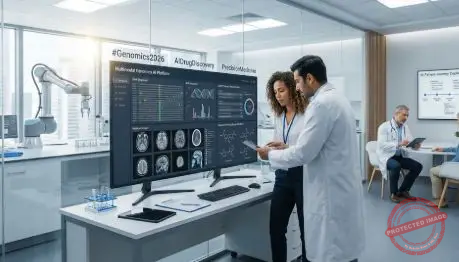
Generative AI and multimodal genomics are turning drug discovery and diagnostics into a continuously learning system rather than a sequence of disconnected experiments.
The 2026 context: From data exhaust to decision engine
For a decade, genomics has been generating data faster than clinicians and researchers could interpret it. In 2026 that bottleneck is being attacked head-on with AI models that treat genomes, medical images and clinical notes as one connected signal. New systems like popEVE, an AI model that uses evolutionary information across hundreds of thousands of species to interpret mutations, are already improving rare-disease diagnostics by spotting pathogenic variants that conventional tools miss. Financial Times
In parallel, pharma companies are deploying dedicated AI supercomputers and multimodal platforms to compress drug discovery cycles from years to months. Eli Lilly’s partnership with Nvidia to build an AI supercomputer for drug discovery is emblematic of this shift, with the company casting AI not as a simple tool but as a “collaborative scientific partner.” Reuters
AI across the drug discovery pipeline
By 2026, AI will no longer be confined to screening small molecules against a single target. Platforms from startups and established players now string together target identification, hit discovery, lead optimization, and biomarker strategy into one integrated AI-assisted workflow.
Companies such as Nabla Bio are showing how generative AI can design protein therapeutics with a turnaround from in silico design to lab testing measured in weeks, not months, enabling more rapid iteration on difficult biologics. Reuters Hybrid AI pipelines combine structural biology, high-throughput laboratory readouts and clinical genomics to build models that not only predict binding affinity but also anticipate resistance mutations and toxicity signals before a compound enters costly trials. Front Line Genomics+1
In oncology, AI-native platforms like those developed by BostonGene blend tumor tissue analytics with genomic and clinical data to derive signatures that guide both target discovery and trial stratification. BostonGene. These systems can simulate how different patient subgroups might respond to a candidate therapy, allowing companies to design smaller, more focused, and potentially more successful trials.
Genomic diagnostics: Rare disease and beyond
AI is equally transformative on the diagnostic side. PopEVE and similar models are redefining how clinicians interpret missense variants, learning from the absence of certain mutations across the tree of life to infer which changes are likely to be harmful in humans. Financial Times
These AI systems sit on top of whole-genome sequencing pipelines, scoring variants in context of population databases, evolutionary conservation, protein structure and real-world clinical phenotypes. In practice, this reduces the proportion of “variants of uncertain significance,” giving genetic counselors more precise answers for families in diagnostic odysseys. In low- and middle-income countries, energy-efficient models are making genome-based diagnostics more accessible in resource-constrained hospitals, where GPUs and cloud computing are limited. Financial Times
AI agents in the clinic: Patient-journey copilots
What makes 2026 different is the emergence of agentic AI systems that stay present throughout the patient journey rather than appearing as single-use tools. In hospital genomics programs, agents can:
They monitor inbound test orders, check for guideline-concordant indications, track sequencing status, and nudge clinicians when results are ready. They draft variant-interpretation summaries and patient-friendly explanations, linking each recommendation back to the evidence base. They monitor EMR streams for patients whose evolving phenotypes suggest revisiting older “negative” genomic tests with updated AI models.
In cardiology, radiology and oncology clinics, multimodal AI copilots correlate genomic markers with image findings and lab results to flag subtle early-warning signals for conditions such as cardiomyopathies or hereditary cancer syndromes. Rather than replacing clinicians, these agents handle tedious cross-referencing and literature review, allowing specialists to focus on nuanced decision-making and patient communication. Front Line Genomics
Risks, bias and regulatory scrutiny
The power of AI-assisted genomics brings higher stakes. Training data for many models is still skewed toward populations of European ancestry, which risks misclassifying variants in underrepresented groups and exacerbating existing healthcare inequities. The rare-disease AI community is responding by intentionally incorporating more diverse population datasets and measuring model performance across ancestries, as the popEVE project has done. Financial Times
Regulators are also tightening expectations. Health authorities are moving toward requiring traceability from AI recommendation back to the evidence, robust post-market surveillance for AI-based diagnostics, and clear boundaries between “assistive” and “autonomous” decision-making. Hospitals need to treat these systems as safety-critical infrastructure, with governance frameworks that cover model updates, drift monitoring and bias audits rather than one-off software purchases.
Strategies for health systems and pharma in 2026
For health systems, the immediate priority is to build an interoperability layer where genomic data, imaging, pathology and clinical notes can be securely pulled into AI workflows without fragmenting into yet more siloed platforms. Leaders are standing up multidisciplinary precision-medicine boards that include bioinformaticians, ethicists and data governance experts alongside clinicians.
Pharma organizations, meanwhile, are formalizing “AI translation” roles to glue together computational teams and wet-lab scientists, ensuring that AI-generated hypotheses are testable, explainable and linked to clear go/no-go criteria. Strategic partnerships with cloud providers and chip manufacturers are common, but forward-looking firms are equally focused on owning their data pipelines and IP rather than outsourcing the most critical components. Front Line Genomics
Closing thoughts and looking forward
By late 2026, AI in genomics-driven drug discovery and diagnosis is shifting from hype to infrastructure. The most successful organizations are not the ones with the flashiest demos, but those that treat AI as a co-worker embedded in validated workflows, subject to the same quality controls as any other clinical or R&D system.
Over the next few years, as these models ingest ever larger and more diverse genomic datasets, they will increasingly move from pattern recognition to mechanistic insight—explaining why a variant behaves the way it does or why a drug fails in a particular subgroup. The institutions that invest now in data quality, responsible governance and cross-functional collaboration will be best positioned to translate this new AI-genomics stack into safer therapies and more equitable care.
Reference sites
Transforming Drug Discovery with AI: From Models to Medicines – Frontline Genomics – https://frontlinegenomics.com/transforming-drug-discovery-with-ai/
AI-powered drug development: 2025 Revolution – Lifebit – https://lifebit.ai/blog/ai-powered-drug-development-2025-revolution/
Genomics launches Mystra: the world’s first AI-enabled human genetics platform – Genomics plc – https://www.genomics.com/newsroom/genomics-mystra-ai-enabled-human-genetics-platform
New AI model enhances diagnosis of rare diseases – Financial Times – https://www.ft.com/content/bc49e334-776b-41d0-a9be-fb0c29c54853
Lilly partners with Nvidia on AI supercomputer to speed up drug development – Reuters – https://www.reuters.com/business/healthcare-pharmaceuticals/lilly-partners-with-nvidia-ai-supercomputer-speed-up-drug-development-2025-10-28/
Mark Samuel, Contributor, Health Management, Montreal, Quebec.
Peter Jonathan Wilcheck, Co-Editor, Miami, Florida.
#Genomics2026 #AIDrugDiscovery #PrecisionMedicine #GenomicDiagnostics #AIAgentsInHealthcare #RareDiseaseAI #OncologyInnovation #MultimodalAI #ClinicalGenomics #HealthcareTransformation
Post Disclaimer
The information provided in our posts or blogs are for educational and informative purposes only. We do not guarantee the accuracy, completeness or suitability of the information. We do not provide financial or investment advice. Readers should always seek professional advice before making any financial or investment decisions based on the information provided in our content. We will not be held responsible for any losses, damages or consequences that may arise from relying on the information provided in our content.

 AAPL
AAPL AMD
AMD CIS.HA
 DELL
DELL IBM
IBM INTC
INTC MSFT
MSFT GOOG
GOOG HPE
HPE NVDA
NVDA TSLA
TSLA TMC
TMC MSI
MSI NOK
NOK OPEAZZX