


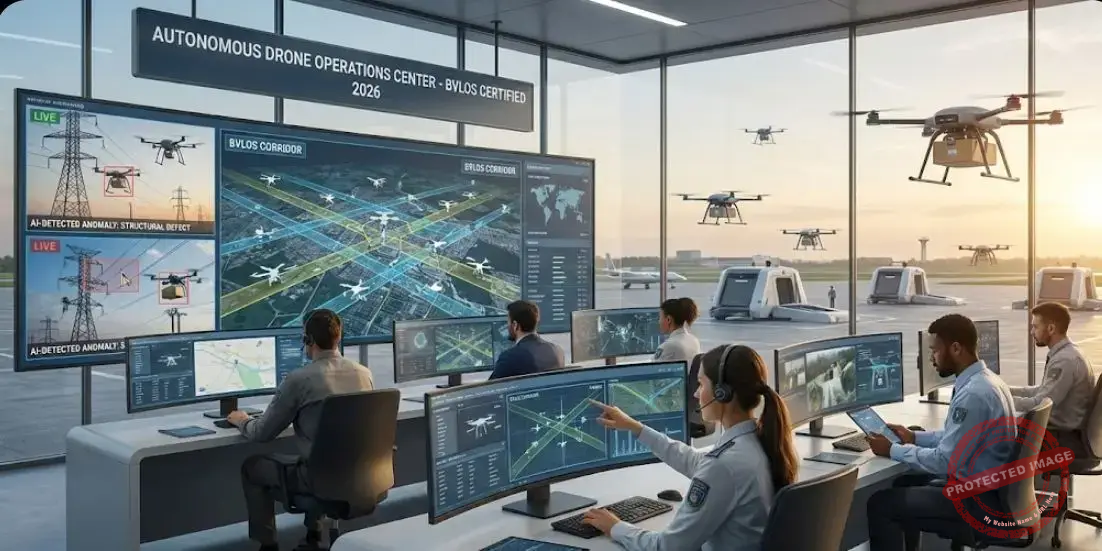
The race to normalize beyond visual line of sight flights in 2026
For a decade, regulators forced drones to behave like radio-controlled toys: always within the pilot’s line of sight, constrained to short hops and small projects. That model is now breaking. In 2025 the U.S. government proposed a federal rule that would make it dramatically easier for drones to travel long distances beyond visual line of sight (BVLOS) without a cumbersome waiver process, with new requirements for detect-and-avoid technology, weight limits and altitude caps under 400 feet. AP News At the same time, the FAA unveiled a dedicated BVLOS rulemaking agenda to “unleash American drone dominance” and move away from one-off approvals toward scalable frameworks. Federal Aviation Administration
By 2026, this shift is expected to enable fleets of highly autonomous drones to handle routine inspections, deliveries and public-safety missions with only light human supervision. The center of gravity moves from the pilot’s thumbs to onboard AI and cloud-based autonomy engines.
Why autonomy and BVLOS matter
Under traditional visual-line-of-sight rules, a utility could inspect just a handful of towers per flight, or a logistics firm might test drone delivery in a single suburb. Human pilots, operating one aircraft at a time, become the bottleneck. BVLOS combined with autonomy inverts that equation.
AI-enabled drones already use onboard perception, GPS-denied navigation, and real-time route optimization to follow repeatable inspection paths, orbit complex assets, or track moving vehicles with minimal input. Market analysts tracking the AI-in-drones segment highlight rapid growth in software that supports object detection, predictive maintenance, and automated decision-making from 2025 through 2033. Grand View Research
Once BVLOS approvals become more routine, these capabilities can be applied at a continental scale: long-range power-line inspections, pipeline patrols, large-farm crop surveys, and middle-mile logistics corridors stop being pilot experiments and become standard operational tools.
Regulation catches up with technology
The tension to date has been simple: technology moved faster than rulebooks. The U.S. has already granted hundreds of waivers allowing companies like Amazon and major utilities to operate BVLOS flights under narrow conditions. Still, the waiver process is slow and highly specialized. AP News
The new BVLOS proposal, and associated NPRM processes, seek to normalize such operations for drones under about 600 kilograms, provided they stay below 400 feet, avoid sensitive areas and integrate collision-avoidance systems that keep them separated from other aircraft. Federal Aviation Administration Regulators are also defining expectations for remote pilot certification, remote ID, and data logging so that autonomous missions can be audited just as manned flights are today.
Globally, similar efforts are emerging. Europe’s EASA and national authorities are building “specific” and “certified” categories for more complex BVLOS missions. At the same time, countries engaged in heavy drone experimentation—such as those influenced by recent conflicts and large-scale infrastructure projects—are codifying lessons into updated guidelines.
From single-mission flights to autonomous operations centers
In 2026, autonomy will be less about a single clever drone and more about orchestrated operations centers. A typical enterprise drone hub will:
Use AI-driven flight-planning tools to schedule missions based on weather, asset priority, and airspace constraints.
Coordinate fleets of dock-based drones that self-launch from rooftops, substations or depot yards, fly their pre-approved BVLOS routes, and return for automated charging or hydrogen refueling.
Feed imagery and telemetry into cloud platforms where computer-vision models flag anomalies—cracked insulators, vegetation encroachment, structural defects—before a human analyst ever opens the feed. Utilities, for instance, are already leveraging AI to move from simple visual checks to predictive maintenance programs that cut unplanned outages and improve grid reliability. Optelos+1
Public safety agencies are evolving too. More departments now treat drones as a first-response “overwatch” asset: automatically dispatched to 911 calls, streaming thermal and optical video back to command centers, often using tactical BVLOS waivers. Search-and-rescue organizations report that drones with thermal cameras routinely reduce the time required to locate missing persons in rugged terrain. UAV Coach
Safety, trust, and airspace integration
The main hurdles to large-scale BVLOS autonomy in 2026 will not be computing power; they will be trust and integration. Manned aviation groups have raised concerns about right-of-way rules and limitations on ADS-B broadcasting for small drones, arguing that some proposals could make drones “invisible” to equipped aircraft. DLA Piper
To reassure pilots, regulators, and communities, autonomous systems will need:
- Robust detect-and-avoid capabilities, including passive optical sensing and active radar or cooperative technologies where appropriate.
- Tight integration with unmanned traffic management (UTM) platforms that fuse flight plans, geofencing, and real-time tracking information from multiple operators.
- Transparent incident reporting and clear accountability frameworks, so that when something goes wrong, it is traceable to specific system components and processes.
- Autonomy vendors are betting that rigorous testing, third-party certification, and strong safety records during early deployments will be enough to overcome skepticism.
Closing thoughts and looking forward
By 2026, the idea of a pilot staring at a drone a few hundred meters away will seem increasingly anachronistic. Autonomous, BVLOS-capable drones, governed by AI flight managers and subject to more explicit rules, will instead be managed much like server clusters: scaled up, monitored via dashboards, and continuously optimized.
The winners in this new era will be the organizations that treat autonomy and BVLOS not as isolated upgrades but as core ingredients in re-engineered workflows—where inspections, deliveries, and emergency responses are conceived from the outset as autonomous air operations. The following two to three years will likely define which standards, platform,s and regulatory models become the default for the rest of the decade.
References
Beyond Visual Line of Sight (BVLOS) – Federal Aviation Administration – https://www.faa.gov/newsroom/beyond-visual-line-sight-bvlos
U.S. Transportation Secretary Sean P. Duffy Unveils Proposed Rule to Unleash American Drone Dominance – Federal Aviation Administration – https://www.faa.gov/newsroom/us-transportation-secretary-sean-p-duffy-unveils-proposed-rule-unleash-american-drone
US government proposes easing some restrictions on drones traveling long distances – AP News – https://apnews.com/article/bdbc54ca3b8ef2ead9ccfc62f3762f4c
AI In Drone Market Size And Share | Industry Report, 2033 – Grand View Research – https://www.grandviewresearch.com/industry-analysis/ai-drone-market-report
Search and Rescue Drones: A Guide to How SAR Teams Use Drones in Their Work – UAV Coach – https://uavcoach.com/search-and-rescue-drones/
Co-Editors:
Dan Ray, Drone Technologies, Montreal, Quebec.
Peter Jonathan Wilcheck, Co-Editor, Miami, Florida.
#DroneTechnology #BVLOS #AutonomousDrones #AviationRegulation #UTM #AIFlightControl #DroneDelivery #InfrastructureInspection #PublicSafetyDrones #DronePolicy
Post Disclaimer
The information provided in our posts or blogs are for educational and informative purposes only. We do not guarantee the accuracy, completeness or suitability of the information. We do not provide financial or investment advice. Readers should always seek professional advice before making any financial or investment decisions based on the information provided in our content. We will not be held responsible for any losses, damages or consequences that may arise from relying on the information provided in our content.

 AAPL
AAPL AMD
AMD CIS.HA
 DELL
DELL IBM
IBM INTC
INTC MSFT
MSFT GOOG
GOOG HPE
HPE NVDA
NVDA TSLA
TSLA TMC
TMC MSI
MSI NOK
NOK OPEAZZX