


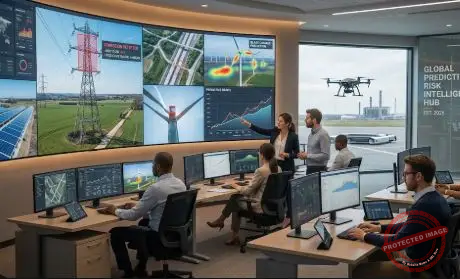
How AI analytics will turn drone fleets into early-warning systems by 2026
The first generation of commercial drone programs was obsessed with one thing: capturing better imagery. High-resolution photos and videos were an upgrade over manual inspections, but they still left human engineers to sift through terabytes of data after the fact. The 2026 wave of drone innovation is different. It is about predictive risk intelligence—using AI and machine learning to spot anomalies automatically, rank risks and even predict failures before they happen.
From imagery to insights
Industrial drone inspection markets are already pivoting from manual image review to AI-assisted workflows. A recent analysis of drone inspection services highlighted how operators increasingly integrate real-time analytics, cloud storage and artificial intelligence to streamline maintenance decisions and support predictive maintenance models. maintworld.com
Utilities, for example, now routinely deploy drones along transmission lines, substations and wind farms. Computer-vision models trained on historical failure data can flag issues such as broken insulators, corrosion, vegetation encroachment or early blade damage in wind turbines. At conferences like Utility Analytics Week, case studies show companies cutting service interruptions and improving grid reliability after adopting drone-plus-AI inspection strategies. Optelos
By 2026, these capabilities are expected to spread to pipelines, rail, telecom towers, ports and factories, forming a common pattern: drones stream data, AI turns that data into prioritized risk lists, and maintenance teams act before minor issues become major incidents.
Architectures for predictive risk intelligence
Delivering predictive risk intelligence at scale requires more than a clever model. Enterprises are building layered architectures that combine:
Onboard filters to compress and pre-classify data at the edge, reducing bandwidth while ensuring that apparent anomalies are flagged immediately.
Cloud-based AI platforms that train and retrain models using labeled imagery, sensor readings, and repair outcomes.
Integrations with enterprise asset management and work-order systems, so that detected anomalies automatically generate tickets, recommended actions and risk scores.
Some vendors specialize in these visual data platforms, enabling utilities and infrastructure owners to centralize drone, ground and satellite data into unified digital records. Utility-focused platforms have reported revenue growth and widespread adoption as operators seek centralized data management and AI-driven analytics capabilities. Scopito
Risk intelligence for safety and compliance
Drones with AI analytics are also transforming safety and compliance. In hazardous environments—chemical plants, refineries, mines—drones can inspect confined spaces or tall structures that are risky for humans to access.
AI models trained to recognize rust, leaks, structural deformation or thermal anomalies can triage thousands of images in minutes, highlighting only the frames that require attention. This shortens inspection cycles and reduces the need for rope access or scaffolding.
For regulators, this kind of traceable, AI-augmented inspection history is attractive. It provides clear evidence that an operator is systematically monitoring risk, not just conducting occasional visual checks. Over time, it may influence how insurance providers price risk, rewarding organizations that demonstrate strong predictive maintenance practices.
Public safety and emergency response
Predictive risk intelligence is not limited to fixed assets. Public safety agencies are exploring how AI-enabled drones can anticipate hazards during emergencies.
Search-and-rescue teams, already using drones with thermal cameras and advanced sensors, are experimenting with models that can automatically detect likely human signatures, vehicles or structural instabilities in rubble. UAV Coach
Wildfire and flood response units are testing pattern-recognition algorithms that estimate how fast a fire front is moving, where embers are likely to jump, or which levees are most at risk of failing, based on real-time aerial imagery combined with historical data. Over the next few years, these tools may shift emergency management from reactive dispatching to proactive resource positioning.
Business value: From cost center to intelligence engine
Until now, many drone programs have struggled to justify their budgets. Leaders saw them as cost centers that generated good-looking imagery but only modest efficiency gains. Predictive risk intelligence changes that narrative.
When drones materially reduce unplanned downtime, avoid catastrophic failures or lower insurance premiums, they start to resemble intelligence engines rather than gadgets. Industry reports on AI-in-drone markets emphasize that software—particularly analytics, navigation and decision-making—will grow faster than hardware revenues through the next decade. Grand View Research
Organizations that industrialize their data pipelines and integrate drone analytics into everyday maintenance and planning workflows will be in the strongest position to capture that value.
Closing thoughts and looking forward
By 2026, the most successful drone programs will not brag about resolution or range; they will talk in terms of avoided failures, risk-adjusted savings and predictive accuracy. The shift from “flying cameras” to “aerial risk intelligence platforms” is already underway and will accelerate as more historical data feeds back into increasingly sophisticated models.
For executives in utilities, energy, transport, and heavy industry, the question is no longer whether drones can capture valuable data. The question is whether their organizations are prepared to ingest, analyze, and act on that data quickly enough to change outcomes. Those who answer yes will see drones quietly turn into one of their most valuable predictive assets.
References
Drone Inspection Service Industry Growth Driven by AI, Cloud, and Security Compliance – Maintworld – https://www.maintworld.com/R-D/Drone-Inspection-Service-Industry-Growth-Driven-by-AI-Cloud-and-Security-Compliance
Utility Analytics Week 2024 Recap: Focus On Drone Inspection And AI Technology In Utilities – Optelos – https://optelos.com/drone-inspection-and-ai-technology-in-utilities/
What 2024 Taught Us About the Future of Utility Inspections – Scopito – https://scopito.com/2025-best-practices-for-utility-inspections/
AI In Drone Market Size And Share | Industry Report, 2033 – Grand View Research – https://www.grandviewresearch.com/industry-analysis/ai-drone-market-report
Search and Rescue Drones: A Guide to How SAR Teams Use Drones in Their Work – UAV Coach – https://uavcoach.com/search-and-rescue-drones/
Co-Editors:
Dan Ray, Drone Technologies, Montreal, Quebec.
Peter Jonathan Wilcheck, Co-Editor, Miami, Florida.
#AIDrones #PredictiveMaintenance #DroneAnalytics #RiskIntelligence #ComputerVision #AssetManagement #UtilityInspection #IndustrialAI #PublicSafety #DigitalTwins
Post Disclaimer
The information provided in our posts or blogs are for educational and informative purposes only. We do not guarantee the accuracy, completeness or suitability of the information. We do not provide financial or investment advice. Readers should always seek professional advice before making any financial or investment decisions based on the information provided in our content. We will not be held responsible for any losses, damages or consequences that may arise from relying on the information provided in our content.

 AAPL
AAPL AMD
AMD CIS.HA
 DELL
DELL IBM
IBM INTC
INTC MSFT
MSFT GOOG
GOOG HPE
HPE NVDA
NVDA TSLA
TSLA TMC
TMC MSI
MSI NOK
NOK OPEAZZX