


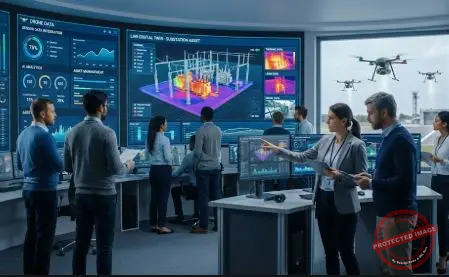
Why 2026 will be the year drone data finally plugs cleanly into enterprise systems
Enterprise drones were once judged almost entirely by their cameras. In 2026, the story is much broader. LiDAR, thermal imaging, hyperspectral payloads and RF sensors are turning drones into rich data collectors that feed digital twins, asset inventories and situational awareness dashboards across entire organizations.
At the same time, cloud platforms designed for drone-captured data are taking shape, helping utilities and infrastructure owners centralize petabytes of imagery and point clouds, run AI analytics and push structured insights into asset-management and GIS tools. Optelos
The rise of multi-sensor payloads
Modern drone airframes increasingly support modular gimbals that can swap payloads between missions: high-resolution RGB cameras for inspection, LiDAR for accurate 3D mapping, thermal sensors for hot-spot detection, and even UV or multispectral sensors for specialized use cases like corona discharge detection on high-voltage equipment. Scopito
Utilities, for example, now conduct corridor mapping flights that combine LiDAR and RGB imagery, then overlay thermal scans to identify overloaded components. Telecom operators use similar configurations to create precise 3D models of towers, enabling remote planning for antenna swaps and 5G upgrades.
Hyperspectral sensors, still relatively niche, are beginning to see deployment over agricultural fields and mines, where spectral signatures can reveal crop stress, mineral composition or contamination that normal cameras cannot detect. As payload costs fall, 2026 is likely to see broader experimentation across environmental monitoring, ESG reporting and precision agriculture.
Building and updating digital twins
The real power of enhanced sensors is realized when their output populates live digital twins—virtual replicas of physical assets and environments that update continuously. Drone-captured data is increasingly used to:
- Create baseline 3D models of facilities, plants, substations and linear assets.
- Detect changes between flights, highlighting new construction, erosion, unauthorized encroachments or structural movement.
- Attach inspection findings and maintenance records directly to components inside the twin, so engineers navigating the digital model can see its full history.
Centralized platforms that specialize in visual data management report that more utilities and drone service providers are adopting integrated workflows, connecting drone imagery with AI analytics and asset management systems to improve proactive grid management and reduce repair times. Scopito
Data integration: From silos to shared context
Historically, drone programs struggled with fragmentation. Images sat on SD cards, point clouds in separate mapping tools, and findings in spreadsheets or PDF reports. This made it hard to link drone insights to work orders, regulatory filings or financial planning.
That is changing. In 2026, successful operators will:
Standardize metadata frameworks that tag every flight with location, asset identifiers, weather data ,and sensor specifics.
Use APIs to push AI-derived findings—such as defect categories and severity rankings—directly into enterprise asset management, GIS, and ERP systems.
Establish governance around data retention, access control, and privacy to support cross-department collaboration without losing control of sensitive information.
Platforms highlighted in utility and drone-inspection case studies emphasize that centralized, AI-ready repositories are now essential infrastructure, not optional extras. Optelos
Operational and regulatory implications
Richer sensors and tighter integration bring new responsibilities. Regulatory regimes are becoming more explicit about how inspection records must be kept, how long they must be retained, and how they should be made available for audits or incident investigations.
For critical infrastructure, the combination of visual, thermal and spectral data raises questions about cybersecurity and national security. Operators must protect not only drone command links but also the stored data, which could reveal sensitive details about grid layouts, refinery structures or transport choke points.
On the positive side, high-fidelity, traceable inspection histories strengthen an operator’s ability to demonstrate compliance with safety and reliability standards and to negotiate better insurance terms.
Closing thoughts and looking forward
By 2026, the organizations extracting the greatest value from drones will be those that view them not as “flying cameras” but as front-line nodes in an enterprise data fabric. Enhanced sensors and robust integration pipelines will allow drone data to flow straight into digital twins, predictive maintenance engines and planning tools.
As standards emerge around data models, APIs, and security, we can expect ecosystems of specialized analytics applications to flourish on top of drone-generated data—much as app stores blossomed once smartphones standardized their operating systems and hardware capabilities. In this sense, 2026 may be remembered as the year drone data finally became a first-class citizen in the enterprise.
References
What 2024 Taught Us About the Future of Utility Inspections – Scopito – https://scopito.com/2025-best-practices-for-utility-inspections/
Utility Analytics Week 2024 Recap: Focus On Drone Inspection And AI Technology In Utilities – Optelos – https://optelos.com/drone-inspection-and-ai-technology-in-utilities/
Drone Inspection Service Industry Growth Driven by AI, Cloud, and Security Compliance – Maintworld – https://www.maintworld.com/R-D/Drone-Inspection-Service-Industry-Growth-Driven-by-AI-Cloud-and-Security-Compliance
Search and Rescue Drones: A Guide to How SAR Teams Use Drones in Their Work – UAV Coach – https://uavcoach.com/search-and-rescue-drones/
AI In Drone Market Size And Share | Industry Report, 2033 – Grand View Research – https://www.grandviewresearch.com/industry-analysis/ai-drone-market-report
Co-Editors:
Dan Ray, Drone Technologies, Montreal, Quebec.
Peter Jonathan Wilcheck, Co-Editor, Miami, Florida.
#DroneSensors #LiDAR #ThermalImaging #DigitalTwins #DroneData #VisualDataManagement #UtilityInspection #GIS #EnterpriseIntegration #ESGData
Post Disclaimer
The information provided in our posts or blogs are for educational and informative purposes only. We do not guarantee the accuracy, completeness or suitability of the information. We do not provide financial or investment advice. Readers should always seek professional advice before making any financial or investment decisions based on the information provided in our content. We will not be held responsible for any losses, damages or consequences that may arise from relying on the information provided in our content.

 AAPL
AAPL AMD
AMD CIS.HA
 DELL
DELL IBM
IBM INTC
INTC MSFT
MSFT GOOG
GOOG HPE
HPE NVDA
NVDA TSLA
TSLA TMC
TMC MSI
MSI NOK
NOK OPEAZZX