


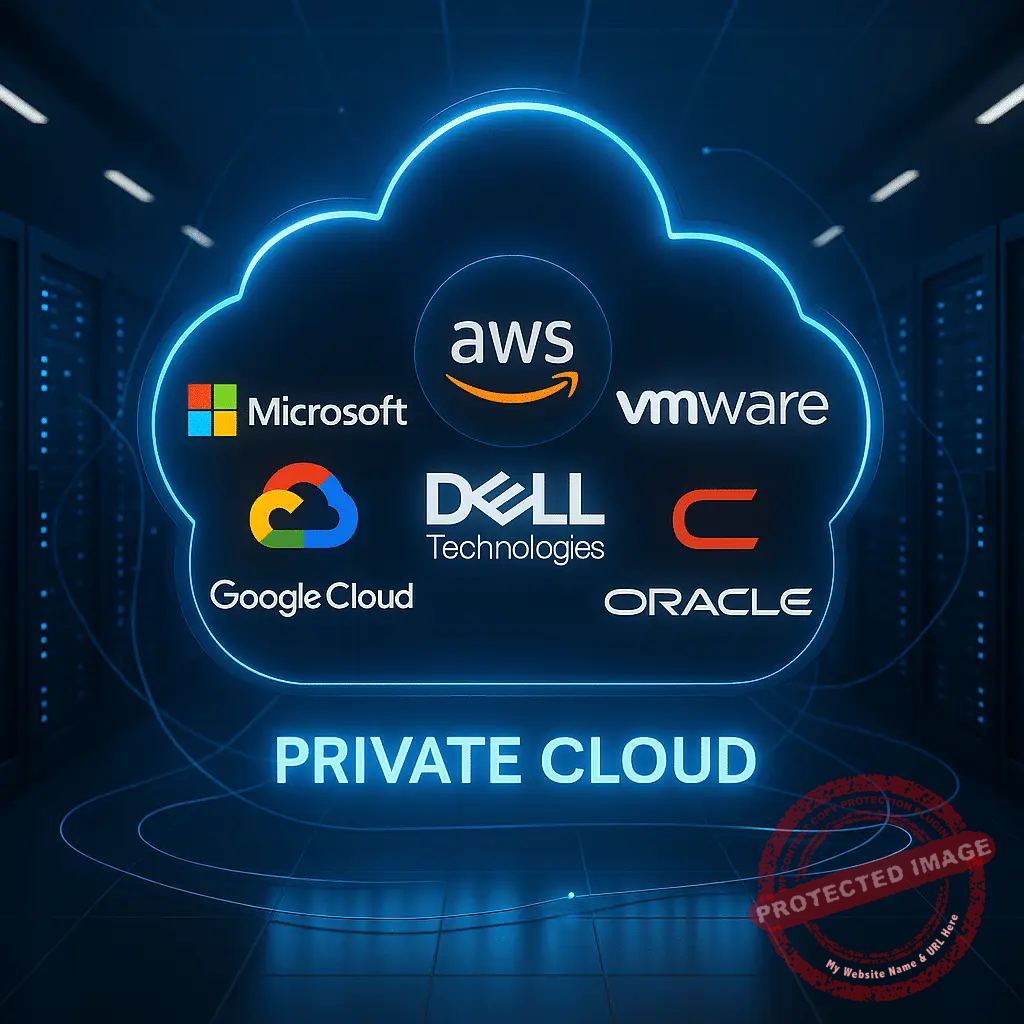
This has been a question that sits at the heart of every CIO and CTO roadmap discussion today, and the answer is more nuanced than simply naming one winner. The private cloud market is evolving into a hybrid and multi-cloud battleground where hyperscalers, legacy infrastructure giants, and open-source platforms collide. Research from multiple firms suggests that by 2030 the private cloud market will be dominated by a handful of integrated platforms led by IBM, Microsoft, AWS, Dell Technologies, VMware, HPE, and Oracle, all of which are pushing hybrid architectures, AI integration, and managed services as their differentiators. Business Wire
In this first article of the series, we explore who is most likely to lead the private cloud landscape by 2026, why the market is consolidating around hybrid and multi-cloud strategies, and how new AI-driven workloads are reshaping the competitive field.
The race for private cloud leadership
Over the past decade, cloud has shifted from a disruptive alternative to the default platform for new workloads. Today, AWS, Microsoft Azure, and Google Cloud collectively command roughly two-thirds of global cloud infrastructure spending, creating a gravitational pull around their ecosystems. CloudZero Yet in the private cloud domain, where enterprises demand tighter control, predictable performance, and strict compliance, traditional enterprise vendors such as VMware, IBM, Dell Technologies, HPE, and Oracle still play a commanding role. Business Wire
This duality has created an unusual market structure. Hyperscalers dominate public cloud and are increasingly extending their stacks into customers’ data centers through platforms such as AWS Outposts, Azure Local (previously Azure Stack HCI), and Google Anthos. Amazon Web Services, Inc.+2Microsoft Azure At the same time, infrastructure incumbents are reinventing themselves as “cloud-as-a-service” providers, with offerings like HPE GreenLake and Dell APEX delivering elastic capacity and cloud-style operations on-premises. Nexstor+2Hewlett Packard Enterprise+2
The result is that private cloud leadership in 2026 will not be decided by public cloud share alone, but by which vendors can deliver the most integrated hybrid experience across on-premises, colocation, and multiple public clouds—while satisfying the looming demands of AI, data sovereignty, and industry-specific regulation.
Hyperscalers: exporting public cloud to the data center
If market share were the only metric, the answer would seem straightforward. AWS remains the global infrastructure leader with a significant share of the IaaS market and tens of billions in quarterly revenue, although Microsoft Azure and Google Cloud are closing the gap with faster growth rates. TechRadar These platforms are now exporting their operating models into private environments.
AWS Outposts brings native AWS infrastructure, APIs, and services into customer data centers or colocation facilities, giving organizations the same compute, storage, and networking primitives they use in AWS regions but with local data processing, low latency, and data residency control. Amazon Web Services, Inc. For banks, manufacturers, and telecoms that require deterministic performance or must keep certain datasets within national borders, this hybrid approach is compelling.
Microsoft’s answer, Azure Local (evolving from Azure Stack HCI), similarly aims to blend Azure services with on-premises hardware using a hyperconverged infrastructure model. It provides unified monitoring, billing, backup, and security through the Azure portal, allowing enterprises to run workloads close to users while centrally managing them as part of their broader Azure estate. Microsoft Azure+2Microsoft Learn For organizations already standardized on Windows Server, Active Directory, and Microsoft 365, this tight integration is a powerful differentiator.
Google’s Anthos, for its part, focuses on application modernization and Kubernetes-centric operations. It allows enterprises to run containers and microservices consistently across on-premises environments, Google Cloud, and even rival clouds such as AWS and Azure. Anthos is positioned as an answer to vendor lock-in and is particularly attractive for organizations with strong data analytics and AI ambitions that want to run workloads near their data centers while taking advantage of Google’s AI capabilities in the cloud. Google Cloud+2Google Cloud
By 2026, these extensions of public cloud into private environments are likely to dominate new private cloud deployments in organizations that have already embraced hyperscalers as strategic partners. However, they are not the only contenders.
Infrastructure giants: private cloud as a service
Dell Technologies, HPE, and others that historically sold racks of servers and storage arrays now pitch “cloud-like” experiences delivered on premises as subscription services. HPE GreenLake offers a unified platform to manage compute, storage, networking, and data services across on-premises and cloud, with consumption-based pricing and integrated security. Hewlett Packard Enterprise Dell APEX mirrors this approach, packaging servers, storage, hyperconverged infrastructure, backup, and more into managed as-a-service bundles that customers can deploy in their own data centers or colocation sites. Nexstor
For enterprises with significant sunk investments in data centers or stringent data locality requirements, these offerings can be more palatable than moving directly to hyperscaler-branded stacks. They allow IT teams to retain greater control over hardware and support contracts while adopting cloud-style elasticity, automation, and financial models.
VMware, now part of Broadcom, underpins many of these environments. Its virtualization stack remains the default substrate for private clouds globally, and its multi-cloud management tools enable organizations to stretch workloads across their own infrastructure and multiple public clouds. Business Wire The company’s future moves, especially in how it bundles or licenses these capabilities under Broadcom’s ownership, will have an outsized influence on the structure of private cloud ecosystems in 2026.
IBM, Red Hat, and the battle for regulated industries
IBM’s strategy rests on hybrid and multi-cloud rather than public cloud scale. With the acquisition of Red Hat, IBM has positioned OpenShift—its Kubernetes-based container platform—as a universal operating layer that can run across private data centers, IBM Cloud, and hyperscalers. This model appeals to banks, insurers, healthcare providers, and governments that value open source, vendor diversity, and rigorous compliance more than raw cloud scale.
Industry analysts continue to list IBM among the key players in the private cloud market, citing its strength in secure, compliant, and AI-ready solutions for regulated sectors. Business Wire IBM’s long-standing relationships with mainframe customers and mission-critical workloads give it a unique foothold for modernizing core systems using private and hybrid cloud architectures.
Oracle Cloud Infrastructure: database-centric private cloud
Oracle approaches private cloud leadership from a different angle: databases and high-performance enterprise applications. Oracle Cloud Infrastructure (OCI) is designed to run Oracle Database and enterprise applications with high performance and low latency, and its Cloud@Customer offering extends OCI into customer data centers with a fully managed, on-premises deployment model. Business Wire
For organizations deeply invested in Oracle databases, ERP, and industry packages, this model allows them to adopt cloud consumption and automation while keeping data close to existing systems. It also aligns with data residency and sovereignty requirements that prevent certain records from leaving specific jurisdictions.
AI, data sovereignty, and security as tie-breakers
One of the defining forces shaping private cloud leadership in 2026 will be AI. Enterprises are rapidly deploying GPU-dense clusters and high-bandwidth storage to train large language models and run real-time inference workloads. These AI workloads require low-latency access to data sources, making private cloud environments near data lakes, transactional systems, and sensitive datasets even more attractive.
Vendors that combine AI-optimized infrastructure with robust data governance will gain an edge. Hyperscalers offer deep AI services—from foundation models to MLOps platforms—but must mitigate concerns around data sovereignty and cross-border transfer. Infrastructure providers like HPE and Dell emphasize on-premises data control and security, while IBM and Oracle highlight compliance and industry-specific governance frameworks.
At the same time, regulatory scrutiny of market concentration and data practices is increasing. Authorities in Europe and the UK have raised concerns about the dominance of top cloud providers and the potential lock-in effects of proprietary ecosystems. IT Pro This pressure may accelerate adoption of open platforms, multi-cloud management tools, and sovereign cloud offerings, shifting some influence away from single-vendor stacks.
Who is best positioned to lead in 2026?
By 2026, no single vendor is likely to “own” private cloud in the way AWS has led public cloud. Instead, leadership will be segmented:
AWS will remain a major force, particularly for organizations that want a consistent AWS experience from region to rack through Outposts and local zones, combined with its unmatched breadth of services and partner ecosystem.
Microsoft will be exceptionally strong among enterprises invested in its productivity and server ecosystem, with Azure Local enabling a tightly integrated, end-to-end hybrid story from desktop to data center to edge.
Google Cloud will expand its footprint in AI-driven hybrid environments where Anthos provides a multi-cloud application platform and Google’s AI stack serves as the innovation engine.
IBM and Red Hat will lead in sectors that prioritize open source, portability, and compliance, especially where mission-critical workloads are being modernized rather than re-platformed wholesale onto hyperscalers.
Dell, HPE, and VMware will continue to power a large share of on-premises private cloud infrastructure, particularly for organizations that want cloud economics and automation while maintaining physical control of assets.
Oracle will retain leadership where Oracle databases and enterprise applications are central to the business, and where Cloud@Customer enables cloud operations within strict data residency regimes.
The more realistic question, then, is not “who will lead in private cloud overall?” but “who will lead in the private cloud segments that matter to a given industry, geography, or workload type?”
Closing thoughts and looking forward
As we approach 2026, private cloud is less a destination and more an operating model that stretches from hyperscale regions to local data centers and edge sites. The leaders will not be chosen purely by revenue share, but by who can deliver consistent platforms, strong security and compliance, AI-ready infrastructure, and flexible deployment models that respect data sovereignty and industry regulation.
CIOs and CTOs planning for 2026 should therefore evaluate prospective leaders through a hybrid lens. The key questions become: Which platforms give us the agility of public cloud while allowing us to keep critical data and workloads where they need to reside? Which vendors support multi-cloud and open standards rather than deepening lock-in? And which partners will keep pace with the accelerating demands of AI, analytics, and automation?
The private cloud race is ultimately a race to make complexity disappear behind a seamless operational fabric. In that race, hyperscalers, infrastructure giants, and open-source champions each bring distinctive strengths. The likely “winners” in 2026 will be those that collaborate as much as they compete, enabling enterprises to stitch together the best of all worlds into a coherent, secure, and AI-ready hybrid cloud.
References
-
“Private Cloud Market Report 2024–2025 & 2030 – IBM, Microsoft, AWS, Dell, VMware, HPE, and Oracle Lead with Hybrid Solutions, AI Integration, and Managed Services,” BusinessWire / ResearchAndMarkets.com – https://www.businesswire.com/news/home/20250929564243/en/Private-Cloud-Market-Report-2024-2025-2030-IBM-Microsoft-AWS-Dell-VMware-HPE-and-Oracle-Lead-with-Hybrid-Solutions-AI-Integration-and-Managed-Services—ResearchAndMarkets.com Business Wire
-
“Private Cloud Market Share & Opportunities 2025–2032,” Coherent Market Insights – https://www.coherentmarketinsights.com/industry-reports/private-cloud-market Coherent Market Insights
-
“21+ Top Cloud Service Providers Globally in 2025,” CloudZero – https://www.cloudzero.com/blog/cloud-service-providers/ CloudZero
-
“Hybrid and Multicloud Application Platform – Anthos,” Google Cloud – https://cloud.google.com/solutions/hybrid-and-multicloud-application-platform Google Cloud
-
“GreenLake,” Hewlett Packard Enterprise – https://www.hpe.com/us/en/greenlake.html Hewlett Packard Enterprise
Co-Editors
Dan Ray, Author, Montreal, Quebec.
Peter Jonathan Wilcheck, Co-Editor, Miami, Florida.
#PrivateCloudLeaders #HybridCloud2026 #AWSOutposts #AzureLocal #GoogleAnthos #HPEGreenLake #DellAPEX #IBMRHOpenShift #OracleCloudInfrastructure #AIinHybridCloud
Post Disclaimer
The information provided in our posts or blogs are for educational and informative purposes only. We do not guarantee the accuracy, completeness or suitability of the information. We do not provide financial or investment advice. Readers should always seek professional advice before making any financial or investment decisions based on the information provided in our content. We will not be held responsible for any losses, damages or consequences that may arise from relying on the information provided in our content.
 AAPL
AAPL AMD
AMD CIS.HA
 DELL
DELL IBM
IBM INTC
INTC MSFT
MSFT GOOG
GOOG HPE
HPE NVDA
NVDA TSLA
TSLA TMC
TMC MSI
MSI NOK
NOK OPEAZZX