


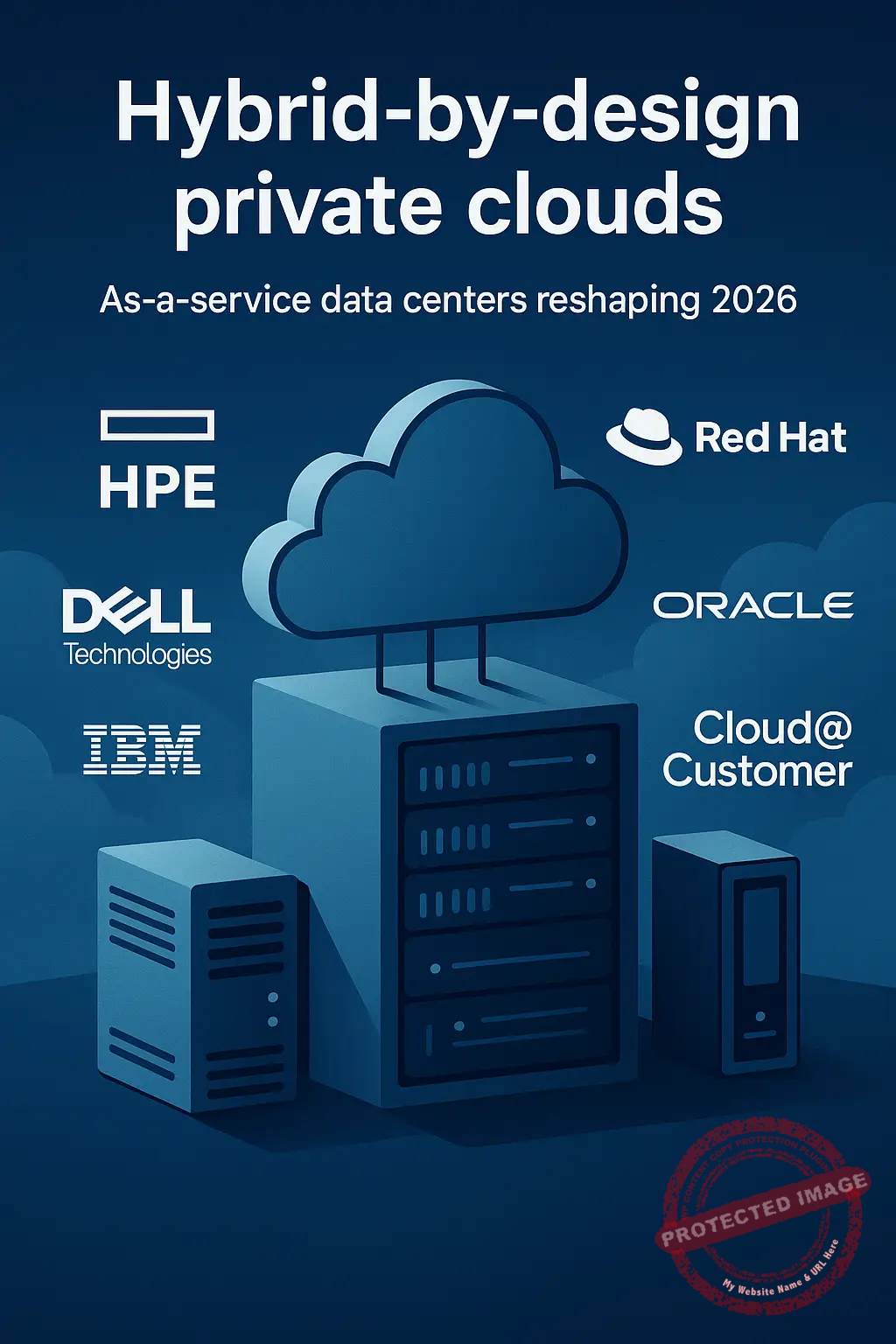
The next wave of private cloud is not about who owns the data center racks, but who can deliver them as a cloud service. By 2026, subscription-based “cloud in your data center” platforms from HPE, Dell Technologies, IBM, Red Hat, Oracle, and others are expected to redefine how enterprises buy, govern, and scale infrastructure. Rather than purchasing hardware and stitching together virtualization, storage, and networking, CIOs are increasingly signing contracts for private cloud capacity that looks and feels like public cloud, but runs behind their own firewalls.
Analysts already see the shift accelerating. The global private cloud market, valued at roughly US$114 billion in 2024, is projected to reach around US$195 billion by 2030, while the hybrid cloud segment that combines public, private, and on-premises infrastructure is forecast to more than double from about US$131 billion in 2024 to nearly US$330 billion by decade’s end. Business Wire This growth is being driven not just by security or compliance concerns, but by a fundamental change in how infrastructure is consumed: as a service, wherever workloads need to run.
From capital expense to subscription: private cloud’s new economics
For most of the last twenty years, building a private cloud meant large upfront capital expenditure. Enterprises bought servers, storage arrays, networking gear, and hypervisors, then layered on management software to approximate the self-service and elasticity of public cloud. The result was powerful but complex, and many organizations struggled to keep up with capacity planning, patching, and lifecycle management.
The new model turns that equation inside out. Instead of buying equipment, organizations sign multi-year subscriptions in which vendors deliver and manage standardized on-site compute, storage, and networking building blocks, charging on a pay-per-use or capacity-based model. Dell APEX, for example, is described as an “everything-as-a-service” platform that lets customers consume infrastructure, PCs, and other IT services through flexible subscriptions. At the same time, Dell handles provisioning, monitoring, and upgrades. Dell HPE GreenLake uses a similar approach, providing a cloud control plane and metered consumption for resources that sit in customer data centers, colocation facilities, or edge locations. Hewlett-Packard Enterprise
This transition from capital expenditure to operational expenditure is attractive to CFOs who want predictable spending and to CIOs who want to avoid both over-provisioning and capacity shortages. It also aligns with how internal teams are organizing: platform engineering groups now treat infrastructure as a product, with clear service tiers, APIs, and chargeback models that mirror those of the public cloud.
Why hybrid-by-design is becoming the default
The move to subscription-based private cloud is not happening in isolation. Enterprises are simultaneously deepening their use of public cloud and, in many cases, operating hundreds of SaaS applications. The resulting environment is decisively hybrid and multi-cloud, spanning on-premises workloads, public cloud regions, and edge locations.
HPE characterizes GreenLake as “hybrid-by-design,” emphasizing a common control plane to manage resources across data centers, colocation sites, and public clouds, along with multiple options for payment and management. Hewlett Packard Enterprise and Dell, similarly, position APEX as enabling a “multicloud by design” approach that extends cloud and container orchestration ecosystems to on-premises environments, giving organizations public cloud agility with private cloud control. Dell
Public cloud providers are also leaning into hybrid. AWS hybrid services, including Outposts, Local Zones, and other on-premises options, are marketed as delivering a consistent AWS experience wherever workloads run, from central regions to customer sites and the edge. Amazon Web Services, Inc. In practice, this means enterprises are less interested in choosing a single winner and more focused on building a fabric that supports workloads in the right place at the right time.
In this world, hybrid-by-design private clouds become the anchor. They host sensitive systems, latency-critical applications, and data subject to sovereignty rules, while integrating seamlessly with external clouds for burst capacity, analytics, and AI services. The vendors that can make these connections invisible to developers and secure for compliance teams will have significant leverage by 2026.
HPE GreenLake: a platform around your data center
HPE was one of the earliest infrastructure providers to embrace an as-a-service model fully. GreenLake has evolved from a consumption-based hardware offering into a complete hybrid cloud platform with services to observe, manage, automate, and secure a distributed estate. It promises a common control plane for workloads running in customer data centers, colocation facilities, and the edge, and increasingly incorporates AI-driven operations and networking following HPE’s acquisition of Juniper Networks. IT Pro
For private cloud buyers, GreenLake for Private Cloud Business Edition is particularly relevant. It delivers virtual machines, containers, and data services as a self-service cloud with unified management and monitoring. Hewlett Packard Enterprise Organizations can choose to operate the environment themselves or rely on HPE-managed services, and they can extend the same operating model into public cloud integrations.
In practice, this means a bank or manufacturer could standardize application deployment pipelines on GreenLake, then selectively integrate with AWS or Azure for advanced analytics or global reach. GreenLake becomes the control hub for cost, compliance, and lifecycle management, while still giving developers access to the broader cloud ecosystem.
Dell APEX: multicloud-by-design infrastructure
Dell Technologies has taken a similar path with APEX, extending its dominance in servers and storage into a portfolio of subscription offerings. APEX Infrastructure and related services provide flexible, scalable infrastructure that can be consumed as needed, with Dell handling routine operations such as monitoring, patching, and hardware replacement. Del Dell Dell
The emphasis is on enabling hybrid and multicloud architectures without forcing customers to standardize on a single public cloud. Dell APEX Infrastructure can serve as the backbone for private clouds that run VMware, Kubernetes, or other platforms, while integrating with public clouds for backup, disaster recovery, or cloud-native workloads. Because the underlying hardware and service contracts remain with Dell, enterprises gain a consistent operational and financial model even as they diversify providers at the software and application level.
This is particularly attractive for organizations that expect frequent technology refresh cycles but do not want to renegotiate capital budgets every three to five years. APEX subscriptions can adjust to new generations of hardware, including GPU-accelerated systems for AI, without disrupting internal chargeback models.
IBM and Red Hat: an open hybrid foundation for regulated industries
IBM’s hybrid cloud story is anchored in Red Hat OpenShift. OpenShift is an enterprise Kubernetes platform that can run on-premises, in IBM Cloud, and on other hyperscalers, providing a consistent environment for containers and, increasingly, virtual machines through OpenShift Virtualization. IBM Cloud+4IBM+4Red Hat
IBM markets this combination as a way to modernize existing workloads while meeting strict regulatory requirements. OpenShift on IBM Cloud is offered as a fully managed service with built-in security and isolation, but the same tooling can be used to run clusters in customer data centers. IBM This is particularly compelling for financial services, healthcare providers, and public sector agencies that must demonstrate control over where data resides and how it is accessed.
Because OpenShift is built on open-source technologies and supports multiple underlying infrastructure stacks, it also mitigates fears of vendor lock-in. Organizations can deploy OpenShift clusters on HPE, Dell, or other hardware, and can connect them to AWS, Azure, or Google Cloud. The result is a private cloud that feels less like a proprietary island and more like a portable application platform that travels with workloads.
Oracle Cloud@Customer and specialized private cloud ecosystems
While HPE, Dell, IBM, and Red Hat focus on general-purpose platforms, Oracle has carved out a niche with Oracle Cloud Infrastructure (OCI) and its Cloud@Customer offerings. Oracle positions Cloud@Customer as a fully managed cloud region deployed in a customer’s data center, delivering the same services, APIs, and SLAs as its public cloud while keeping data and workloads on premises.
This is especially attractive for enterprises that rely heavily on Oracle databases and applications. Recent financial disclosures show Oracle significantly raising its revenue forecast for OCI, citing strong demand for cloud and AI solutions and multi-billion-dollar customer contracts. Reuters As OCI expands through partnerships with other hyperscalers, Cloud@Customer deployments become an important way for organizations to standardize database workloads while still interoperating with other clouds.
Other specialized private cloud ecosystems are emerging as well. Telecom providers are building network-centric private clouds at the edge. Industrial players are deploying operational technology clouds near factories and energy sites. In many of these cases, the underlying model mirrors what HPE, Dell, IBM, and Oracle are doing: private infrastructure delivered and operated as a cloud service, tuned for specific workloads and regulatory regimes.
What hybrid-by-design private Clouds mean for CIOs and operations teams
Post Disclaimer
The information provided in our posts or blogs are for educational and informative purposes only. We do not guarantee the accuracy, completeness or suitability of the information. We do not provide financial or investment advice. Readers should always seek professional advice before making any financial or investment decisions based on the information provided in our content. We will not be held responsible for any losses, damages or consequences that may arise from relying on the information provided in our content.
 AAPL
AAPL AMD
AMD CIS.HA
 DELL
DELL IBM
IBM INTC
INTC MSFT
MSFT GOOG
GOOG HPE
HPE NVDA
NVDA TSLA
TSLA TMC
TMC MSI
MSI NOK
NOK ECDH26.CME
 OPEAZZX