


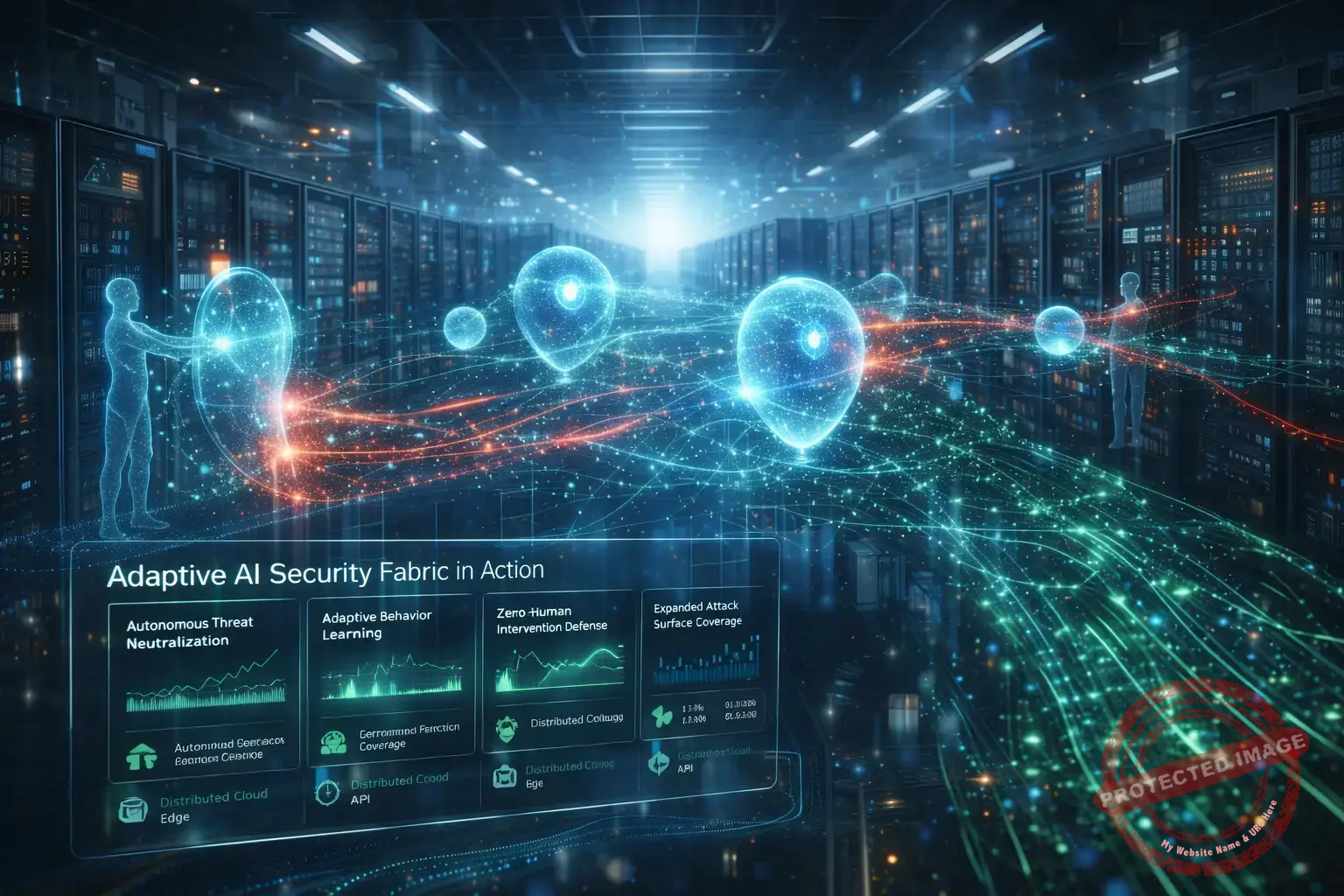
How AI-native hosting platforms are transforming security from reactive monitoring to continuous, self-directed protection
From perimeter defense to autonomous security fabric
By 2026, cybersecurity within web hosting environments has undergone a fundamental transformation. The traditional perimeter-based model, built around firewalls, intrusion detection systems, and human-led incident response, is proving insufficient against the speed, scale, and sophistication of modern attacks. AI web hosting platforms are responding by embedding autonomous security capabilities directly into hosting infrastructure, creating environments that defend themselves continuously rather than reacting after damage occurs.
This shift reflects a broader reality facing enterprises. Digital platforms are more distributed, dynamic, and interconnected than ever before. Applications span cloud regions, edge nodes, APIs, and third-party services, dramatically expanding the attack surface. In this context, security teams can no longer rely on manual triage or static rulesets. AI-native hosting introduces an adaptive security fabric that operates across infrastructure layers, learning from behavior rather than waiting for known signatures.
Continuous threat detection replaces alert overload
One of the most immediate impacts of AI web hosting in 2026 is the reduction of alert fatigue. Traditional security operations generate vast volumes of alerts, many of which are low-value or false positives. Human analysts are forced to prioritize signals under time pressure, increasing the risk that genuine threats go unnoticed. AI-native hosting platforms invert this model.
Autonomous security agents continuously analyze network traffic, application behavior, identity activity, and system logs in real time. Rather than flagging isolated events, they assess intent and context, correlating signals across the environment to determine whether behavior represents a credible threat. Only high-confidence incidents surface for human review, while routine mitigation actions are handled automatically. This dramatically improves signal quality and allows security teams to focus on strategic oversight rather than constant firefighting.
Automated response compresses attack timelines
Speed is critical in modern cyber defense. In 2026, attackers increasingly use automation and AI to probe systems, escalate privileges, and exfiltrate data in minutes rather than days. AI web hosting platforms counter this by compressing defensive response timelines to seconds.
When anomalous behavior is detected, autonomous agents can isolate affected workloads, restrict network access, rotate credentials, and apply patches without waiting for human approval. These actions occur within predefined policy boundaries, ensuring consistency and compliance. For enterprises operating critical digital services, this capability significantly reduces blast radius and downtime. However, it also requires confidence that automated actions will not disrupt legitimate operations, reinforcing the importance of robust governance frameworks.
Identity becomes the primary security control plane
By 2026, identity has become the dominant control plane for cybersecurity within AI web hosting environments. As applications become more distributed and ephemeral, traditional network boundaries lose relevance. AI-native hosting platforms place identity and behavior at the center of security decision-making.
Autonomous agents continuously evaluate user and service identities, monitoring authentication patterns, privilege usage, and behavioral deviations. Suspicious activity triggers adaptive responses, such as step-up authentication, session termination, or privilege reduction. This dynamic approach allows hosting platforms to enforce least-privilege access in real time, reducing the risk of credential misuse and lateral movement within environments.
AI-driven vulnerability management shifts left and right
Vulnerability management has traditionally been periodic and reactive, relying on scheduled scans and manual remediation. In 2026, AI web hosting platforms treat vulnerability management as a continuous process that spans the entire application lifecycle.
AI agents analyze deployed code, configurations, and dependencies to identify vulnerabilities as they emerge. They correlate this information with threat intelligence to prioritize remediation based on real-world exploitability rather than theoretical risk. In some cases, agents can automatically patch or reconfigure systems, while in others they generate detailed remediation guidance for development teams. This approach reduces exposure windows and aligns security more closely with development and operations workflows.
Compliance monitoring becomes embedded and auditable
Regulatory compliance remains a major concern for organizations adopting AI web hosting in 2026. Autonomous security systems must operate within legal and regulatory constraints, particularly in industries such as finance, healthcare, and government. AI-native hosting platforms increasingly embed compliance controls directly into infrastructure operations.
Security agents enforce policies related to data residency, encryption, access logging, and retention automatically. Every action taken by an AI system is recorded in immutable audit logs, enabling organizations to demonstrate compliance during regulatory reviews. This continuous compliance model reduces the need for manual audits and point-in-time assessments, but it also raises expectations for transparency and explainability.
Governance challenges shape enterprise adoption
Despite the benefits, autonomous cybersecurity introduces new governance challenges. Enterprises must define clear boundaries for AI decision-making, establish escalation paths for ambiguous situations, and retain the ability to override automated actions when necessary. In 2026, mature organizations treat AI security agents as collaborators rather than replacements for human judgment.
Procurement decisions increasingly evaluate not only technical capability but also governance maturity. Enterprises assess how hosting providers manage model updates, handle false positives, and respond to systemic failures. Clear accountability frameworks are essential, particularly when automated actions have business or legal consequences. Trust is built through transparency, testing, and shared responsibility rather than blind reliance on automation.
Economic pressures influence security architecture choices
Cost remains a significant factor in cybersecurity architecture decisions. AI-driven security capabilities require substantial compute resources, particularly for real-time analysis across large environments. While autonomous systems can reduce long-term labor costs and breach impact, upfront investment remains a barrier for some organizations.
In 2026, many enterprises adopt tiered security strategies. Mission-critical applications and sensitive data environments receive full AI-native protection, while lower-risk workloads rely on more traditional controls. This selective deployment reflects a pragmatic balance between risk reduction and budget constraints, acknowledging that not all assets require the same level of autonomy.
Market evolution favors integrated security platforms
The AI web hosting market in 2026 is moving toward tighter integration between hosting, security, and identity services. Standalone security tools are increasingly difficult to operate effectively in highly automated environments. Hosting providers that offer deeply integrated security capabilities gain an advantage by reducing complexity and improving coordination between systems.
At the same time, enterprises remain cautious about over-consolidation. Vendor lock-in, data portability, and interoperability remain key considerations. Successful platforms are those that balance integration with openness, allowing organizations to maintain strategic flexibility while benefiting from autonomous security capabilities.
Closing Thoughts and Looking Forward
By 2026, AI web hosting has redefined cybersecurity from a reactive, human-intensive function into a continuous, autonomous defense capability. Security agents now detect, assess, and respond to threats at machine speed, fundamentally altering how risk is managed in digital environments. This transformation delivers clear benefits in resilience and efficiency, but it also demands new approaches to governance, accountability, and trust.
Organizations that thrive in this environment will be those that embrace autonomy thoughtfully. Rather than delegating security entirely to machines, they will establish clear policies, maintain human oversight, and invest in transparency. As AI-native hosting continues to mature, cybersecurity will increasingly be measured not by the absence of alerts, but by the presence of systems that quietly and consistently protect the digital foundations of modern business.
References
Autonomous Security Operations Explained, MIT Technology Review, https://www.technologyreview.com/2024/11/14/autonomous-security-operations/
AI and the Future of Cyber Defense, World Economic Forum, https://www.weforum.org/stories/2024/ai-cybersecurity-future/
Zero Trust and Identity-Centric Security, Microsoft Security Blog, https://www.microsoft.com/security/blog/zero-trust/
Managing Cyber Risk in Automated Cloud Environments, McKinsey & Company, https://www.mckinsey.com/capabilities/risk-and-resilience/our-insights/cyber-risk-cloud
Co-Editors
Dan Ray, Co-Editor, Montreal, Quebec.
Peter Jonathan Wilcheck, Co-Editor, Miami, Florida.
Post Disclaimer
The information provided in our posts or blogs are for educational and informative purposes only. We do not guarantee the accuracy, completeness or suitability of the information. We do not provide financial or investment advice. Readers should always seek professional advice before making any financial or investment decisions based on the information provided in our content. We will not be held responsible for any losses, damages or consequences that may arise from relying on the information provided in our content.
 AAPL
AAPL AMD
AMD CIS.HA
 DELL
DELL IBM
IBM INTC
INTC MSFT
MSFT GOOG
GOOG HPE
HPE NVDA
NVDA TSLA
TSLA TMC
TMC MSI
MSI NOK
NOK OPEAZZX