


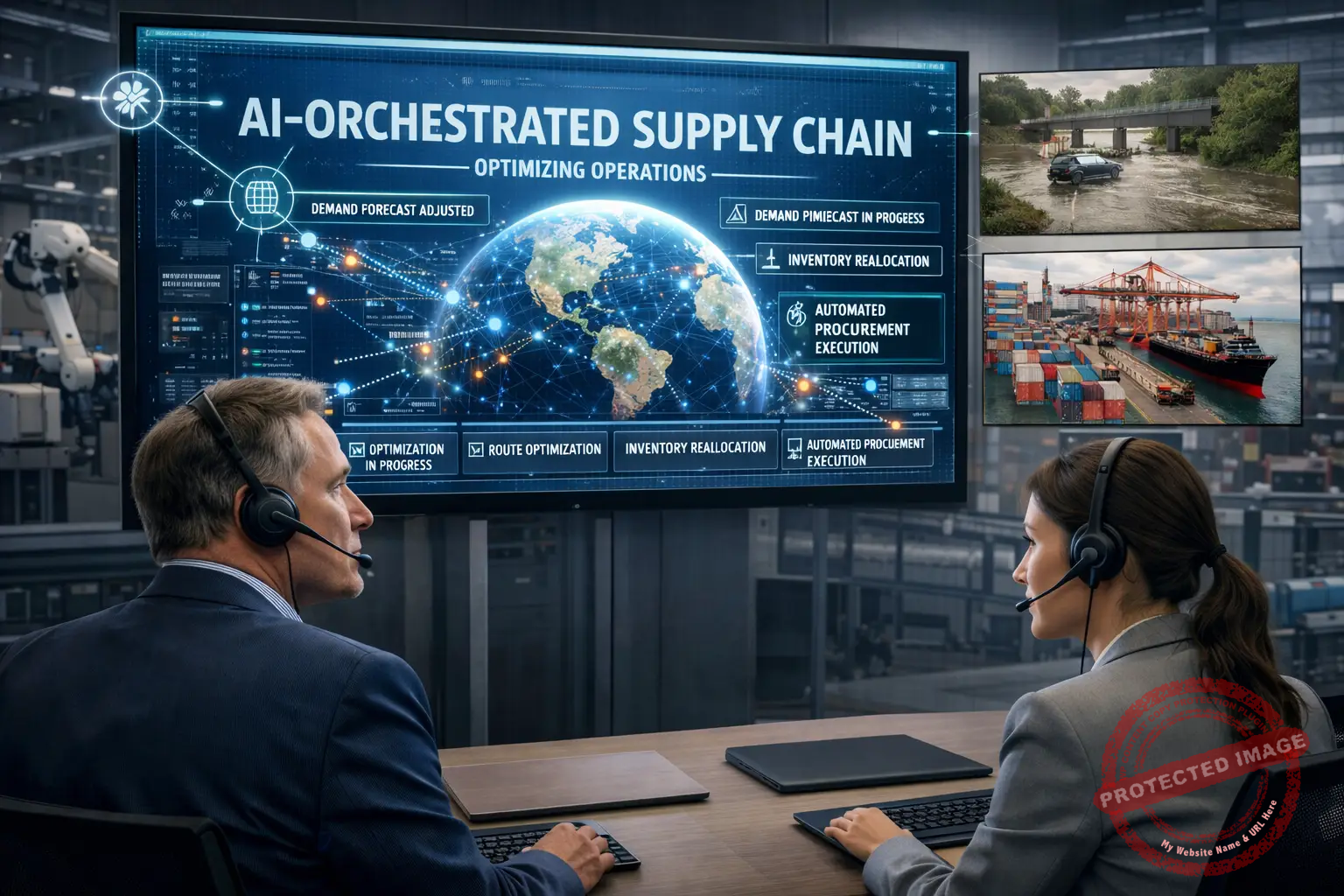
In 2026, artificial intelligence is no longer a speculative overlay on supply chain systems but a coordinating force shaping how goods, data, and decisions move across global networks under tighter economic and geopolitical constraints.
From predictive insight to coordinated action
For more than a decade, supply chain leaders invested in analytics designed to predict demand, flag risks, or optimize inventory. By 2026, the emphasis has shifted decisively from insight generation to coordinated action. Enterprises are no longer satisfied with dashboards that describe problems; they expect AI systems to recommend, sequence, and in some cases autonomously execute responses across procurement, logistics, manufacturing, and distribution. This change reflects a broader organizational reality: volatility is now persistent, not episodic. Disruptions related to climate events, labor availability, trade policy, and transportation capacity have become part of baseline planning assumptions rather than exceptional scenarios. AI orchestration platforms are emerging to connect previously siloed systems and enable faster, more consistent decision cycles that human teams alone cannot sustain at scale.
What orchestration means in 2026 supply chains
AI orchestration in the 2026 context does not imply a single monolithic system controlling the entire supply chain. Instead, it refers to a layered architecture in which machine learning models, optimization engines, and rules-based controls interact across enterprise resource planning systems, transportation management systems, warehouse platforms, and supplier networks. These systems ingest near real-time signals from sales channels, production lines, ports, carriers, and external data sources such as weather and regulatory updates. The value lies in the coordination logic that reconciles competing objectives, such as cost, service level, resilience, and sustainability, and translates them into executable plans. In practice, orchestration systems propose actions like rerouting shipments, adjusting production schedules, reallocating inventory, or renegotiating supplier commitments within predefined governance constraints.
Budget realities driving pragmatic adoption
The adoption curve for AI-orchestrated supply chains in 2026 is shaped less by technological maturity than by budget discipline. Many enterprises are emerging from multi-year periods of inflationary pressure and capital scrutiny, forcing CIOs and supply chain executives to justify investments with measurable outcomes. As a result, orchestration initiatives are often scoped narrowly at first, targeting high-impact domains such as transportation planning, inventory positioning for top revenue products, or supplier risk mitigation. Rather than replacing core systems, organizations are layering orchestration capabilities on top of existing platforms to minimize disruption and control costs. This incremental approach aligns with board-level expectations for faster returns while still building the foundation for broader automation over time.
Integration challenges across legacy environments
Despite progress, integration remains one of the most significant barriers to orchestration at scale. Many supply chains still rely on heterogeneous landscapes built over decades through acquisitions and regional customization. Data quality varies widely across sites and partners, complicating the training and operation of AI models. In 2026, successful orchestration programs are those that invest early in data normalization, master data governance, and event standardization. Rather than attempting to cleanse all data upfront, leading organizations prioritize critical flows that directly affect service levels and working capital. This selective integration strategy reflects a growing recognition that perfection is neither achievable nor necessary for meaningful gains.
Human oversight and organizational trust
Another defining feature of AI orchestration in 2026 is the emphasis on human oversight. While algorithms may generate recommendations or execute predefined actions, accountability remains firmly with supply chain leaders. Trust in AI systems is built gradually through transparency, auditability, and consistent performance under stress. Many organizations are establishing control towers staffed by cross-functional teams who monitor AI-driven decisions and intervene when exceptions arise. This model balances speed with governance and helps address concerns from regulators, customers, and internal stakeholders about automated decision-making in critical operations.
Public sector and regulated supply chains
Public sector supply chains, including healthcare, defense logistics, and emergency response, are also experimenting with orchestration concepts, albeit under stricter constraints. In 2026, these organizations face heightened expectations for resilience and accountability, particularly following lessons learned from recent global crises. AI orchestration is being applied to scenarios such as medical supply distribution, infrastructure maintenance planning, and disaster response logistics. However, adoption is tempered by regulatory requirements, procurement rules, and the need for explainable decision logic. As a result, public sector implementations often prioritize decision support over full automation, using AI to surface trade-offs and resource constraints rather than execute actions autonomously.
Security and data sovereignty considerations
As orchestration platforms aggregate sensitive operational data, security and data sovereignty have become central concerns. In 2026, supply chain leaders must contend with rising cyber threats targeting logistics providers, ports, and industrial systems. AI-driven coordination amplifies both the value and the risk of centralized data flows. Enterprises are responding by segmenting architectures, enforcing zero-trust principles, and carefully controlling which data is shared with external partners or cloud services. Data residency requirements in certain regions further complicate global orchestration strategies, requiring localized deployments or hybrid models that respect national regulations while maintaining coordination at a higher level.
Measuring value beyond efficiency
Traditional supply chain metrics such as cost per unit or on-time delivery remain important, but orchestration initiatives in 2026 are increasingly evaluated against broader outcomes. These include resilience, measured by recovery time from disruptions; adaptability, reflected in the speed of plan adjustments; and sustainability, captured through emissions visibility and reduction. AI orchestration enables more dynamic trade-offs between these objectives, but quantifying the benefits remains challenging. Organizations that succeed are those that align metrics with strategic priorities and communicate clearly how orchestration supports enterprise goals beyond short-term efficiency gains.
Talent constraints and new skill profiles
The human dimension of orchestration extends beyond oversight to talent availability. In 2026, demand for professionals who can bridge supply chain operations, data science, and systems integration continues to outpace supply. Enterprises are responding by upskilling existing teams, forming hybrid roles, and relying more heavily on external partners for implementation and support. At the same time, there is growing recognition that domain expertise is as critical as technical skill. Models that lack contextual understanding of operational realities can generate recommendations that are theoretically optimal but practically unworkable, reinforcing the need for close collaboration between technologists and operators.
Market signals and realistic expectations
Market signals suggest that AI-orchestrated supply chains are moving from early adoption to early majority stages, but expectations are becoming more grounded. Vendors and integrators are emphasizing modular deployments, faster time to value, and clearer accountability for outcomes. Buyers, in turn, are more cautious about claims of full autonomy or universal applicability. In 2026, orchestration is best understood as an evolving capability rather than a finished product. Its effectiveness depends on organizational readiness, data maturity, and the willingness to adapt processes alongside technology.
Closing Thoughts and Looking Forward
As 2026 unfolds, AI-orchestrated supply chains represent a pragmatic response to an environment defined by uncertainty and constraint. Rather than promising perfect foresight or total automation, orchestration offers a way to coordinate decisions across complex networks with greater speed and consistency. Organizations that approach this shift with clear priorities, disciplined integration strategies, and strong governance are likely to see meaningful gains within the year. Looking forward, the lessons learned from early orchestration efforts in 2026 will shape how enterprises expand automation, redefine roles, and balance efficiency with resilience in the years that follow.
References
Artificial Intelligence in Supply Chain Management: A Review. International Journal of Production Research. https://www.tandfonline.com/doi/full/10.1080/00207543.2020.1799243
The State of Supply Chain Resilience. World Economic Forum. https://www.weforum.org/reports/the-state-of-supply-chain-resilience
AI in Logistics and Supply Chain Management. McKinsey & Company. https://www.mckinsey.com/capabilities/operations/our-insights/ai-in-logistics-and-supply-chain-management
Supply Chain Control Towers Explained. Gartner. https://www.gartner.com/en/supply-chain/research/control-tower
Cybersecurity in Global Supply Chains. OECD. https://www.oecd.org/digital/cybersecurity/global-supply-chains
Dan Ray, Co-Editor, Montreal, Quebec.
Peter Jonathan Wilcheck, Co-Editor, Miami, Florida.
#SupplyChainAI, #AIOrchestration, #SupplyChain2026, #LogisticsTechnology, #EnterpriseAI, #ResilientSupplyChains, #DigitalOperations, #SupplyChainStrategy, #AIIntegration, #FutureOfLogistics
Post Disclaimer
The information provided in our posts or blogs are for educational and informative purposes only. We do not guarantee the accuracy, completeness or suitability of the information. We do not provide financial or investment advice. Readers should always seek professional advice before making any financial or investment decisions based on the information provided in our content. We will not be held responsible for any losses, damages or consequences that may arise from relying on the information provided in our content.
 AAPL
AAPL AMD
AMD CIS.HA
 DELL
DELL IBM
IBM INTC
INTC MSFT
MSFT GOOG
GOOG HPE
HPE NVDA
NVDA TSLA
TSLA TMC
TMC MSI
MSI NOK
NOK ECDH26.CME
 OPEAZZX