


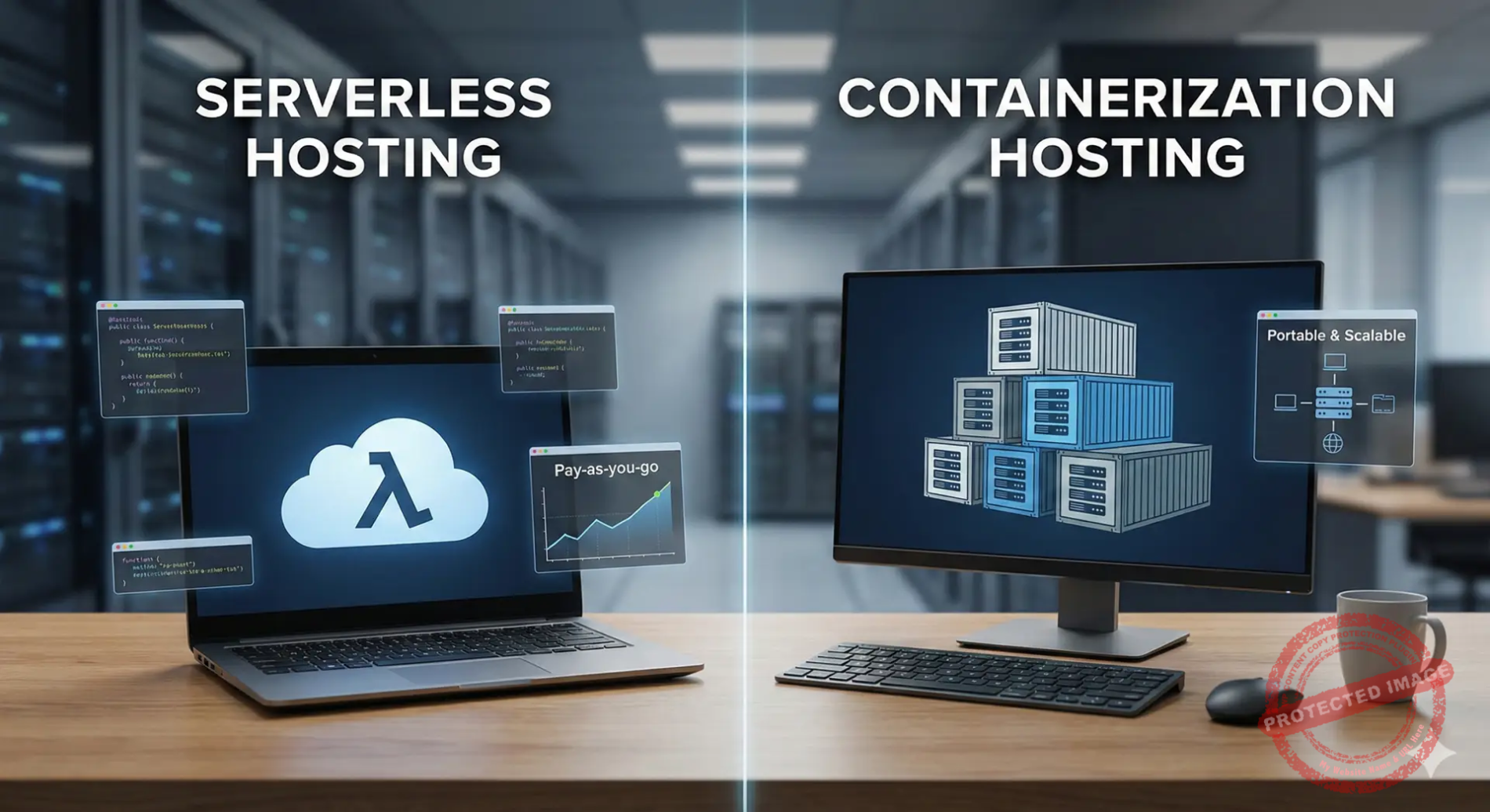
By 2026, serverless computing and containerized architectures have moved from niche adoption to mainstream hosting defaults, reshaping how applications are built, scaled, secured, and financed across enterprise and public-sector environments.
From Server-Centric Thinking to Execution-Centric Design
For much of the hosting industry’s history, infrastructure strategy began with servers. Organizations selected instance sizes, planned capacity, and optimized utilization around fixed compute resources. Even early cloud models preserved this mindset, simply virtualizing servers rather than eliminating them. By 2026, that paradigm has shifted decisively. The primary unit of value is no longer the server, but the execution of application logic.
Serverless and containerization embody this transition. Containers provide consistent, portable runtime environments, while serverless platforms abstract infrastructure entirely, executing code only when needed. Together, they enable a hosting model focused on outcomes rather than capacity. Developers deploy functions and services; platforms handle provisioning, scaling, and recovery automatically.
For technology leaders, this shift simplifies certain decisions while complicating others. Infrastructure planning gives way to architectural discipline, governance, and observability. The challenge in 2026 is not accessing these capabilities, but using them coherently at scale.
Containers as the Operational Backbone
By 2026, containers are the dominant packaging format for modern applications. Their appeal lies not in novelty but in predictability. A container encapsulates code, dependencies, and configuration in a consistent unit that behaves the same across development, testing, and production environments. This consistency reduces friction across teams and accelerates release cycles.
Container orchestration platforms manage scheduling, scaling, and resilience across clusters. Hosting providers increasingly offer managed orchestration services, reducing the operational burden on customers while preserving flexibility. These services integrate networking, storage, and security controls directly into the container lifecycle.
However, container adoption introduces complexity. Misconfigured orchestration environments can amplify risk rather than reduce it. In 2026, organizations that succeed with containerized hosting invest heavily in governance models, standardized deployment patterns, and continuous monitoring to maintain control without sacrificing agility.
Serverless Computing and the Economics of Execution
Serverless computing changes the economic model of hosting more radically than any prior innovation. Instead of paying for reserved or provisioned capacity, organizations pay for execution time and resource consumption at fine granularity. This aligns costs directly with usage, a compelling proposition for variable or unpredictable workloads.
In 2026, serverless platforms are widely used for event-driven processing, API backends, data transformation, and integration tasks. Their ability to scale instantly without pre-provisioning supports rapid experimentation and global reach. For small teams and startups, serverless hosting lowers barriers to entry. For enterprises, it enables targeted modernization without wholesale platform replacement.
Yet serverless is not universally optimal. Long-running processes, latency-sensitive workloads, and complex state management can challenge pure serverless models. As a result, hybrid architectures that combine containers and serverless functions are common in 2026, allowing organizations to match execution models to workload characteristics.
Performance, Latency, and Cold-Start Trade-Offs
Performance considerations shape how serverless and containerized hosting is adopted in 2026. Containers provide predictable performance characteristics but require careful resource management to avoid contention. Serverless functions introduce latency variability, particularly during initialization phases.
Hosting platforms mitigate these issues through pre-warming strategies, intelligent scheduling, and tighter integration with edge infrastructure. Functions can be deployed closer to users, reducing round-trip time and improving responsiveness. At the same time, performance tuning remains an application-level responsibility, requiring collaboration between developers and platform teams.
For user-facing applications, these trade-offs influence architectural choices. In 2026, performance is treated as a design constraint rather than an afterthought, shaping how and where execution occurs across hosting environments.
Security and Isolation in Cloud-Native Hosting
Security models evolve alongside serverless and container adoption. Traditional perimeter-based approaches are ill-suited to highly dynamic execution environments. In response, hosting platforms emphasize identity-based access, runtime isolation, and continuous verification.
Containers introduce shared-kernel risks that must be managed through hardened runtimes, image scanning, and policy enforcement. Serverless platforms reduce certain attack surfaces by abstracting infrastructure but introduce new concerns around function permissions and event triggers.
In 2026, security best practices emphasize least privilege, immutable infrastructure, and automated remediation. Hosting providers embed these controls into platforms, but responsibility remains shared. Organizations must define policies, validate configurations, and monitor outcomes to maintain trust in automated execution environments.
Observability and Debugging at Scale
As infrastructure becomes more abstract, observability becomes more critical. In 2026, understanding application behavior across containers, functions, and managed services requires sophisticated monitoring and tracing capabilities. Simple metrics are insufficient to diagnose issues in distributed, ephemeral environments.
Hosting platforms respond by integrating observability tooling that captures logs, metrics, and traces across execution boundaries. These tools correlate events across services, enabling teams to identify performance bottlenecks and failure modes quickly.
Despite these advances, debugging remains challenging. Ephemeral workloads disappear before issues can be inspected manually. As a result, organizations invest in proactive testing, synthetic monitoring, and chaos engineering to surface problems before they affect users.
Skills, Culture, and Organizational Change
The adoption of serverless and containerized hosting in 2026 reshapes organizational roles. Infrastructure teams focus less on hardware and more on platform reliability, security policy, and cost governance. Developers assume greater responsibility for performance and resilience through architectural decisions.
This shift requires cultural change. Organizations accustomed to centralized control must adapt to decentralized execution models. Training and enablement become critical, as does alignment between development, operations, and security functions.
Talent scarcity remains a constraint. Expertise in cloud-native architectures, orchestration, and serverless design is in high demand. Hosting providers address this gap through managed services and opinionated platforms that reduce the need for deep internal specialization.
Closing Thoughts and Looking Forward
By 2026, serverless computing and containerization have transformed web hosting from a capacity-centric service into an execution-centric platform. This evolution enables unprecedented agility, scalability, and cost alignment, but it also demands new disciplines in architecture, governance, and observability. Organizations that approach cloud-native hosting strategically, recognizing both its power and its limits, are best positioned to deliver resilient digital services in an environment defined by rapid change and rising expectations. The future of hosting lies not in managing servers, but in mastering execution across increasingly abstract platforms.
References
What Are Containers and Why They Matter
Publication: Cloud Native Computing Foundation
https://www.cncf.io/about/who-we-are/
Serverless Computing Explained
Publication: AWS
https://aws.amazon.com/serverless/
The State of Cloud-Native Development
Publication: Red Hat
https://www.redhat.com/en/resources/state-of-kubernetes
Observability in Distributed Systems
Publication: Google Cloud
https://cloud.google.com/learn/what-is-observability
Security Considerations for Cloud-Native Applications
Publication: National Institute of Standards and Technology
https://www.nist.gov/cloud-computing-security
Co-Editors
Dan Ray, Co-Editor, Montreal, Quebec.
Peter Jonathan Wilcheck, Co-Editor, Miami, Florida.
#ServerlessHosting, #Containerization, #CloudNative, #WebHosting2026, #Kubernetes, #ServerlessComputing, #ApplicationHosting, #CloudArchitecture, #EnterpriseIT, #FutureOfHosting
Post Disclaimer
The information provided in our posts or blogs are for educational and informative purposes only. We do not guarantee the accuracy, completeness or suitability of the information. We do not provide financial or investment advice. Readers should always seek professional advice before making any financial or investment decisions based on the information provided in our content. We will not be held responsible for any losses, damages or consequences that may arise from relying on the information provided in our content.
 AAPL
AAPL AMD
AMD CIS.HA
 DELL
DELL IBM
IBM INTC
INTC MSFT
MSFT GOOG
GOOG HPE
HPE NVDA
NVDA TSLA
TSLA TMC
TMC MSI
MSI NOK
NOK ECDH26.CME
 OPEAZZX