


From pilot projects to robot-rich networks in warehouses, factories, and ports
By 2026, automation and robotics will no longer be confined to a handful of highly optimized warehouses. Instead, fleets of intelligent machines will operate across distribution centers, manufacturing plants, ports, and even retail backrooms, orchestrated by AI systems that treat robots, people, and assets as a single, adaptive workforce. This expansion is being driven by ongoing labor shortages, rising e-commerce expectations, and relentless pressure to reduce unit costs without sacrificing resilience.
Warehouses become cyber-physical hubs
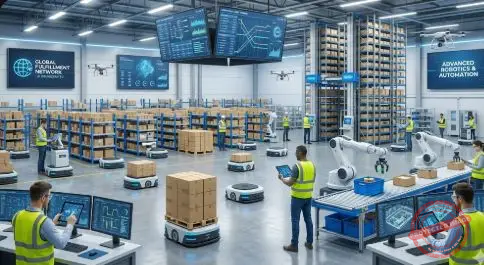
The modern warehouse is becoming a dense digital organism, filled with autonomous mobile robots, robotic arms, and automated storage and retrieval systems. Recent industry analysis shows warehouse robotics can dramatically increase productivity and accuracy, helping businesses meet demand while overcoming labor constraints.Inbound Logistics+1
Leading retailers and logistics providers are investing at scale. Amazon has deployed over one million robots in its facilities worldwide, and robotics now touch roughly three quarters of its global deliveries, fundamentally changing productivity per worker over the past decade.New York Post Marks & Spencer is building a highly automated food distribution center in the United Kingdom, using cranes and robots to handle goods in what will be the largest supply chain investment in the company’s history.The Times
These sites increasingly serve as testbeds for new forms of human–robot collaboration, where robots handle repetitive lifting, sorting, and palletizing while humans focus on exception handling, quality checks, and equipment oversight.
Automation extends beyond the four walls
Robotics is also moving upstream and downstream in the value chain. In factories, collaborative robots assist with assembly, packaging, and quality inspection. At ports and rail terminals, automated guided vehicles shuttle containers and trailers, while computer vision systems monitor yard operations.
Retailers and consumer goods companies are experimenting with automated micro-fulfillment centers attached to urban stores, using robotics to pick online orders and support rapid home delivery. For grocery chains, this hybrid model helps reconcile store replenishment, online fulfillment, and last-mile logistics in a single automated footprint.Manhattan
Sensors, computer vision, and AI orchestration
The next wave of automation is as much about intelligence as mechanics. Robots are increasingly equipped with computer vision and advanced sensors so they can recognize items, detect anomalies, and navigate complex environments safely. AI-powered orchestration platforms coordinate these machines in real time, prioritizing tasks based on order SLAs, congestion, and resource availability.Manhattan
Walmart, for example, is rolling out sensor-equipped shipping labels across millions of grocery pallets in the United States. These tags use Bluetooth to transmit data about the location and condition of goods, feeding AI systems that automatically adjust replenishment and reduce manual checks.Financial Times This sensor layer complements warehouse robotics and creates a continuous stream of data from suppliers to store shelves.
The economics of automation: more than labor substitution
The business case for robotics and automation is evolving. Historically, projects were justified primarily on labor cost savings and throughput gains. While these remain important, organizations are increasingly quantifying benefits in terms of resilience, safety, and sustainability.Inbound Logistics
Automated systems can maintain consistent performance during demand spikes, reduce error-related returns, and lower injury rates by taking on dangerous tasks. High-density automated storage also supports smaller facility footprints or allows companies to hold more inventory closer to customers, which can reduce transportation emissions and lead times. For many firms, phased rollouts—starting with high-impact zones and scaling gradually—help manage capital outlays and build internal capabilities.Inbound Logistics
Workforce transformation and new roles
One of the most sensitive aspects of automation is its impact on jobs. The experience of early adopters suggests that while certain manual roles decline, new positions emerge around robotics maintenance, flow control, analytics, and process design. At Amazon, for instance, workers have transitioned from physically demanding warehouse jobs into better-paid roles overseeing robot fleets and managing flow, supported by large-scale upskilling initiatives.New York Post
By 2026, successful companies will be those that invest heavily in training programs, cross-skilling, and career pathways into automation-related roles. Rather than treating robotics as a zero-sum replacement for labor, they will frame it as a way to eliminate unsafe, monotonous tasks and create higher-value work in supervision, troubleshooting, and continuous improvement.
Governance, cybersecurity, and interoperability
Automation at scale also introduces new operational risks. Robots and automated systems are increasingly connected to corporate networks and cloud platforms, widening the attack surface for cyber threats. A compromised warehouse control system or robotic fleet could disrupt operations just as severely as a physical incident.
To mitigate these risks, organizations are implementing zero-trust architectures, segmenting operational technology networks, and enforcing strict identity and access controls for robotics platforms. Standards for safety, interoperability, and data exchange are becoming more important as companies integrate equipment from multiple vendors.Manhattan
Closing thoughts and looking forward
By 2026, robotics and advanced automation will define how competitive supply chains operate. The leaders will not necessarily be those with the most robots, but those who integrate automation into a broader strategy encompassing data, AI, workforce development, and sustainability.
Automation projects that succeed will be designed as multi-year journeys rather than one-off installations, with clear roadmaps for expansion, change management, and ROI tracking. As automation spreads beyond warehouses into factories, yards, and stores, companies will need to coordinate investments across their entire network. The reward is a supply chain that is faster, safer, more resilient, and capable of supporting new business models in an increasingly on-demand world.
References
Warehouse Robotics: What It Is, Types, and How It Works – Inbound Logistics – https://www.inboundlogistics.com/articles/warehouse-robotics-what-it-is-types-and-how-it-works/ Inbound Logistics
Navigating the Future of Warehouse Robotics & Automation – Manhattan Associates – https://www.manh.com/our-insights/resources/blog/navigating-the-future-warehouse-robotics-automation Manhattan
Walmart Steps Up Automation with Labour-Saving Sensors – Financial Times – https://www.ft.com/content/3bc2afe8-aaed-4224-a0b9-7a0e2e5dd603 Financial Times
Marks & Spencer Spending £340m on Giant Warehouse with Robots – The Times – https://www.thetimes.co.uk/article/m-and-s-robot-warehouse-northhampton-8mwqd5xpc The Times
Amazon Will Soon Employ More Robots Than Humans as 1 Million Machines Toil Across Facilities – New York Post – https://nypost.com/2025/07/02/business/amazon-will-soon-employ-more-robots-than-humans-report/ New York Post
Dan Ray, Supply Chain Management, Montreal, Quebec.
Peter Jonathan Wilcheck, Co-Editor, Miami, Florida.
#SupplyChainAutomation #WarehouseRobotics #Fulfillment2026 #HumanRobotCollaboration #RetailLogistics #GrocerySupplyChain #CyberPhysicalSystems #AutomationStrategy #LaborShortageSolutions #DigitalFulfillment
Post Disclaimer
The information provided in our posts or blogs are for educational and informative purposes only. We do not guarantee the accuracy, completeness or suitability of the information. We do not provide financial or investment advice. Readers should always seek professional advice before making any financial or investment decisions based on the information provided in our content. We will not be held responsible for any losses, damages or consequences that may arise from relying on the information provided in our content.

 AAPL
AAPL MSFT
MSFT GOOG
GOOG TSLA
TSLA AMD
AMD IBM
IBM TMC
TMC IE
IE INTC
INTC MSI
MSI NOK
NOK DELL
DELL ECDH26.CME