


Agentic AI moves from hype to hard ROI as enterprises teach software to act, not just answer
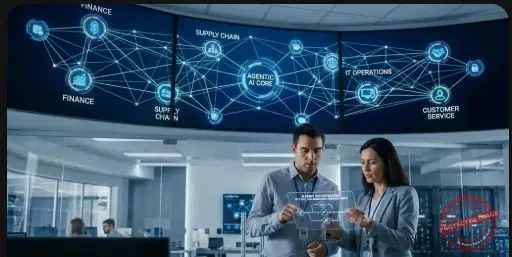
Agentic AI is quickly becoming the organizing principle for next-generation AI, shifting the focus from single chatbots to networks of goal-driven agents that can plan, reason, and take actions across complex enterprise environments. Rather than answering isolated prompts, these systems orchestrate workflows, call tools and APIs, collaborate with other agents, and learn from feedback loops. Analyst houses now describe “agentic AI meshes” as distributed architectures where many agents coordinate across applications, data sources, and infrastructure, opening new possibilities in IT modernization, finance operations, supply chain, and customer service. McKinsey & Company+1
From copilots to AI colleagues
The first wave of AI in business largely revolved around copilots: assistants that surface information, generate a draft, or summarize a meeting. Agentic AI builds on this foundation but adds persistent memory, planning, and tool usage. An agent might not simply summarize a contract; it can read a batch of contracts, flag unusual clauses, open a ticket in a workflow tool, propose redlines, and notify stakeholders.
For many organizations, the big leap is the agent’s ability to autonomously break a goal into steps. A procurement agent can monitor supplier performance, trigger a risk assessment, initiate sourcing when thresholds are breached, and loop in a human approver only for exceptions. In IT, modernization agents can analyze legacy code, recommend refactoring paths, generate tests, and coordinate deployment pipelines. Cloud providers are already integrating agentic capabilities into their migration and modernization suites, reporting multi-fold improvements in project speed and cost. IT Pro
Multi-agent systems as the new enterprise fabric
While a single agent can perform useful tasks, the real power lies in multi-agent systems. Here, specialized agents act as experts that negotiate, critique, and delegate to each other. A “planner” agent defines a strategy, a “research” agent collects context, an “execution” agent calls APIs, and a “guardrail” agent enforces policy and compliance.
Industry guidance increasingly frames this as a mesh of agents that is vendor-agnostic and composable, able to span SaaS tools, internal microservices, and even edge devices. In this model, the enterprise becomes a fabric of services exposed to agents, who can route work dynamically to whichever system can best fulfill the task. This architecture promises resilience and flexibility, but it also demands rigorous design for identities, permissions, and observability across the entire agent network. McKinsey & Company
Business value: from isolated pilots to agent networks
Early adopters report that agentic AI is particularly powerful in domains where processes are well understood but fragmented across tools and teams. IT modernization, cloud cost optimization, KYC onboarding, and incident response are all fertile ground. Cloud platforms are launching ready-made agent frameworks for code transformation, documentation generation, testing, and mainframe migration, often reporting modernization time reductions of several multiples compared to manual methods. IT Pro
At the same time, device-level agentic models are emerging, able to observe interfaces, move the mouse and keyboard, and complete tasks on behalf of users. This “computer use agent” paradigm opens a new frontier where AI can learn to use software the way a human would, accelerating automation even for legacy applications that lack APIs. IT Pro
Risk, governance, and operational discipline
As agents gain autonomy, the burden on governance grows. Companies must define clear scopes of authority for each agent, implement strong identity and access controls, and ensure every action is logged and explainable. Observability must go beyond traditional monitoring, capturing prompts, decisions, tool calls, and outcomes to support root-cause analysis and compliance reviews.
Best practice is converging on a “human-in-control” model: agents propose, humans approve for high-impact actions, and gradually more autonomy is granted as confidence grows. Organizations are also adopting AI risk management frameworks that emphasize transparency, reliability, robustness, and accountability across the AI lifecycle. NIST+1
Closing thoughts and looking forward
By 2026, agentic AI is set to become the backbone of enterprise automation, turning static workflows into dynamic, adaptive systems that respond in real time to data and events. Rather than replacing humans, these agents will increasingly handle the brittle, repetitive, cross-system orchestration work that humans find tedious and error-prone. The enterprises that win will be those that treat agentic AI not as a single product but as a strategic architecture, investing in platforms, governance, and cross-functional teams that can safely scale from a handful of agents to hundreds.
References:
Seizing the agentic AI advantage – McKinsey – https://www.mckinsey.com/capabilities/quantumblack/our-insights/seizing-the-agentic-ai-advantage
Agentic AI use cases for enterprise ops – Coherent Solutions – https://www.coherentsolutions.com/insights/agentic-ai-use-cases-for-enterprise-ops
Here’s how to pick the right AI agent for your organization – World Economic Forum – https://www.weforum.org/stories/2025/05/ai-agents-select-the-right-agent
AWS targets IT modernization gains with new agentic AI features – ITPro – https://www.itpro.com/technology/artificial-intelligence/aws-targets-it-modernization-gains-with-new-agentic-ai-features-in-transform
Microsoft quietly launches Fara-7B, a new agentic small language model – ITPro – https://www.itpro.com/technology/artificial-intelligence/microsoft-fara-7b-agentic-small-language-model
Dan Ray, Co-Editor, Montreal, Quebec.
Peter Jonathan Wilcheck, Co-Editor, Miami, Florida.
#AgenticAI #AIAgents #EnterpriseAutomation #MultiAgentSystems #AIArchitecture #ITModernization #AIOps #DigitalTransformation #AutonomousSystems #AI2026
Post Disclaimer
The information provided in our posts or blogs are for educational and informative purposes only. We do not guarantee the accuracy, completeness or suitability of the information. We do not provide financial or investment advice. Readers should always seek professional advice before making any financial or investment decisions based on the information provided in our content. We will not be held responsible for any losses, damages or consequences that may arise from relying on the information provided in our content.
 AAPL
AAPL MSFT
MSFT GOOG
GOOG TSLA
TSLA AMD
AMD IBM
IBM TMC
TMC IE
IE INTC
INTC MSI
MSI NOK
NOK DELL
DELL ECDH26.CME