


How self-optimizing CMPs are turning policies into real-time infrastructure decisions
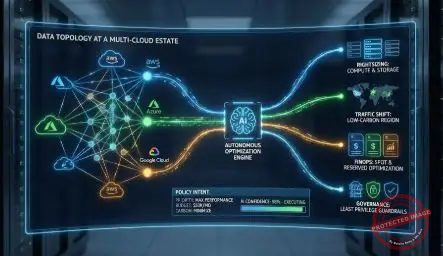
Cloud management platforms are quietly evolving from glorified dashboards into autonomous control systems for the enterprise cloud estate. In 2026, the most advanced CMPs use AI and machine learning not just to detect problems but to continuously optimize compute, storage, networking, and even carbon footprint against business goals. The result is a subtle but profound shift: instead of engineers chasing alerts, policies are encoded once, and AI automation continuously steers workloads toward the best possible configuration.
From scripts and playbooks to self-driving clouds
For more than a decade, cloud automation meant infrastructure as code, runbooks, and scheduled jobs. That model is powerful but inherently static. It assumes predictable patterns, stable environments and human operators who can afford to be the bottleneck in every change. As multi-cloud estates grow and AI-heavy workloads become the norm, those assumptions no longer hold.
Industry observers tracking AI and FinOps note that AI workloads generate highly variable demand and require expensive GPU infrastructure, where even small inefficiencies can translate into significant financial and environmental impacts. FinOps Foundation+1 At the same time, AI governance brings new compliance and audit requirements, further complicating manual operations. To cope, enterprises are turning to AI-driven CMPs that treat automation as an always-on loop rather than a collection of one-off scripts.
Inside the AI engines of next-generation CMPs
Vendors building modern CMPs are combining several AI techniques: anomaly detection, forecasting, optimization, and reinforcement learning. AI-driven platforms highlighted in recent rankings of cloud management tools now position themselves explicitly as “AI-powered FinOps and automation engines” that connect to AWS, Azure, Google Cloud, and Kubernetes to adjust usage, commitments, and topology continuously. nOps+2Kumoco
These platforms ingest telemetry from cloud provider APIs, application performance monitoring, cost data, and even carbon intensity feeds. Time-series models forecast demand for different services and regions. Optimization algorithms then search the decision space: which instances to rightsize, which workloads to scale vertically or horizontally, whether to shift traffic to spot or reserved capacity, and whether to move jobs to lower-carbon regions. Over time, reinforcement learning systems refine their recommendations based on the outcomes of previous actions and human feedback.
In parallel, AI is applied to governance and security. CMPs can parse policy documents, classify resources by risk, and suggest guardrails that enforce least privilege or data-residency requirements. Some platforms are beginning to use generative models to summarize complex change histories and explain why the automation engine took certain decisions—an important step for trust and regulatory scrutiny.
Autonomous optimization meets FinOps discipline.
The most impressive results come from pairing AI automation with disciplined FinOps practices. The FinOps community has published guidance on optimizing cloud usage and shared schemas that normalize cost data across providers, making it easier for AI to reason over multi-cloud spend. FinOps Foundation+3FinOps Foundation+3FinOps Foundation
Vendors at the intersection of AI governance and FinOps describe their approach as a “dual engine” where AI models detect optimization opportunities while FinOps processes ensure that finance, engineering and product teams agree on budgets, priorities and acceptable trade-offs. Ilink Digital In practice, this means CMPs present recommendations in business language: the projected annual savings of a rightsizing action, the impact on service-level objectives, and the potential change in carbon emissions. Stakeholders can then approve, reject or let the system act automatically when confidence is high.
Cast AI, and the rise of automation-first startups
The funding environment underscores how central AI automation has become to cloud management. In 2025, a Miami-based startup specializing in automating cloud infrastructure management raised more than $100 million, with investors explicitly citing demand from organizations trying to manage AI-era cloud costs and performance. Reuters The platform automatically tunes CPU and GPU resource usage in Kubernetes clusters, and counts major enterprises among its customers.
This mirrors a broader trend: CMPs and adjacent tools increasingly assume full automation and layer in dashboards and controls as secondary features. In that worldview, humans define intent and constraints, while the platform constantly experiments and optimizes within those boundaries.
What AI-driven CMPs mean for SRE, DevOps and platform teams
The shift toward AI automation does not eliminate operations roles, but it fundamentally changes them. Site reliability engineers and platform teams move from executing changes to curating policies, validating models, and improving the quality of telemetry that AI depends on. FinOps practitioners focus less on manually combing through invoices and more on designing business-aligned guardrails.
FinOps guidance emphasizes that optimization is only as good as tagging, account structure and governance. FinOps Foundation The same is true for AI automation. Poorly tagged resources and ambiguous ownership make it difficult for CMPs to align optimization with the right teams and budgets. Enterprises investing in AI-powered CMPs therefore often run parallel programs to clean up tagging and document ownership, so that automation can act with confidence.
Risks, limitations, and the importance of transparency
AI automation also introduces new risks. Models can be trained on incomplete or biased data, leading to mis-optimization that harms performance or violates compliance. There is also a risk of over-optimization, in which systems pursue short-term cost savings at the expense of resilience or long-term vendor relationships.
To mitigate those risks, leading CMPs are investing in transparency and control. Some providers expose explanations for recommendations, confidence scores, and safety rails that prevent dangerous actions. Others allow organizations to restrict automation to certain domains, such as noncritical batch workloads or development environments, while keeping production changes manual until trust is built.
Regulators and industry bodies are also starting to pay attention. As AI automation touches infrastructure that underpins critical services, organizations will likely face more stringent requirements to document decision processes and provide human oversight.
Closing Thoughts and Looking Forward
AI automation in cloud management platforms represents one of the most impactful shifts in cloud operations since the rise of infrastructure-as-code. By turning observability and policy into a continuous optimization loop, CMPs help enterprises control costs, improve performance, and advance sustainability goals at a scale humans cannot match. The key to success will be combining powerful AI engines with robust FinOps practices, clear governanc,e and transparent controls.
Over the next few years, expect CMPs to offer “autonomy tiers,” allowing organizations to gradually expand the scope of AI-driven actions as trust grows. The winners will be platforms that respect human expertise, make their reasoning explainable, and give businesses fine-grained control over when to let automation take the wheel and when to keep a hand on the manual override.
References
FinOps for AI Overview – FinOps Foundation – https://www.finops.org/wg/finops-for-ai-overview/
AI + FinOps: The Dual Engine Driving Smarter Microsoft Cloud Management – iLink Digital – https://www.ilink-digital.com/insights/blog/ai-finops-the-dual-engine-driving-smarter-microsoft-cloud-management-2/
20 Best Cloud Management Platforms in 2025 – nOps – https://www.nops.io/blog/best-cloud-management-platforms-software-tools-solutions/
Kumoco Cloud Manager: AI-Powered Cloud Management Platform – Kumoco – https://kumoco.com/cloud-management/
Cast AI Secures $108 Million Funding to Expand Cloud Automation – Reuters – https://www.reuters.com/business/media-telecom/cast-ai-secures-108-million-funding-expand-cloud-automation-2025-04-30/
Benoit Tremblay, Author, Tech Cost Management, Montreal, Quebec;
Peter Jonathan Wilcheck, Co-Editor, Miami, Florida.
#CloudAutomation #AICMP #SelfOptimizingCloud #CloudManagementPlatforms #FinOpsAutomation #KubernetesAutomation #CloudCostControl #AIGovernance #MultiCloudOps #PolicyDrivenIT
Post Disclaimer
The information provided in our posts or blogs are for educational and informative purposes only. We do not guarantee the accuracy, completeness or suitability of the information. We do not provide financial or investment advice. Readers should always seek professional advice before making any financial or investment decisions based on the information provided in our content. We will not be held responsible for any losses, damages or consequences that may arise from relying on the information provided in our content.
 AAPL
AAPL MSFT
MSFT GOOG
GOOG TSLA
TSLA AMD
AMD IBM
IBM TMC
TMC IE
IE INTC
INTC MSI
MSI NOK
NOK DELL
DELL ECDH26.CME