


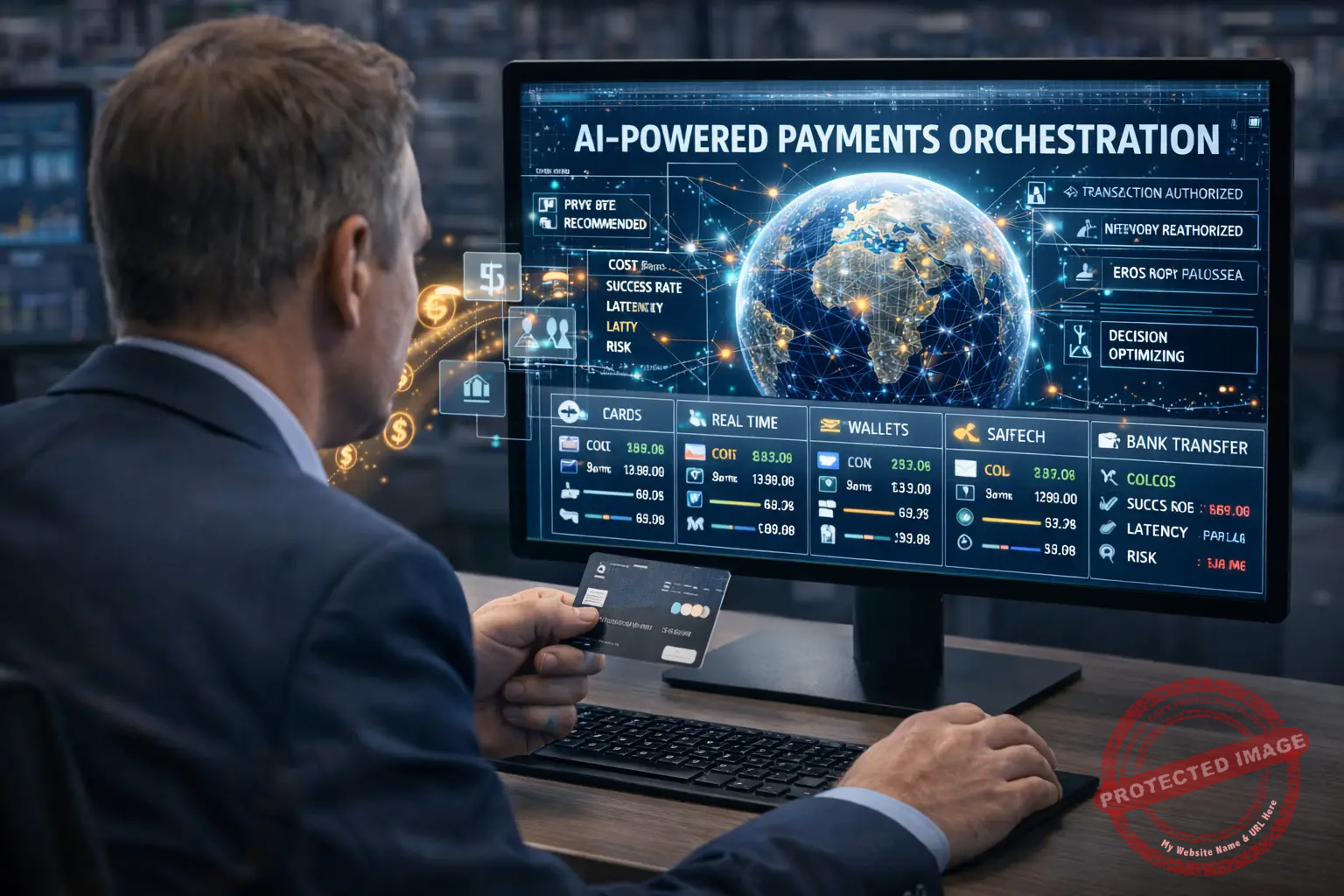
As digital transactions accelerate, artificial intelligence is redefining how payments are routed, authorized, secured, and optimized, turning payment processing from a back-office function into a strategic control layer for global commerce.
Payment processing enters its orchestration era
By 2026, payment processing is no longer defined primarily by point-of-sale terminals or card networks operating behind the scenes. It is increasingly shaped by software-driven orchestration layers that sit above traditional rails and dynamically determine how each transaction is handled in real time. This shift reflects the convergence of artificial intelligence, cloud-native infrastructure, and the growing complexity of global commerce. Enterprises now operate across dozens of payment methods, currencies, regulatory regimes, and fraud environments. Static routing rules and manually configured gateways are proving insufficient. AI-driven payment orchestration platforms are emerging as the connective tissue that allows organizations to adapt payment flows continuously, balancing cost, authorization success, latency, and risk on a per-transaction basis.
The change is not theoretical. By 2026, large merchants, marketplaces, and public-sector payment programs are budgeting explicitly for orchestration capabilities as part of core payments modernization initiatives. What once required months of configuration and reconciliation is increasingly handled through machine learning models that learn from transaction outcomes and adjust routing logic automatically. The strategic implication is that payment performance is no longer a fixed attribute of a provider contract but a variable that can be optimized in software, provided organizations invest in the data, integration, and governance foundations required to support it.
From payment gateways to intelligent routing layers
Historically, payment gateways acted as relatively simple conduits, forwarding transactions to acquiring banks or processors based on predefined rules. In a multi-region, omnichannel environment, this approach leads to inefficiencies, higher decline rates, and unnecessary fees. AI-driven orchestration introduces an adaptive layer that evaluates multiple parameters in milliseconds, including transaction amount, device context, historical authorization behavior, network performance, and regional compliance requirements. In 2026, these systems are increasingly trained on millions of historical transactions and continuously refined using live feedback loops.
For technology leaders, the architectural shift matters as much as the functional one. Orchestration platforms are typically deployed as cloud-native services with APIs that integrate into commerce platforms, ERP systems, and customer-facing applications. This allows payment logic to evolve independently of front-end checkout experiences. The result is greater agility, but also new dependencies on data quality, model transparency, and vendor interoperability. Organizations planning for 2026 must treat payment orchestration as part of their broader application architecture, not as an isolated financial tool.
AI as a lever for authorization performance
One of the most immediate drivers of orchestration adoption is authorization optimization. Even small improvements in approval rates can translate into significant revenue gains at scale. By 2026, AI models are widely used to predict which acquiring path is most likely to succeed for a given transaction, factoring in issuer behavior patterns that change over time. These models can also decide when to retry a transaction, whether to adjust parameters such as transaction descriptors, or when to route through alternative networks.
However, the benefits come with constraints. Authorization models are probabilistic, not deterministic, and their effectiveness depends on continuous access to high-quality data. Enterprises operating in regulated environments must also ensure that automated decisioning does not violate transparency or fairness requirements. In 2026, leading organizations are establishing cross-functional governance teams that include payments specialists, data scientists, legal counsel, and compliance officers to oversee how orchestration logic evolves and how its outcomes are monitored.
Fraud prevention moves closer to the transaction edge
Fraud detection has long relied on rules engines and post-transaction analysis. AI-driven orchestration brings fraud decisioning into the transaction path itself, enabling risk assessment and mitigation to occur before authorization requests are finalized. By correlating device signals, behavioral patterns, and historical outcomes, orchestration systems can decide whether to apply additional authentication, route a transaction through a lower-risk channel, or block it entirely.
In 2026, this real-time fraud intelligence is particularly important as payment methods diversify and attackers exploit inconsistencies across channels. Orchestration platforms increasingly act as aggregation points for fraud signals sourced from internal systems and external partners. The challenge for organizations is managing false positives and customer friction. Overly aggressive models can reduce fraud losses but at the expense of conversion and user trust. As a result, enterprises are investing in explainability tools that allow teams to understand why certain routing or blocking decisions were made and to adjust thresholds as conditions change.
Compliance and regulatory pressure shape orchestration design
Regulatory complexity is a central consideration in payment processing strategy for 2026. Data residency requirements, strong customer authentication rules, and sector-specific mandates all influence how transactions can be routed and processed. AI-driven orchestration must encode these constraints into its decision logic, ensuring that optimization does not come at the cost of compliance.
Public-sector payment programs illustrate this tension clearly. Governments adopting digital disbursements and online fee collection are under pressure to improve efficiency while maintaining strict oversight. In 2026, orchestration platforms used in these contexts often include configurable policy layers that sit alongside machine learning models, allowing hard regulatory constraints to override probabilistic optimization. For enterprise IT leaders, this reinforces the need to evaluate orchestration solutions not only on performance metrics but also on their ability to support auditability, policy enforcement, and long-term regulatory adaptability.
Integration challenges and enterprise readiness
Despite their promise, AI-driven orchestration platforms are not plug-and-play solutions. Integration complexity remains a significant barrier to adoption in 2026. Legacy payment systems, fragmented data sources, and inconsistent transaction schemas can limit the effectiveness of AI models. Organizations that underestimate the integration effort risk deploying orchestration layers that operate on incomplete or delayed data, undermining their potential benefits.
Successful adopters are approaching orchestration as a phased transformation. Initial deployments often focus on specific geographies or transaction types, allowing teams to validate models and integration patterns before scaling. This incremental approach aligns with budget realities in 2026, as technology spending faces increased scrutiny. CIOs and CTOs are expected to demonstrate measurable improvements in authorization rates, fraud reduction, or processing costs within defined timeframes to justify further investment.
Talent, governance, and operational maturity
AI-driven payment orchestration introduces new operational requirements. Payments teams must collaborate more closely with data engineering and machine learning specialists, roles that are already in short supply. In 2026, talent scarcity is a practical constraint, pushing organizations to favor platforms that offer managed models and tooling rather than requiring extensive in-house development.
Governance frameworks are equally critical. As orchestration logic becomes more autonomous, organizations must define clear accountability for outcomes. This includes monitoring model drift, responding to anomalous behavior, and ensuring that automated decisions align with business objectives. Enterprises that treat orchestration as a purely technical upgrade risk losing visibility into how payment performance is achieved and at what trade-offs.
Market signals and competitive differentiation
By 2026, payment orchestration is increasingly viewed as a source of competitive differentiation rather than a cost center optimization. Marketplaces, subscription platforms, and cross-border retailers are using orchestration capabilities to tailor payment experiences to local preferences while maintaining centralized control. The ability to experiment rapidly with new payment methods or routing strategies without disrupting core systems is becoming a strategic asset.
At the same time, the market remains fragmented. No single approach fits all organizations, and vendor capabilities vary widely. Enterprises must navigate trade-offs between flexibility, transparency, and reliance on proprietary models. This uncertainty reinforces the importance of due diligence and pilot programs when evaluating orchestration technologies.
Closing Thoughts and Looking Forward
As 2026 unfolds, AI-driven payment orchestration stands out as one of the most consequential shifts in payment processing technology. It reflects a broader trend toward software-defined financial infrastructure, where intelligence and adaptability are embedded directly into transaction flows. For technology and business leaders, the opportunity lies in treating payments as a strategic system that can be measured, optimized, and governed like any other critical platform. The risks are equally real, encompassing integration complexity, regulatory exposure, and organizational readiness. Those who invest thoughtfully, align stakeholders, and ground their strategies in realistic 2026 expectations will be best positioned to turn payment orchestration into a durable advantage rather than an operational liability.
References
Payment orchestration explained: how intelligent routing improves authorization rates. Stripe Payments Documentation. https://stripe.com/guides/payment-orchestration
The rise of intelligent payment routing in global commerce. McKinsey & Company Insights. https://www.mckinsey.com/industries/financial-services/our-insights/intelligent-payment-routing
AI and the future of fraud prevention in payments. World Economic Forum. https://www.weforum.org/agenda/2023/10/ai-fraud-prevention-payments/
Modernizing government payments with digital platforms. U.S. Department of the Treasury. https://home.treasury.gov/policy-issues/financial-markets-financial-institutions-and-fiscal-service/digital-payments
Global payments report 2024: preparing for the next wave. Boston Consulting Group. https://www.bcg.com/publications/2024/global-payments-report
Dan Ray, Co-Editor, Montreal, Quebec.
Peter Jonathan Wilcheck, Co-Editor, Miami, Florida.
#PaymentProcessing, #AIPayments, #PaymentOrchestration, #DigitalCommerce, #FraudPrevention, #Fintech2026, #EnterpriseIT, #FinancialInfrastructure, #RegTech, #TransactionSecurity
Post Disclaimer
The information provided in our posts or blogs are for educational and informative purposes only. We do not guarantee the accuracy, completeness or suitability of the information. We do not provide financial or investment advice. Readers should always seek professional advice before making any financial or investment decisions based on the information provided in our content. We will not be held responsible for any losses, damages or consequences that may arise from relying on the information provided in our content.
 AAPL
AAPL MSFT
MSFT GOOG
GOOG TSLA
TSLA AMD
AMD IBM
IBM TMC
TMC IE
IE INTC
INTC MSI
MSI NOK
NOK DELL
DELL ECDH26.CME