


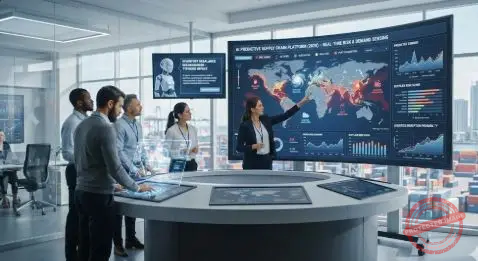
How AI turns volatility into a planning advantage by 2026
For most of the last decade, supply chain planning has been defined by spreadsheets, backward-looking reports, and long meetings where teams debated whose forecast was “least wrong.” By 2026, that mindset is giving way to something more dynamic. AI-driven predictive analytics is evolving from a bolt-on forecasting tool into the nerve center of supply chain decision-making, continuously scanning signals, simulating scenarios, and recommending actions across the entire network.
From static forecasts to living, learning predictions
Traditional demand planning tools aggregated historical sales and adjusted for seasonality or promotions. In an era of pandemics, climate disruptions, geopolitical shocks, and viral social media trends, those methods feel painfully slow. New AI models combine machine learning, time-series analysis, and external data such as macroeconomic indicators, weather, mobility data, and even social sentiment to generate high-frequency predictions that update as conditions change.AIMultiple
Enterprises are deploying these models in cloud-based platforms designed specifically for supply chains, using them to anticipate stock-outs, rebalance inventory between regions, and detect demand shifts at a SKU or store level. Leading vendors now embed AI into supply chain planning modules, warehouse management, and transportation systems, turning forecasts into executable recommendations that planners can accept, modify, or reject.Deposco
Beyond forecasting: risk sensing and disruption anticipation
The most transformative change is that predictive analytics is no longer limited to future demand. Supply chain leaders are training models on disruption data: port congestion histories, carrier on-time performance, supplier lead-time variability, cyber incidents, and extreme weather events. These models generate risk scores for lanes, suppliers, and nodes so teams can see where a network is likely to break before it does.SSRN
For example, if a typhoon threatens a major port or a labor dispute escalates at a rail operator, AI systems can calculate the probability of delays, estimate the financial impact, and propose alternative routings or sourcing options. Rather than scrambling after a disruption has already hit, companies are using predictive analytics to stage inventory, pre-book capacity, or activate contingency suppliers days earlier than before.SCMR
Data foundations: the unglamorous prerequisite
AI-driven predictive analytics depends on something many supply chains still struggle with: clean, consistent data. Multiple ERPs, regional spreadsheets, legacy on-prem systems, and inconsistent master data standards can make it difficult to feed models with trustworthy inputs.
To address this, organizations are investing in data lakes and unified data models that harmonize item, location, customer, and supplier hierarchies across regions. Modern platforms integrate streaming data from IoT sensors, transportation management systems, and e-commerce channels into a single view, enabling models to run on near real-time information instead of outdated batch files.SSRN
Governance is becoming as important as algorithms. Data stewards establish quality checks, lineage tracking, and access controls so that sensitive supply chain data can be used for analytics without compromising security or privacy.
AI agents and autonomous planning pods
By 2026, the frontier is shifting from predictive models that surface insights to AI “agents” that can initiate workflows. Early versions of these systems already exist in control towers and planning platforms, where AI can automatically generate purchase orders, reschedule shipments, or propose production plan changes within guardrails approved by humans.25madison.com
Imagine a regional demand spike detected in e-commerce data. An AI agent evaluates inventory availability, transportation lead times, supplier capacity, and promotional calendars. It then recommends pulling inventory from slower-moving markets, adding an extra replenishment cycle, and temporarily adjusting minimum order quantities. Planners review the plan through a natural-language interface, ask the agent to explain its assumptions, then approve or refine the suggestion.
This agentic model turns planners into supervisors and scenario designers rather than spreadsheet operators. It also makes predictive analytics more accessible to non-technical users, who can interact with models through conversational queries instead of complex dashboards.
Human skillsets: from gut feel to model literacy
Even the best models can be dangerous without human oversight. Supply chain teams are learning how to interpret confidence intervals, understand model drift, and recognize where AI may be extrapolating beyond reliable data. Leading companies are rolling out training programs in data literacy, optimization basics, and ethics for planners, buyers, and logistics managers.AIMultiple
Rather than replacing planners, predictive analytics is redefining their work. They focus more on cross-functional collaboration—aligning sales, finance, and operations—while AI handles the repetitive number crunching. Organizations that succeed treat AI as a team member whose recommendations must be challenged, validated, and continuously improved.
Guardrails: avoiding black-box decisions
The move to AI-driven predictions introduces new risks. Over-reliance on opaque models can cause organizations to overlook edge cases or rare events that fall outside the training data. Poorly governed algorithms might prioritize short-term cost reduction at the expense of service levels, supplier relationships, or sustainability commitments.
To counter this, companies are building model catalogs, documenting each algorithm’s purpose, inputs, and limitations. They are setting policies for explainability, requiring that high-impact decisions come with a traceable rationale. Some are experimenting with “shadow modes,” where AI recommendations run alongside traditional processes to compare performance before fully automating decisions.SSRN
Closing thoughts and looking forward
By 2026, AI-driven predictive analytics will be less about a single killer app and more about an ecosystem that spans forecasting, risk management, and execution. The most advanced supply chains will use these capabilities not only to respond faster but to shape demand, co-design inventory strategies with customers, and negotiate more intelligently with suppliers.
The organizations that win will be those that pair strong data foundations and governance with a culture of experimentation. They will treat predictive analytics as a constantly evolving capability rather than a one-time implementation project. As AI agents grow more capable, the role of human judgment—understanding trade-offs, ethics, and strategy—will become even more critical. Supply chains that master this blend of machine intelligence and human insight will turn volatility into a source of competitive advantage rather than existential risk.
References
Artificial Intelligence in Supply Chain: From Predictive Models to AI Agents – 25Madison – https://www.25madison.com/content/artificial-intelligence-in-supply-chain-from-predictive-models-to-ai-agents 25madison.com
Top 13 Supply Chain AI Use Cases with Examples – AIMultiple – https://research.aimultiple.com/supply-chain-ai/ AIMultiple
2026: The Age of the AI Supply Chain – Supply Chain Management Review – https://www.scmr.com/article/2026-the-age-of-the-ai-supply-chain SCMR
AI-Enabled Real-Time Supply Chain Visibility and Monitoring – SSRN – https://papers.ssrn.com/sol3/papers.cfm?abstract_id=5199933 SSRN
Improving Efficiency and Sustainability via Supply Chain Analytics – Technological Forecasting & Social Change (ScienceDirect) – https://www.sciencedirect.com/science/article/pii/S0040162524006395 ScienceDirect
Dan Ray, Supply Chain Management, Montreal, Quebec.
Peter Jonathan Wilcheck, Co-Editor, Miami, Florida.
#SupplyChainManagement2026 #PredictiveAnalytics #AIInSupplyChain #DemandForecasting #RiskManagement #SupplyChainResilience #DataGovernance #AIControlTower #InventoryOptimization #DigitalSupplyChain
Post Disclaimer
The information provided in our posts or blogs are for educational and informative purposes only. We do not guarantee the accuracy, completeness or suitability of the information. We do not provide financial or investment advice. Readers should always seek professional advice before making any financial or investment decisions based on the information provided in our content. We will not be held responsible for any losses, damages or consequences that may arise from relying on the information provided in our content.
 AAPL
AAPL MSFT
MSFT GOOG
GOOG TSLA
TSLA AMD
AMD IBM
IBM TMC
TMC IE
IE INTC
INTC MSI
MSI NOK
NOK DELL
DELL ECDH26.CME