


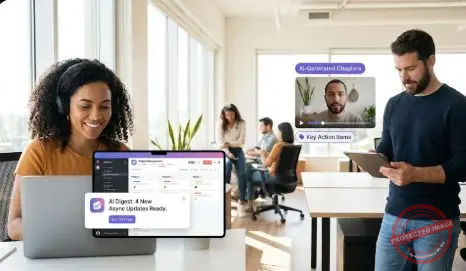
As remote teams spread across continents and time zones, the most important meetings are increasingly the ones that never happen live. By 2026, advanced asynchronous communication tools powered by AI will become the backbone of remote collaboration, replacing “always-on” meeting culture with documentation-first, time-zone-friendly workflows.
From “Zoom fatigue” to async-first cultures
The first generation of remote work leaned heavily on video calls. That approach delivered continuity during the crisis but quickly led to burnout, fragmented focus, and calendars filled with overlapping meetings. Remote organizations began to realize that the real promise of digital work was not more live communication, but less.
Asynchronous communication flips the default. Instead of requiring everyone to be present at the same time, teams record short video briefs, share rich written updates, and rely on structured workspaces that persist information. The missing ingredient was always context. Without real-time discussion, how would teams ensure that everyone understood decisions, risks, and next steps?
This is where AI-native async tools have surged. Modern AI meeting assistants capture live or recorded sessions, transcribe them, and generate structured summaries with key points, action items, and decisions, turning raw conversation into reference-grade documentation for colleagues to watch or read later. Reviews of leading AI meeting assistants highlight features like cross-platform recording, transcript search, and automatic action-item extraction as essential for remote teams. People Managing People
By 2026, remote workers will expect every important discussion—whether held live or recorded—to produce high-quality async artifacts by default.
AI meeting summaries as the new “minutes”
Modern AI transcription and summarization tools are already transforming remote meetings. Guides aimed at remote teams describe how platforms automatically record calls, generate real-time transcripts, translate multiple languages, and deliver concise summaries with task lists and milestones. SuperAGI SpeakNotes
In a 2026 workflow, a product manager might record a 10-minute update video instead of scheduling a live status meeting. An AI assistant will:
Transcribe the recording into text.
Highlight risks, decisions, and dependencies.
Extract action items and assign them to the right people in project tools.
Generate a short executive summary for leadership and a longer narrative for the delivery team.
For teammates in other time zones, the experience feels like attending a perfectly organized meeting on their own schedule. They can skim summaries on their phone, search transcripts for specific topics, and respond with threaded comments or their own short video replies.
Technology reviewers now categorize “AI meeting summary tools” as a distinct product segment, emphasizing their role in eliminating note-taking and improving follow-through for remote teams. Create & Grow
Async video, audio, and “message spaces”
Text alone is often too dry to carry nuance, but live meetings are too demanding of time and attention. Remote-first companies are converging on async video and audio messages as a middle ground. Employees record quick updates, design walkthroughs, or stakeholder pitches, which appear in dedicated “message spaces” organized by project.
These messages are enriched with AI-generated captions, translations, and topic tags, so colleagues can consume them in seconds rather than minutes. Some platforms allow viewers to jump directly to segments labeled “decision” or “risk,” while others provide AI search across thousands of recorded conversations.
Major collaboration platforms are integrating these capabilities directly, with AI features that automatically summarize huddles and route action items into channels or task boards. Slack
In 2026, this means a globally distributed engineering team can operate almost entirely asynchronously: developers post design proposals as annotated videos, teammates comment when they wake up, and AI agents roll those decisions into documentation, Jira tickets, or pull-request templates.
Intelligent scheduling and rhythm design
The move to async does not mean the end of meetings; it means fewer and better ones. AI-powered schedulers are starting to analyze time zones, energy patterns, and historical attendance to propose “minimal viable meeting” schedules. These tools can suggest that a weekly review be converted into an async update plus a monthly live session, or that a particular team should shift its stand-up to written form.
Async-first organizations codify “communication rhythms” into their operating models. Daily updates might be written; weekly updates might be video-based; monthly rituals might still be live, but heavily supported by AI summarization.
Blogs and playbooks on asynchronous communication emphasize that success depends less on any single tool and more on consistent patterns: clear channels for decisions, standardized templates for updates, and norms that value documentation over ad hoc conversations. MeetGeek
Challenges: Context, overload, and digital wellbeing
If async tools are poorly implemented, organizations risk replacing meeting fatigue with notification fatigue. A flood of transcripts, summaries, and video messages can quickly overwhelm even the most disciplined remote worker.
The next wave of AI agents will help by acting as personal “communication filters.” They will prioritize updates based on each person’s projects, summarize whole channels into daily digests, and allow workers to set “focus windows” where only critical alerts break through.
Trust and privacy are also crucial. AI meeting assistants often have access to sensitive corporate data and personal voice recordings. Remote organizations must ensure vendors meet enterprise-grade security standards, provide robust data protection, and allow fine-grained control over what is stored, who can search it, and how long it is retained. SuperAGI
Closing thoughts and looking forward
By 2026, advanced asynchronous communication will be the defining capability of high-performing remote teams. AI transcription, summarization, and scheduling will convert messy, real-time conversations into structured, searchable knowledge that crosses time zones effortlessly.
Organizations that embrace async-first operating models will enjoy deeper focus, fewer interruptions, and more inclusive participation from globally distributed employees. The future of remote work is not about being online at the same time—it is about keeping work moving forward, even while parts of the team are asleep.
Co-Editors:
Dan Ray, Remote Technologies, Montreal, Quebec.
Peter Jonathan Wilcheck, Co-Editor, Miami, Florida.
References
20 Best AI Meeting Assistant Tools Reviewed in 2025 – People Managing People – https://peoplemanagingpeople.com/tools/best-ai-meeting-assistants/ People Managing People
The 9 Best AI Meeting Assistants in 2025 – Zapier – https://zapier.com/blog/best-ai-meeting-assistant/ Zapier
The 2025 Guide to Asynchronous Communication – MeetGeek – https://meetgeek.ai/blog/asynchronous-communication MeetGeek
8 Best Tools for AI Meeting Summaries in 2025 – Create & Grow – https://createandgrow.com/8-best-tools-for-ai-meeting-summaries-in-2025/ Create & Grow
AI Meeting Transcription: How It’s Revolutionizing Remote Work – Speaknotes – https://speaknotes.io/blog/ai-meeting-transcription-remote-work SpeakNotes
#RemoteTechnologies #AsynchronousWork #RemoteCollaboration #AIMeetingAssistants #MeetingSummaries #TranscriptionAI #RemoteTeams #HybridWork #DigitalWorkplace #FutureOfWork
Post Disclaimer
The information provided in our posts or blogs are for educational and informative purposes only. We do not guarantee the accuracy, completeness or suitability of the information. We do not provide financial or investment advice. Readers should always seek professional advice before making any financial or investment decisions based on the information provided in our content. We will not be held responsible for any losses, damages or consequences that may arise from relying on the information provided in our content.
 AAPL
AAPL MSFT
MSFT GOOG
GOOG TSLA
TSLA AMD
AMD IBM
IBM TMC
TMC IE
IE INTC
INTC MSI
MSI NOK
NOK DELL
DELL ECDH26.CME