


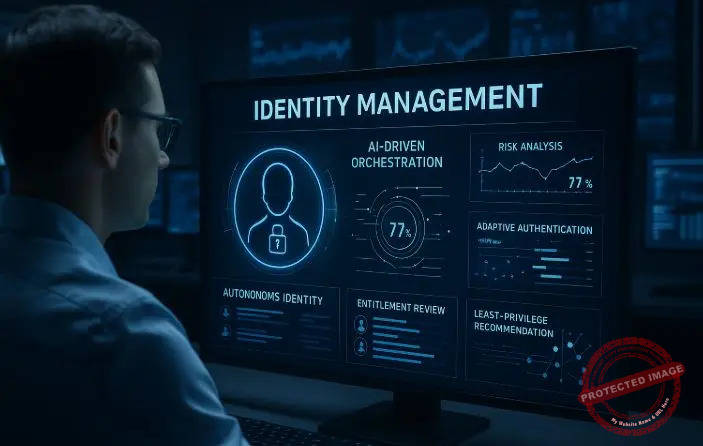
AI-driven orchestration turns identity from a manual chore into an always-on control plane
Identity and Access Management is shifting from static directories and ticket queues to a live, adaptive control layer for the enterprise. By 2026, AI and machine learning sit at the center of IAM platforms, continuously interpreting risk, automating joiner–mover–leaver workflows, and even proposing entitlement clean-ups before auditors ever raise a flag. Modern IAM is no longer just about “who can log in”; it is about using intelligent systems to ensure every identity has exactly the right access, at the right moment, and for the right reason.Avatier
From role-based access to autonomous identity
Over the last decade, most organizations have pursued role-based access control and basic single sign-on as their IAM milestones. That foundation is now table stakes. In 2026, the real differentiator is the degree of autonomy in identity operations. AI engines correlate HR data, SaaS activity logs, device health, geolocation, and historical behavior to infer what access a person or workload should have.
Instead of painstakingly modeling every job role, teams feed policy templates and examples into machine-learning systems. These models learn that a financial analyst typically needs a mix of ERP, reporting, and collaboration entitlements, and they provision those automatically when HR flags a new hire. When an employee transfers to a different region or business unit, the same system adjusts access based on patterns it has seen in thousands of previous moves, removing stale rights before they become a compliance headache.Avatier
AI copilots for identity teams
The most visible change for security and IAM specialists is the rise of “identity copilots.” These are AI assistants embedded in admin consoles, ticketing tools and chat platforms. Instead of manually digging through groups and permissions, analysts can ask in natural language which entitlements a user truly needs, or what would break if a risky permission were removed.
Behind the scenes, the copilot reviews current access, compares it with peers in the same role, inspects recent usage analytics and evaluates relevant policies. It then recommends a least-privilege entitlement set and can even generate the approval workflow for managers and system owners. The Medium “playbook” on AI agent identity highlights how similar agents are already being treated as digital workers that require their own access policies and monitoring, reinforcing the need for machine-readable reasoning and auditable decision trails in IAM.Medium
In large enterprises, this drastically compresses the time to complete access requests and removes a significant source of business friction. For overworked identity teams, it also reduces repetitive work and surfaces only the outliers that genuinely require human judgment, such as requests that deviate from standard peer patterns or touch highly sensitive data.
Continuous risk analysis and adaptive authentication
AI’s other big job inside IAM is real-time risk scoring. Classical IAM assumed that a successful login plus a second factor was “good enough” for the duration of a session. In 2026, every interaction is scored using behavioral biometrics, device telemetry, IP reputation, and recent threat intelligence feeds.
If an employee suddenly accesses payroll data at an unusual time from a new country on an older, unpatched laptop, the system increases their risk score and can silently step up controls: triggering re-authentication, restricting certain transactions, or even isolating the session through a Zero Trust Network Access gateway. Frameworks such as Zero Trust maturity models emphasize this idea of continuous verification and least-privilege enforcement across users and devices, and AI simply makes it practical at large scale.CISA
The same risk engines now protect non-human identities and AI agents. Instead of blindly trusting an access token, the platform evaluates whether the request pattern matches a known workload and whether the target system is appropriate for that identity. An AI agent that suddenly starts querying production databases it has never touched before should trigger alarms, not sail through authentication.Medium+1
Data, governance and model risk inside IAM
As IAM becomes more autonomous, the quality of underlying data and controls becomes a strategic concern. Bad HR feeds, incomplete application inventories or mislabeled sensitivity levels can lead AI engines to grant or revoke the wrong access. Mature IAM programs in 2026 treat identity data management as seriously as financial reporting, with data stewards, lineage tracking, and strict controls over who can modify entitlements and policies.Avatier
There is also a new category of model risk. An organization must be able to explain why an AI system recommended a specific access change, particularly in regulated industries like banking or healthcare. Model documentation, versioning, approval histories and rollback capabilities all become core features of IAM platforms.
Closing thoughts and looking forward
By 2026, “autonomous identity” is less a slogan and more an operational reality in leading organizations. AI and ML are embedded in every step of the identity lifecycle, from provisioning and certifications to runtime risk evaluation. The winners will be enterprises that pair this autonomy with strong data governance and transparent controls, turning IAM into a proactive guardian of both security and business agility. Those that cling to manual spreadsheets and ticket queues will struggle to keep up with the explosion of users, apps and non-human identities that must be governed.
References
What is Identity and Access Management (IAM)? Complete 2025–2026 Guide for Enterprise Security – Avatier – https://www.avatier.com/blog/iam-complete-guide-for-enterprise-security/ Avatier
AI Agent Identity & Zero-Trust: The 2026 Playbook for Securing Autonomous Systems in Banks, Telecom, and Governments – Medium – https://medium.com/%40raktims2210/ai-agent-identity-zero-trust-the-2026-playbook-for-securing-autonomous-systems-in-banks-e545d077fdff Medium
Top 4 Zero Trust Frameworks in 2026 and How to Choose – Seraphic Security – https://seraphicsecurity.com/learn/zero-trust/top-4-zero-trust-frameworks-in-2026-and-how-to-choose/ Seraphic Security
Zero Trust Maturity Model – Cybersecurity and Infrastructure Security Agency (CISA) – https://www.cisa.gov/zero-trust-maturity-model CISA
Non-Human Identities – CrowdStrike – https://www.crowdstrike.com/en-us/cybersecurity-101/identity-protection/non-human-identities/ CrowdStrike
Co-Editor: Benoit Tremblay, Author, IT Security Management, Montreal, Quebec; Peter Jonathan Wilcheck, Co-Editor, Miami, Florida.
#IdentityManagement #AutonomousIdentity #AIinSecurity #MachineLearningIAM #ZeroTrust #AccessGovernance #SecurityOperations #CyberRisk #DigitalIdentity #EnterpriseSecurity
Post Disclaimer
The information provided in our posts or blogs are for educational and informative purposes only. We do not guarantee the accuracy, completeness or suitability of the information. We do not provide financial or investment advice. Readers should always seek professional advice before making any financial or investment decisions based on the information provided in our content. We will not be held responsible for any losses, damages or consequences that may arise from relying on the information provided in our content.
 AAPL
AAPL MSFT
MSFT GOOG
GOOG TSLA
TSLA AMD
AMD IBM
IBM TMC
TMC IE
IE INTC
INTC MSI
MSI NOK
NOK DELL
DELL ECDH26.CME