


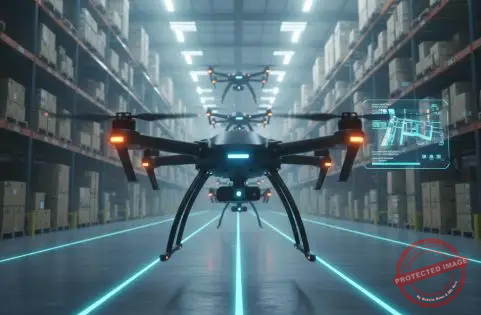
How AI and analytics are transforming fulfillment centers from reactive operations into predictive, self-optimizing platforms.
From Gut Feel To Algorithmic Orchestration
Fulfillment leaders have always cared about numbers—pick rates, order cycle times, on-time delivery. Historically, those metrics were compiled after the fact, informing next month’s planning rather than today’s actions. That lag is vanishing.
Modern fulfillment centers stream real-time data from scanners, robots, conveyor sensors, wearable devices, order management systems, and transportation feeds. AI-enabled warehouse management platforms ingest this data and make continuous decisions: which SKU belongs in which slot, how to batch orders, which associate or robot should handle each task, and how to route work around congestion.
Enterprise providers emphasize that AI in warehouse management now optimizes product placement and picking patterns, identifies at-risk orders, and orchestrates both human and robotic resources. Oracle+2Körber This is the digital nervous system of the modern fulfillment center.
Forecasting Demand And Staffing With Precision
One of the clearest use cases for AI is demand forecasting. By analyzing historical orders, promotional calendars, seasonality, and external signals, machine-learning models can predict volume and SKU mix at the level of individual nodes and even time windows.
Those forecasts feed labor scheduling engines that build shift plans, allocate workers to zones, and reserve robot capacity accordingly. When the model predicts a spike in ultra-fast deliveries in a specific city, the system can pre-position inventory at local micro-fulfillment nodes and schedule extra staff or bots there in advance.
Warehouse-focused case studies show that such AI-driven forecasting and labor planning can improve inventory turns and reduce overtime while boosting on-time performance. MHS Lift Over time, these models learn from their misses, refining their view of how local weather, social events, or marketing campaigns actually affect orders.
Real-Time Optimization On The Fulfillment Floor
Beyond planning, AI is increasingly embedded in daily execution. As orders stream in, the system continuously reshuffles priorities. High-value or time-sensitive orders bubble to the top. Batches are reorganized so pick paths stay short. Robots are rerouted around congestion points.
Vendors describe AI control layers that monitor utilization of every station, from decanting to packing, and automatically rebalance work to keep throughput steady. Oracle+2Körber If a sorter goes down, the system can reroute flows within minutes; if a spike in returns hits a particular node, it can divert some processing to another facility with spare capacity.
The result is a fulfillment center that behaves less like a static plant and more like a living system, sensing and responding to disruptions in real time.
Quality Control, Risk, And The Returns Loop
AI also strengthens quality and risk management. Computer-vision systems mounted over packing stations can verify that the right items are in the box before sealing, comparing images to reference data. Weight sensors flag anomalies when a carton is unexpectedly heavy or light. Out-of-tolerance events trigger human checks, reducing mis-ships and costly resends.
On the risk side, predictive analytics can identify patterns that precede operational problems: a rising defect rate on a particular inbound lane, a carrier whose performance is sliding in a geography, or a growing backlog in reverse logistics. Fulfillment leaders can respond with targeted audits, supplier interventions, or temporary routing changes.
As returns grow as a share of e-commerce volume, AI is starting to evaluate the condition of returned items via images and sensor data, automatically deciding whether they should be restocked, refurbished, or recycled. Inbound Logistics That closes feedback loops between customer experience, warehouse operations, and sustainability goals.
Making Data Actionable For People
For all its sophistication, data is only useful if people can act on it. Modern fulfillment control towers provide supervisors with rich visualizations of live operations: heat maps of congestion, dashboards of order-promise risk, drill-downs to zone or station performance.
These tools are increasingly built with operations staff in mind, not just data scientists. Supervisors can run “what-if” scenarios—such as moving a team from packing to picking—before making the change, seeing the simulated impact on throughput. They can adopt or override AI recommendations, creating a collaborative loop between human judgment and machine guidance.
Industry sources note that a growing share of organizations now use AI technologies to empower workers to be more productive and make better decisions, not simply to automate them away. OPEX Fulfillment centers are becoming classrooms where workers develop data literacy alongside operational skills.
Closing Thoughts And Looking Forward
Data and AI are turning fulfillment centers into intelligent systems. Instead of reacting to yesterday’s reports, these operations anticipate demand, adjust in real time, and improve through continuous learning.
In the years ahead, expect deeper integration between planning and execution, richer use of external data like traffic and weather, and closer coupling between warehouses and the rest of the supply chain. Fulfillment networks that learn faster will not just ship faster; they will operate with higher resilience, lower waste, and sharper customer focus.
References
AI in Warehouse Management: Impacts and Use Cases – Oracle – https://www.oracle.com/scm/ai-warehouse-management/
AI and Warehouse Automation: The Future of Fulfillment – Körber Supply Chain – https://www.koerber.com/en/insights-and-events/supply-chain-insights/ai-warehouse-automation
The Impact of AI and Data Analytics on Warehouse Management – MHS Lift – https://mhslift.com/ai-data-analytics-warehouse-management/
Human-Robot Collaboration in the Warehouse of the Future – OPEX – https://www.opex.com/insights/human-centric-supply-chain-automation/
Sustainable Warehousing – Inbound Logistics – https://www.inboundlogistics.com/articles/sustainable-warehousing/
Author: Claire Gauthier – eCommerce Technologies, Montreal, Quebec
Co-Editor: Peter Jonathan Wilcheck – Miami, Florida
#DataDrivenFulfillment #AIWarehouseAnalytics #PredictiveDemand #ControlTower #OrderOptimization #EcommerceFulfillment #InventoryForecasting #ReturnsManagement #SupplyChainData #SmartWarehousing
Post Disclaimer
The information provided in our posts or blogs are for educational and informative purposes only. We do not guarantee the accuracy, completeness or suitability of the information. We do not provide financial or investment advice. Readers should always seek professional advice before making any financial or investment decisions based on the information provided in our content. We will not be held responsible for any losses, damages or consequences that may arise from relying on the information provided in our content.
 AAPL
AAPL MSFT
MSFT GOOG
GOOG TSLA
TSLA AMD
AMD IBM
IBM TMC
TMC IE
IE INTC
INTC MSI
MSI NOK
NOK DELL
DELL ECDH26.CME