


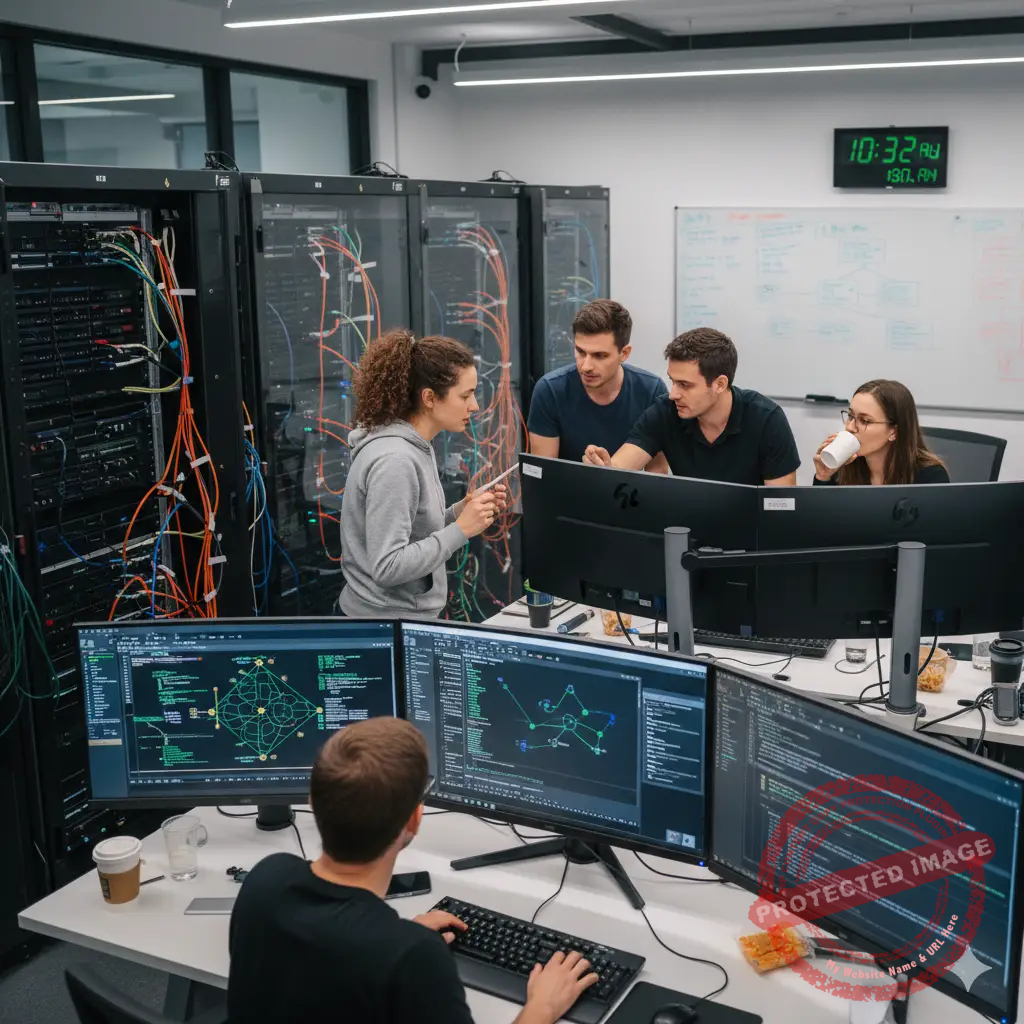
How Cognitive Automation, Decentralized Control, and Quantum Readiness Are Transforming Cluster Management.
The Dawn of Intelligent Orchestration
The evolution of cluster management has entered a new phase — one where automation meets cognition. What began as static infrastructure management has matured into dynamic, intelligent orchestration, where AI, analytics, and distributed control systems work in harmony to manage thousands of interdependent workloads across the cloud-to-edge continuum.
As businesses increasingly depend on data-intensive operations — from AI training to IoT analytics — traditional orchestration models are no longer adequate. The future lies in self-governing clusters: environments capable of making autonomous decisions, learning from operational data, and optimizing themselves in real time.
This era of Next-Generation Orchestration and Cluster Intelligence marks the convergence of cloud automation, adaptive networking, AI-driven scheduling, and quantum computing — all geared toward one goal: achieving autonomous efficiency at global scale.
From Automation to Autonomy
Earlier generations of orchestration focused on process automation — automating deployment, scaling, and failover. The new paradigm transcends these basics, introducing autonomous orchestration systems that act with minimal human input.
Through reinforcement learning and advanced simulation, clusters can anticipate changes in workload patterns, adjust configurations proactively, and self-heal from failures before they escalate.
A next-gen orchestrator continuously ingests telemetry data — CPU utilization, thermal output, latency metrics, and even carbon intensity — and optimizes resources holistically. The result is infrastructure that thinks for itself, blending AI reasoning with deterministic control.
Technologies like IBM Cloud Pak for AIOps, Google’s Autopilot for Kubernetes, and NVIDIA’s DGX Cloud Orchestration exemplify this intelligent automation shift. They fuse data-driven decision-making with predictive modeling to create adaptive, resilient systems.
The Cognitive Layer: AI as the Brain of Orchestration
In next-generation clusters, artificial intelligence is not just a monitoring tool — it is the operational brain. AI systems continuously analyze patterns in workload behavior, energy consumption, and network traffic to forecast needs and anomalies.
These insights enable the orchestrator to predict and prevent incidents such as bottlenecks, hardware degradation, or security breaches. For example, if an AI model detects abnormal latency trends, the orchestrator can automatically reroute workloads or spin up redundant containers before service degradation occurs.
The cognitive layer also extends into semantic orchestration, where natural language interfaces allow engineers to query systems conversationally:
“Show me the least efficient node cluster.”
“Optimize for lowest latency in Asia-Pacific.”
This human-AI collaboration model transforms cluster management from a technical discipline into an intelligent dialogue between operators and infrastructure.
Decentralized and Federated Orchestration
With computing resources spreading across regions, clouds, and edge environments, centralized orchestration models are hitting scalability and latency limits. The solution lies in decentralized and federated orchestration architectures.
In this model, each cluster operates as a semi-autonomous domain — capable of local decision-making — while a global controller coordinates overarching policies. This mirrors the human nervous system: distributed reflexes with a central brain for global coordination.
Federated orchestration frameworks like KubeFed (Kubernetes Federation) and IBM Edge Application Manager enable policy-based synchronization across thousands of clusters worldwide, supporting geo-distributed applications that can balance workloads dynamically based on regional demand, compliance rules, and energy availability.
This shift toward distributed control not only improves scalability and resilience but also enables true global workload mobility — a key requirement for AI, IoT, and latency-sensitive 5G services.
Integration with Quantum-Ready Infrastructure
As data volumes and computational complexity surge, classical computing alone may soon reach its limits. The orchestration of the future will need to integrate with quantum computing environments — managing hybrid workloads across classical and quantum systems.
IBM, Google, and AWS are pioneering quantum orchestration frameworks that allow containerized applications to offload specific tasks (like optimization, simulation, or cryptography) to quantum processors.
In these hybrid systems, the orchestrator intelligently decides which computations are best suited for classical or quantum execution. The result: quantum-augmented clusters capable of solving previously intractable problems — from real-time logistics optimization to advanced molecular modeling.
As quantum-safe encryption becomes standard, orchestrators will also play a key role in managing cryptographic transitions across multi-cloud ecosystems.
Self-Learning Clusters and Feedback Loops
The essence of next-gen orchestration lies in its ability to learn continuously. Feedback loops, powered by deep learning and digital twins, allow clusters to simulate scenarios before executing changes in production.
For instance, before scaling down a compute zone, the orchestrator can run simulations predicting the performance impact and rollback risk. If outcomes are favorable, the change proceeds autonomously.
Over time, these feedback systems become self-improving, refining their models and strategies based on historical performance data. The result is ever-evolving infrastructure intelligence — clusters that don’t just adapt, but evolve.
Data Fabric and Interconnect Intelligence
Modern clusters depend on intelligent data fabrics that unify storage, analytics, and connectivity across environments. Future orchestrators will integrate data-aware scheduling, moving workloads based not only on CPU and memory availability but also data locality, latency, and security sensitivity.
These intelligent fabrics will use telemetry-driven routing to ensure data follows the most efficient and compliant paths between edge, core, and cloud. Combined with software-defined interconnects, orchestrators will achieve data-motion efficiency — optimizing both compute and communication simultaneously.
Emerging platforms like Red Hat OpenShift Data Foundation and Cisco Intersight Workload Optimizer exemplify this evolution, linking data performance directly to orchestration intelligence.
AI-Augmented Security and Policy Enforcement
As automation expands, so does the attack surface. Next-generation orchestration will include embedded AI-driven security that enforces Zero Trust principles natively across every layer.
AI models will continuously monitor network flows, detect anomalies, and automatically isolate suspicious workloads — turning orchestration into an active defense mechanism. Policies such as data residency, compliance enforcement, and identity verification will be codified as Security-as-Code, ensuring policy consistency across multi-cloud environments.
Confidential computing and hardware-based attestation will ensure workloads remain secure even in shared or untrusted infrastructures. This convergence of orchestration and cybersecurity creates a self-defending infrastructure that evolves with the threat landscape.
Orchestration at the Edge: Real-Time Intelligence
Edge computing presents one of the greatest orchestration challenges — and opportunities. Managing thousands of lightweight clusters deployed across cities, factories, and vehicles demands hyper-efficient, autonomous coordination.
Next-gen orchestrators integrate edge AI agents capable of operating independently during network outages, making localized decisions in milliseconds. These agents synchronize with central orchestration layers when connectivity resumes, ensuring global consistency without sacrificing local autonomy.
In smart manufacturing or autonomous logistics, these capabilities enable clusters to process real-time sensor data, run predictive maintenance algorithms, and coordinate robotics — all without human intervention.
The convergence of edge AI, low-latency fabrics, and federated orchestration defines the new frontier of real-time intelligence at scale.
Observability and Digital Twins
Comprehensive observability is central to next-gen orchestration. With billions of telemetry points generated every minute, AI-enhanced monitoring systems use predictive analytics and digital twin modeling to visualize the health, performance, and environmental impact of entire infrastructure ecosystems.
Digital twins act as virtual mirrors of clusters, allowing operators to simulate energy consumption, failure scenarios, and optimization strategies safely before deployment.
When coupled with natural language querying (“Explain last night’s performance anomaly in Cluster B”), observability evolves from dashboard monitoring to interactive infrastructure intelligence — empowering faster, data-driven decisions.
Sustainability-Driven Orchestration
The intelligence of tomorrow’s clusters extends beyond performance optimization — it includes environmental responsibility.
AI-driven orchestration now incorporates carbon intensity, thermal output, and renewable energy forecasts into workload placement. Clusters can shift compute tasks dynamically between regions based on sustainability metrics, achieving not just efficiency but ecological balance.
This evolution aligns with corporate net-zero mandates and emerging green computing standards, transforming orchestrators into stewards of both technology and the planet.
Human-AI Collaboration and the Future of Operations
Despite the rise of autonomy, human oversight remains essential. The next generation of cluster management emphasizes collaborative intelligence — systems designed to enhance human judgment, not replace it.
Engineers and operators interact with orchestration systems through AI copilots, using natural language to ask questions, test scenarios, and implement optimizations. These copilots act as advisors, explaining the reasoning behind automated decisions — ensuring transparency, accountability, and trust.
This partnership between human expertise and machine intelligence defines the future of IT operations: Explainable Automation — where orchestration systems not only act intelligently but also communicate their intent.
Closing Thoughts and Looking Forward
The next generation of cluster orchestration represents a leap beyond automation — into cognition, decentralization, and sustainability.
Intelligent orchestrators will soon operate as autonomous digital ecosystems, capable of managing everything from edge nodes to quantum workloads, securing themselves, optimizing energy use, and learning continuously from experience.
As AI, data fabrics, and quantum computing converge, cluster intelligence will evolve into a new paradigm: self-optimizing, self-defending, and self-sustaining digital infrastructure.
The future of computing is not just about speed or scale — it’s about awareness. And in that future, clusters will no longer be managed; they will manage themselves.
References
-
“The Future of Autonomous IT Operations,” Forbes Tech Council, https://www.forbes.com/sites/forbestechcouncil/autonomous-it-operations
-
“Next-Generation Cloud Orchestration with AI,” Google Cloud Blog, https://cloud.google.com/blog/products/ai-machine-learning/next-gen-cloud-orchestration
-
“Quantum Computing Integration in Hybrid Cloud,” IBM Research Blog, https://research.ibm.com/blog/quantum-hybrid-cloud
-
“Federated Kubernetes and the Future of Distributed Control,” Red Hat Blog, https://www.redhat.com/en/blog/kubernetes-federation
-
“Digital Twins and AI for Infrastructure Optimization,” Microsoft Azure Blog, https://azure.microsoft.com/blog/digital-twin-infrastructure
Author: Serge Boudreaux – AI Hardware Technologies, Montreal, Quebec
Co-Editor: Peter Jonathan Wilcheck – Miami, Florida
Post Disclaimer
The information provided in our posts or blogs are for educational and informative purposes only. We do not guarantee the accuracy, completeness or suitability of the information. We do not provide financial or investment advice. Readers should always seek professional advice before making any financial or investment decisions based on the information provided in our content. We will not be held responsible for any losses, damages or consequences that may arise from relying on the information provided in our content.
 AAPL
AAPL MSFT
MSFT GOOG
GOOG TSLA
TSLA AMD
AMD IBM
IBM TMC
TMC IE
IE INTC
INTC MSI
MSI NOK
NOK DELL
DELL ECDH26.CME