


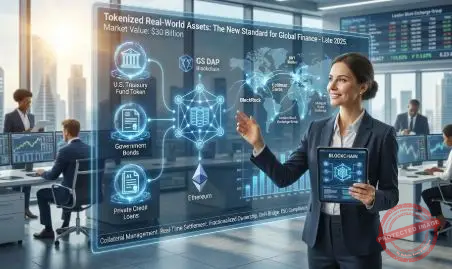
A few years ago, “tokenization” sounded like a speculative buzzword. In late 2025, it has become a quiet, methodical systems upgrade for the world’s largest financial institutions. From money market funds to government bonds and private credit, real-world assets (RWAs) are being represented as tokens on blockchains, changing how collateral moves, how trades settle and who can access previously illiquid markets.
From pilot projects to tens of billions in tokenized assets
Analysts now estimate that the market for tokenized real-world assets has crossed roughly $30 billion, still small relative to global capital markets but growing rapidly. DB Research Flagship examples such as BlackRock’s BUIDL, a tokenized U.S. Treasury fund running on Ethereum, have helped institutional investors gain comfort with the idea that regulated products can live on blockchain rails while remaining within existing legal frameworks. DB Research
In mid-2025, Goldman Sachs and BNY Mellon launched tokens tied to money market funds on BNY’s LiquidityDirect platform, recording ownership on Goldman’s GS DAP blockchain. The goal was not to create a new cryptocurrency, but to modernize the plumbing of collateral management and reduce settlement frictions. Reuters
European market infrastructures are moving in parallel. The London Stock Exchange Group has rolled out a blockchain-based Digital Markets Infrastructure for private funds, and completed its first fundraising transaction on the platform, handling everything from issuance to settlement on a distributed ledger. Financial Times In Switzerland, a subsidiary of the Stuttgart Stock Exchange received regulatory approval to operate a blockchain-based trading system that directly settles tokenized assets on Ethereum without intermediaries like central securities depositories. Reuters
Taken together, these projects signal a new phase where tokenization is less about speculative trading and more about streamlining existing financial workflows.
Why tokenization matters for market structure
Tokenizing assets is not just about putting a wrapper on existing securities. When done properly, tokenization can collapse several layers of reconciliation and post-trade processing into a single shared ledger. Ownership, corporate actions, collateral status and settlement instructions can all be represented programmatically in smart contracts rather than scattered across siloed databases. DB Research
For banks and brokers, that means the potential for lower operational risk, fewer failed trades and real-time visibility into client positions. For asset managers, it opens new options for intraday liquidity and automated rebalancing. For corporates and fund issuers, it can cut the cost and time needed to bring products to market.
Perhaps most importantly, tokenization enables fractionalization. Large-ticket instruments like commercial real estate, infrastructure debt or private equity interests can be represented as smaller token units, allowing a broader base of investors to gain exposure under appropriate regulatory frameworks. In emerging markets, where access to global capital has historically been constrained, tokenized instruments could eventually be listed on regional platforms that plug into global liquidity pools. Financial Times
New risks, old responsibilities
Regulators are keenly aware that this shift introduces new risks alongside benefits. In November 2025, the International Organization of Securities Commissions (IOSCO) warned that tokenization can blur the line between owning an actual asset and owning a token that merely represents it, particularly when tokens are issued by third parties rather than the underlying company or fund. Reuters
If record-keeping between on-chain tokens and off-chain asset ledgers is not perfectly synchronized, investors could face uncertainty about their true claims. Operational failures, smart-contract bugs or key management issues could also impair access to tokenized assets, even if the underlying instruments remain sound.
These concerns are prompting supervisors to ask hard questions about governance, legal finality and interoperability with existing post-trade infrastructure. Many institutional platforms are therefore starting conservatively: they maintain traditional books and records as the “golden source” while treating blockchain tokens as mirrored representations, gradually increasing on-chain reliance as controls mature. Investopedia
Liquidity, collateral and the DeFi connection
Beyond core capital markets, RWA tokenization is creating bridges into decentralized finance. Protocols now allow tokenized Treasuries or money market fund shares to be used as collateral in on-chain lending markets, bringing real-world yield into crypto-native environments. While this unlocks new business models, it also transmits risk between traditional finance and DeFi. DB Research
A key design challenge is maintaining sound KYC and AML controls when assets cross between permissioned and permissionless environments. Here, there is growing interest in combining tokenized RWAs with decentralized identity and zero-knowledge proofs, so that only verified participants can access certain pools, while their underlying credentials remain private. altme.io
There is also the question of liquidity fragmentation. If multiple platforms issue tokens referencing similar pools of U.S. Treasuries or corporate bonds, but do so using incompatible smart-contract standards or legal structures, the market could become balkanized. Standard-setting bodies and industry consortia are working on common frameworks to avoid this outcome, but it remains an open risk. DB Research
Tokenization in the age of higher rates and stricter ESG
The macro backdrop matters. In a higher-rate environment, the ability to mobilize high-quality collateral like Treasuries quickly and across multiple venues becomes a competitive advantage. Tokenization can shorten settlement cycles and allow treasurers to optimize cash and collateral usage on a more granular, intraday basis.
At the same time, ESG and sustainability reporting pressures are prompting issuers to provide more granular, auditable data about how funds are managed and how projects are financed. Tokenized green bonds and sustainability-linked instruments can embed reporting hooks and automated coupon adjustments, turning what used to be static disclosures into programmable outcomes.
Here again, the combination of on-chain data, oracles and verifiable attestations is key. For example, emissions data or certification documents can be anchored on-chain, while ZKPs ensure that only necessary aggregates are revealed to investors or regulators. Token Metrics
Closing thoughts and looking forward
Real-world asset tokenization is no longer a speculative pitch; it is a multi-year modernization program across exchanges, custodians, banks and asset managers. The first wave focused on low-risk, high-volume instruments like money market funds and Treasuries, where the operational benefits are clear and legal structures are well understood. The next wave will likely target more complex private markets, infrastructure financing and cross-border issuance, where programmable ownership and settlement could have an even bigger impact.
However, the industry will need to avoid the temptation to “move fast and break finance.” Tokenization does not eliminate the need for strong governance, investor protections or robust operational controls. Instead, it gives firms new tools to encode those safeguards directly into the asset’s lifecycle. As standards for identity, compliance and interoperability mature, the most successful tokenization platforms will be those that treat blockchain not as a marketing label, but as a neutral, shared ledger that quietly makes markets safer, faster and more inclusive.
References
Asset Tokenization 101: Everything You Should Know – Deutsche Bank Research – https://www.dbresearch.com/PROD/RI-PROD/PROD0000000000610273/Asset_Tokenization_101%3A_Everything_you_should_know.PDF DB Research
BlackRock Working on Tokenizing Funds Tied to Real-World Assets – The Block – https://www.theblock.co/post/370378/blackrock-working-on-tokenizing-funds-tied-to-real-world-assets-bloomberg The Block
Global Securities Watchdog Says ‘Tokenization’ Creates New Risks – Reuters – https://www.reuters.com/sustainability/boards-policy-regulation/global-securities-watchdog-says-tokenization-creates-new-risks-2025-11-11/ Reuters
Goldman, BNY Team Up to Launch Tokens Tied to Money Market Funds – Reuters – https://www.reuters.com/markets/wealth/goldman-bny-team-up-launch-tokens-tied-money-market-funds-2025-07-23/ Reuters
Goldman Sachs, BNY Mellon Step into Tokenized Money Market Funds – Investopedia – https://www.investopedia.com/bny-mellon-and-goldman-sachs-step-into-tokenized-money-market-funds-11777455 Investopedia
Co-Editors.
Benoit Tremblay, Co-Editor IT Security Management, Montreal, Quebec.
Peter Jonathan Wilcheck, Co-Editor, Miami, Florida.
#Blockchain #AssetTokenization #RealWorldAssets #TokenizedFunds #DigitalMarketsInfrastructure #OnchainCollateral #InstitutionalDeFi #CapitalMarketsInnovation #SecuritiesRegulation #FinancialInfrastructure
Post Disclaimer
The information provided in our posts or blogs are for educational and informative purposes only. We do not guarantee the accuracy, completeness or suitability of the information. We do not provide financial or investment advice. Readers should always seek professional advice before making any financial or investment decisions based on the information provided in our content. We will not be held responsible for any losses, damages or consequences that may arise from relying on the information provided in our content.
 AAPL
AAPL MSFT
MSFT GOOG
GOOG TSLA
TSLA AMD
AMD IBM
IBM TMC
TMC IE
IE INTC
INTC MSI
MSI NOK
NOK DELL
DELL ECDH26.CME