


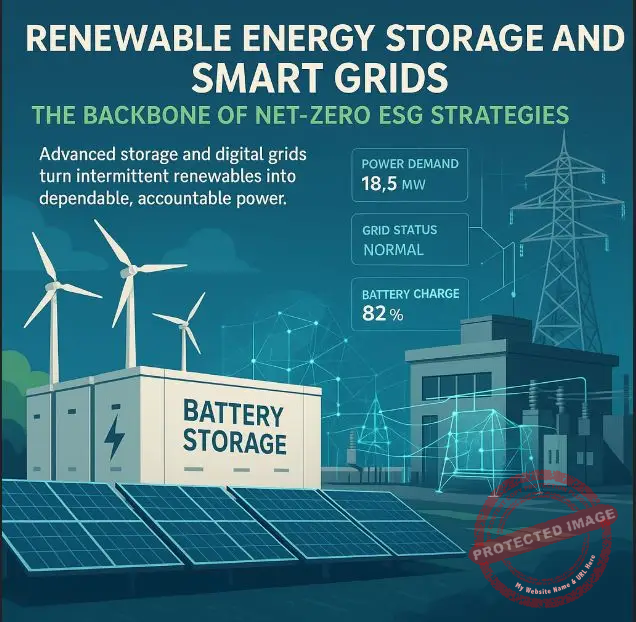
Advanced storage and digital grids turn intermittent renewables into dependable, accountable power.
Storage moves to the center of ESG-aligned power procurement
Corporate buyers are rapidly increasing their use of renewable power purchase agreements and on-site generation. Still, investors and regulators are demanding proof that decarbonization claims truly reflect hour-by-hour consumption. Energy-intensive sectors and hyperscale data center operators are pursuing “24/7 carbon-free” power, which is practical only when renewable generation is tightly integrated with energy storage and flexible grid operations. Deloitte Brazil
Industry outlooks now highlight battery energy storage systems as the fastest bridge to firm, low-carbon power in the near term, while longer-duration technologies such as advanced flow batteries, thermal storage and hydrogen solutions mature. WTW
Battery storage as ESG infrastructure
Commercial and utility-scale battery storage projects are increasingly framed as ESG investments rather than purely operational assets. A surge in deployments since 2024 has been driven by technology cost declines, supportive regulation and the need for resilience against extreme weather events and grid congestion. Morgan Lewis
For corporates, on-site battery systems allow facilities to shift loads, shave peaks and ride through outages while aligning their consumption with periods of renewable generation. Insurers and risk advisors emphasize that storage can reduce both business interruption risk and exposure to volatile power prices exacerbated by climate-driven supply shocks. WTW
Smart grids as the digital nervous system of decarbonization
Storage alone cannot deliver ESG-aligned power without modernized, intelligent grids. Smart grids use digital sensors, automation and advanced analytics to balance supply and demand in real time, integrate distributed generation and enable new flexibility services. International agencies and consulting firms stress that grid modernization and expansion are bottlenecks for clean-energy deployment, and therefore critical to achieving climate targets. IEA+2The Department of Energy’s Energy.gov
Smart-metering, dynamic tariffs and demand-response programs can also provide granular data for ESG reporting, allowing organizations to track the emissions intensity of electricity at specific times and locations. Combined with storage, this enables genuinely time-matched low-carbon consumption claims rather than annualized averages. KPMG
Social and governance dimensions of the new grid
The “S” and “G” in ESG are increasingly part of grid modernization debates. Policymakers are under pressure to ensure that clean-energy infrastructure, including storage and transmission lines, is deployed in ways that are equitable, respectful of communities and transparent in decision-making. Concerns about land use, environmental justice and ratepayer impacts are driving new engagement models and governance requirements. The Department of Energy’s Energy.gov
For companies, participation in grid-services markets and flexibility programs comes with responsibilities around data privacy, cyber-security and fair treatment of smaller customers and prosumers. Boards are beginning to view energy strategy as a governance issue that touches everything from climate commitments to digital risk management.
Closing thoughts and looking forward
By 2026, advanced storage and smart grids will be the infrastructure layer that determines whether ESG climate commitments are credible. Organizations that actively participate in grid modernization—through investment, advocacy and innovative contracting—will have more options to secure reliable, verifiable low-carbon power. Those that treat the grid as an externality may struggle with physical constraints, regulatory delays and reputational risk around the integrity of their decarbonization claims.
The next ESG frontier in this space will be transparency: publishing time-stamped data on the carbon intensity of electricity consumption, documenting participation in flexibility and resilience programs, and showing how energy strategies support not only net-zero goals but also affordability, equity and system stability.
Reference sites
2026 Renewable Energy Industry Outlook – Deloitte Insights – https://www.deloitte.com/us/en/insights/industry/renewable-energy/renewable-energy-industry-outlook.html Deloitte Brazil
Energy Storage Is Powering the Future – WTW – https://www.wtwco.com/en-se/insights/2025/10/energy-storage-is-powering-the-future WTW
A 2025 Update on Utility-Scale Energy Storage Procurements – Morgan Lewis – https://www.morganlewis.com/pubs/2025/03/a-2025-update-on-utility-scale-energy-storage-procurements Morgan Lewis
Smart Grids – International Energy Agency – https://www.iea.org/energy-system/electricity/smart-grids IEA
Grid Modernization and Expansion: Critical for a Clean Energy Future – Deloitte Insights – https://www.deloitte.com/us/en/insights/industry/power-and-utilities/grid-modernization-and-expansion-critical-for-clean-energy-future.html Deloitte Brazil
Co-Editor: Benoit Tremblay, Author, Tech Cost Management, Montreal, Quebec;
Peter Jonathan Wilcheck, Co-Editor, Miami, Florida.
#ESG #EnergyStorage #SmartGrid #Renewables #CleanEnergy #NetZero #Resilience #Decarbonization #DataCenters #SustainableInfrastructure
Post Disclaimer
The information provided in our posts or blogs are for educational and informative purposes only. We do not guarantee the accuracy, completeness or suitability of the information. We do not provide financial or investment advice. Readers should always seek professional advice before making any financial or investment decisions based on the information provided in our content. We will not be held responsible for any losses, damages or consequences that may arise from relying on the information provided in our content.
 AAPL
AAPL MSFT
MSFT GOOG
GOOG TSLA
TSLA AMD
AMD IBM
IBM TMC
TMC IE
IE INTC
INTC MSI
MSI NOK
NOK DELL
DELL ECDH26.CME