


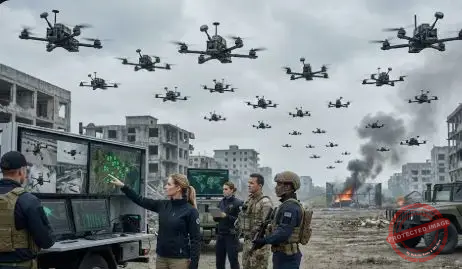
How multi-drone coordination will move from research to real-world operations by 2026
For years, “drone swarms” sounded like sci-fi: flocks of small aircraft flying in intricate formations, cooperating like a school of fish. In 2025, the concept grew far more tangible. Defense trials in Europe showed directed-energy weapons shooting down coordinated swarms, while research and field deployments in Ukraine and other conflict zones demonstrated how drone groups can dynamically reconfigure communication networks and persist in contested environments. Winssolutions
At the same time, civilian innovators began reframing swarm technology as a tool for emergency communications, search and rescue, and large-area inspection. By 2026, we can expect early commercial and public-safety deployments where multiple drones share tasks, data, and decision-making in the field.
What makes a swarm a swarm?
A true drone swarm is more than a handful of drones launched at once. The defining features are:
Decentralized coordination, where individual drones follow simple rules based on local data rather than a single central controller issuing all commands.
Continuous communication that allows drones to share situational information, redistribute tasks and adjust formations in real time.
Collective behaviors—such as area coverage, pursuit or perimeter defense—that emerge from local interactions rather than being scripted for each aircraft individually.
Technology-focused outlets covering swarm deployments emphasize their resilience: when one unit fails, others adapt, re-routing communications or coverage without bringing down the mission. Winssolutions
Emergency communication networks and disaster response
One of the most promising near-term applications for swarms is emergency communications. When floods, earthquakes or storms destroy terrestrial infrastructure, swarms of small drones can act as airborne mesh nodes, relaying data among responders and survivors.
Analyses of swarm deployments in emergency networks describe how UAVs equipped with Wi-Fi, RF or 5G radios can form ad-hoc meshes, providing temporary coverage across devastated regions. These networks can support voice, messaging and telemetry when cell towers are offline, and they can be redeployed as needs shift. Winssolutions
Search-and-rescue missions stand to benefit as well. Swarms equipped with thermal cameras and optical zoom can divide large search areas among multiple units. Articles on swarm-based SAR highlight advantages such as faster coverage, sensor fusion and redundancy when individual drones fail, all of which combine to increase the chance of locating survivors quickly. Technology Innovators
Security, defense and counter-swarm dynamics
Conflict zones have rapidly accelerated swarm R&D, with reports that both offensive and defensive systems are being tested at scale. Some Ukrainian companies, for instance, are trialing swarms designed to resist electronic warfare, while Western defense ministries are experimenting with low-cost radio-frequency directed-energy weapons that can neutralize entire groups of small drones for mere cents per shot. Winssolutions
These developments create evolutionary pressure. As counter-swarm systems improve, offensive swarms will need better autonomy, stealth, and resilience. Civilian operators may benefit indirectly from this arms race, as technologies developed for defense—robust communications, sophisticated path-planning, anti-jamming techniques—find peaceful applications in emergency response and infrastructure protection.
Civilian inspection and mapping swarms
Outside of crisis scenarios, commercial swarm concepts are emerging in large-area mapping and inspection. Imagine dozens of small drones jointly surveying an entire solar farm, highway corridor, or agricultural region in a fraction of the time one drone would need.
The main constraints here are airspace coordination and operational complexity. Regulators will demand clear risk assessments and robust de-confliction mechanisms before approving true multi-drone BVLOS swarms over populated areas. However, controlled environments—such as remote energy projects, offshore platforms, and private test ranges—are likely venues for early adoption.
Software vendors are already providing “multi-UAV mission control” capabilities that allow operators to plan and monitor missions involving several drones simultaneously. The leap from there to more autonomous, swarm-like behaviors is incremental rather than radical.
Closing thoughts and looking forward
By 2026, drone swarms will still be in the early stages of civilian deployment, but their direction of travel is clear. In emergencies, they will serve as agile communication grids and search-and-rescue multipliers. In the industry, they will gradually tackle larger mapping and inspection tasks, especially in remote or hard-to-reach environments.
Ethical and regulatory questions will loom large, especially as the line blurs between civilian and defense technologies. Policymakers will need to distinguish between swarms that save lives and those that threaten them, crafting rules that encourage beneficial uses while constraining malicious ones. For innovators and operators, the opportunity lies in demonstrating concrete public-safety and infrastructure benefits that build trust in multi-drone systems.
References
How Drone Swarm Technology is Used in Emergency Communication Networks – WINSS Solutions – https://www.winssolutions.org/drone-swarm-emergency-communication-networks/
Drone Swarm Technology for Search and Rescue Missions: Saving Lives in Emergency Situations – Technology Innovators – https://www.technology-innovators.com/drone-swarm-technology-for-search-and-rescue-missions-saving-lives-in-emergency-situations/
The UK Just Took Down a Swarm of Drones With a 13-Cent-a-Shot Energy Weapon – Business Insider – https://www.businessinsider.com/uk-took-down-swarm-drones-new-radio-weapon-rfdew-thales-2025-4
Infrared drone used to rescue missing 78-year-old man on Christmas Eve – New York Post – https://nypost.com/2024/12/28/us-news/california-malibu-police-use-infrared-drone-to-rescue-missing-man-on-christmas-eve/
Search and Rescue Drones: A Guide to How SAR Teams Use Drones in Their Work – UAV Coach – https://uavcoach.com/search-and-rescue-drones/
Co-Editors:
Dan Ray, Drone Technologies, Montreal, Quebec.
Peter Jonathan Wilcheck, Co-Editor, Miami, Florida.
#DroneSwarms #EmergencyResponse #MeshNetworks #SearchAndRescue #DefenseTech #CounterUAS #MultiUAV #DisasterRecovery #DroneSecurity #AutonomousSystems
Post Disclaimer
The information provided in our posts or blogs are for educational and informative purposes only. We do not guarantee the accuracy, completeness or suitability of the information. We do not provide financial or investment advice. Readers should always seek professional advice before making any financial or investment decisions based on the information provided in our content. We will not be held responsible for any losses, damages or consequences that may arise from relying on the information provided in our content.

 AAPL
AAPL MSFT
MSFT GOOG
GOOG TSLA
TSLA AMD
AMD IBM
IBM TMC
TMC IE
IE INTC
INTC MSI
MSI NOK
NOK DELL
DELL ECDH26.CME